Stories of Change


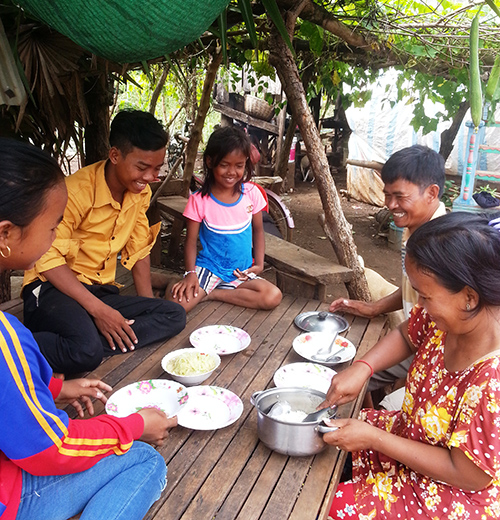
Chhundy and her family enjoy a meal together. Photo: CWS


Winter melon is loaded with nutritious vitamins B1, B3 and C and potassium, which is said to help maintain healthy blood pressure levels. Winter melon is used in many Khmer dishes, especially healthy soups like Samlor Korko. The gourd’s young leaves are edible as salad greens, and its seeds can be dried and fried for a snack. Cambodians also believe that winter gourd has medicinal benefits.

Winter melon: a new lease on life

Phan Chhundy is 48 and lives with her husband, Him Song, who works as a day wage laborer on a cassava farm. The couple and their three children, ages 11, 14 and 16, live in Lbaeuk village in central Cambodia. There they own a small plot – about half an acre – for their house and a vegetable garden. That garden is used for food, and when possible, the family sells some vegetables for extra income.

The family does not own a rice paddy, and their income is quite meager. They used to go hungry. That changed in 2015, when Chhundy joined an educational workshop led by a CWS team member. She learned how to grow different, more nutritious vegetables, like sponge gourd, broccoli and winter melon. Chhundy chose to grow winter melon, which is more affordable to grow and easier to sell than other vegetables.

With her family’s help, Chhundy sells her winter melon and earns a comfortable income.  Chhundy and her family now have enough to eat each day. Their nutrition has also improved as she cooks winter melon, along with other vegetables, for her family. Chhundy says that she is grateful to CWS for the opportunity to improve her family’s income. Our team, in turn, is proud of this outstanding outcome, which was accomplished because Chhundy and Him Song were ambitious enough to pursue it.
Stories of Change


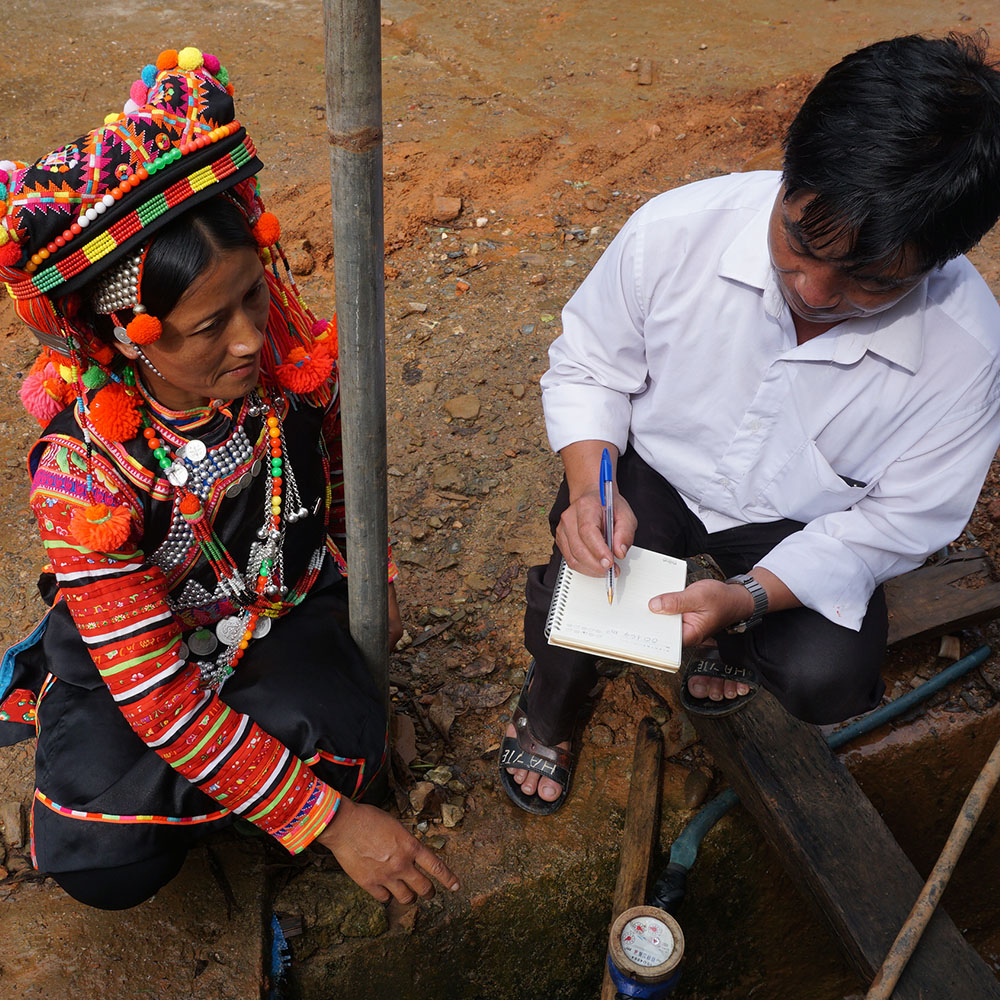
Cho Lo Xa checks her family's water meter alongside the manager of the community's water system.


CWS efforts in Vietnam positively impacted 37,967 people in 62 rural and mountainous communities between July 2015 and June 2016.

Sustainable and fair access to water in northern Vietnam

The remote village of Me Giong is in Ka Lang commune in Muong Te district in northern Vietnam. It is just six miles from the border with China. The village is made up of about 80 families, almost all of whom are of the Ha Nhi ethnic minority. The community’s water source is a gravity-fed system, which means that water is piped down from the hills into the community.

The old pipe in Me Giong was not properly maintained, and over time it wore down and broke. Without the water system, community members walked to a nearby stream to collect water and for bathing, washing clothes and often defecation. Although it wasn’t a long walk, it was a rugged and time-consuming one.

At the request of our local government partner, CWS visited the village to meet families and community leaders and assess the situation. Two main issues became apparent. There was almost no management of the old water system. Furthermore, there was no way of controlling how much water each household was using. Houses upstream were inadvertently using too much water, so houses downstream were facing water shortages. The pipe was also broken in several places, so the water that was left for downstream houses would often leak out of holes in the pipe before reaching its destination.

Ly Phi Nha and his wife Chu Lo Xa were among the families affected by the water shortages. They earn their living through hillside farming and poultry. Although both husband and wife are functionally illiterate and have only a primary school education, they are supporting their two sons’ educations. Their older son is in grade seven at the local junior secondary school, and their mom tells us that she expects both sons to finish secondary school through grade 12.

The family told CWS staff that they used to collect stream water with buckets and store it in plastic containers. They later built a brick water tank after attending a CWS awareness-raising session about sanitation, but they still faced a water shortage because both the broken pipe and the annual dry season. When there wasn’t enough water in the tank, the family collected water from the stream twice each day. The first was early in the morning before going to the field or to school, and the second was in the late afternoon. Both sons would forego brushing their teeth before going to school to save water.

Ly Phi Nha and Chu Lo Xa raised the issue with the community leadership, but there was little that could be done about it. Once our partners reached out to CWS, though, we were able to hold community discussions and investigate the root causes of the water shortages and how to solve them.

What emerged was a coordinated solution, developed with extensive input, recommendations and planning from community members. CWS supplied more than half a mile of new pipe, and the community members took care of digging the trough for the pipe and burying it. Each family now has a water meter and pays an affordable amount – for Ly Phi Nha and Chu Lo Xa, it is about $2 US each month – for water usage. This is helping to balance out the amount of water that each family uses. The money is used to pay a community member to manage the bookkeeping and collect fees for the project and repair the pipes when necessary.

This sustainable solution has helped ensure that water is available to each family in the community and that the system is taken care of. In Chu Lo Xa’s words, “Now we feel more comfortable while working in the field without thinking of having to leave earlier to collect and carry buckets of water home. We also no longer have to go to the stream for bathing and washing clothes. Our boys also enjoy time after school without worrying of helping us collect and carry water.”


Stories of Change


Albertus Tey. Photo: CWS


Tana Toraja is one of the most landslide-prone parts of Indonesia.

In landslide-prone areas of Indonesia, relying on more than good luck

Albertus Tey moved to Tana Toraja on Sulawesi Island in central Indonesia 19 years ago to join his wife Maria Imbong Barangan. They live with their five children in a wooden house in Batu hamlet. Albertus is a farmer and also the hamlet chief and a member of the newly formed Village Disaster Risk Management Team. The team formed as part of CWS’s Safe Schools, Safe Communities project.

To emphasize all that he has learned as part of the Village Disaster Risk Management Team, Albertus told us about his recent firsthand experience with landslides, which are very common on Sulawesi.

“Not too long ago I went to get my youngest son from my in-law’s place, where he was visiting. It was pouring rain, so we visited a while longer than planned. After two hours the rain stopped and we left to go home. We were in the front yard when I heard a loud, thundering noise and, looking up, I saw a big boulder rolling in a mudslide down the hill next to the house. I screamed for everyone – eight people in all – to get out of the house, which they did, miraculously, and ran to safety. Fortunately the landslide didn’t damage the house, either,” said Alberthus. The disaster was averted.

Knowing that he cannot always rely on good luck, Albertus realizes the importance of disaster risk reduction as well as disaster response preparedness, which are key issues in the Safe Schools, Safe Community initiative.

“I have learned many new things about being ready for disasters. I have learned about the Hazard, Vulnerability and Capacity Assessment, which is an important tool. As head of a family, chief of a hamlet, and a member of Disaster Preparedness Team, I am responsible to share the information and my knowledge, especially with those who live in my hamlet, where landslides are too frequent,” he added.


Stories of Change


Jean Samuel Ciné. Photo: CWS


CWS and other ACT Alliance members have repaired and rebuilt 222 houses in Ganthier and Boen since January 12, 2010.

More than just a house

In Ganthier and Boen, Haiti, CWS leads an ACT Alliance program to improve living conditions for families by increasing access to dignified, safe housing and improved access to clean water and sanitation facilities. This program started in 2011 to help families who were living in camps following the devastating earthquake in 2010.

We have built 222 houses so far, but the impact goes beyond just the new homeowners. Each house is built by a local contractor and a crew of five to six workers.

Jean Samuel Ciné is a mason who has been employed to build some of the houses. He is 38, married and the father of a son and a daughter. He is from Latranblay, Haiti, and he has been part of construction teams for the full five years that the program has been in effect. He says that things have gone smoothly overall; the only rough spot was when heavy rains delayed work by two days.

Initially, the program focused on repairing houses. After that, construction began on new houses for families whose homes could not be repaired. In Jean Samuel’s words, “Every time we start a
new phase in the construction an engineer does a workshop with us to go over the construction
norms. There are a lot of changes that have been made after the earthquake that happened on
January 12, 2010. For example, we didn’t use rocks in the foundation of the house before, but
now we do.”

For each new house, the first step is a workshop for the masons and laborers that is run by the engineer. Then the team marks the land for digging the foundation. The new homeowners are responsible for digging of the foundation itself, and then they continue to participate throughout the duration of the construction process, under the lead of the technical team. CWS partner SSID provides materials.

Although he is not the owner of one of the new homes, the program has still had a positive impact on Jean Samuel’s life. He says, “The work in the project helps me a lot. First of all economically; it allows me to take care of my family, pay school for my children, and I purchased a plot of land and have built a shelter on it, so I no longer rent a house. Professionally, it has helped me advance in my knowledge. I have learned some new techniques; before I didn’t know how to cover a house, but I learned it in the project.” The program and his employment made it possible for him to move back to Haiti following the earthquake; he had previously been living in Santo Domingo in the Dominican Republic.

In Jean Samuel’s words, “I think that this project should continue so that more people can get a house, even in other areas of the country too.”

Peliote Fanord, another mason, adds, “The project helps me a lot. With my salary I take care of my family and now I am building a four room house in Bosquet. It is a very good project that helps the population and that helps us as well as masons. The project helps me to improve my technical knowledge too. For example, before I didn’t put rebar in the windows, but now I do, thanks to the project.”


Stories of Change


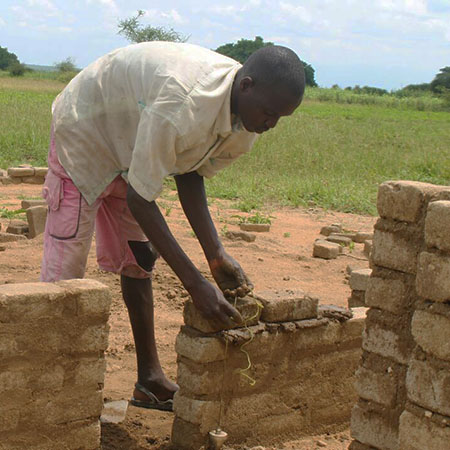
Loyang Paul practices his masonry skills at the Kacheri Youth Vocational Skills Center, part of the CWS-supported TOGETHER program in the Karamoja region of Uganda where he is training in brick laying and concrete practice. Photo: CWS


Although 81% of boys in Uganda attend primary school, only 16% attend secondary school.

Source: UNICEF

A lifelong dream, realized!

“Dropping out of school didn’t end my ambition for education,” says Loyang Paul, a 21-year-old from Lokona village, Uganda.

Loyang is the fourth child out of nine in his family. He and his siblings faced significant hurdles in their attempts to obtain an education. The family faced biting poverty and hunger in a society where job training for cattle herding was prioritized above education. Loyang recalls his father saying, “If education is a right [for] every child, where was this right when we were growing up, and, besides, where would I buy books when this so-called school child also needs to eat?”

Despite these cultural priorities, Loyang was determined to attend school. He enrolled in the nearby government school but unfortunately dropped out in his fifth year.

For Loyang, though, new hope arrived in 2015 in the form of the Kacheri Youth Vocational Skills Center, part of the CWS-supported TOGETHER program. The center trains young adults in skills such as brick laying and tailoring. Each community in the sub-county could send two youth to the center free of charge, for a total of 44. Loyang was not among those chosen, but he joined soon after when another student dropped out and there was a vacancy.

Loyang says that the center has changed his life. He has built a network with colleagues and instructors, and he has new skills in laying bricks and in identifying sites and setting foundations for houses. He is proud of all that he has accomplished and the expertise that he now possesses. He hasn’t graduated yet, and already his family members refer to him as “Fundi” (“mason”).

The training that he has received will have a lasting impact for Loyang. He plans to start his own brick laying business after graduation. This increase in income will help support his siblings’ needs as well as his own, and he plans to build a permanent house for his parents and eventually enroll in higher education courses on civil engineering.

Loyang concludes his story by expressing sincere gratitude to all the TOGETHER staff and partners, his instructors and colleagues, the government and the community. He says he appreciates initiatives that support vulnerable young people and help alleviate poverty in youth and their families.


Stories of Change


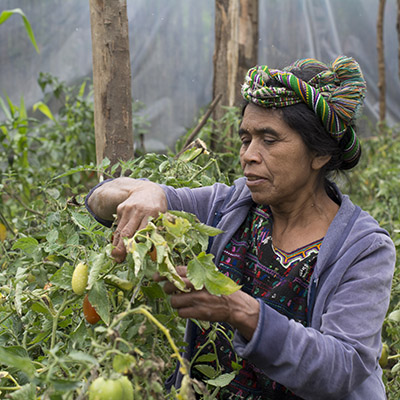
Petrona works in a greenhouse in Flores de Turanza, Guatemala. Photo: Alex Morse / Foods Resource Bank


In the last year and a half, 771 women in Guatemala have participated in family agriculture as part of CWS programs.

Greenhouses keep families together in Guatemala

Petrona is from Flores de Turanza, Guatemala. She works in a greenhouse that has built by CIEDEG, the local partner of CWS and Foods Resource Bank. CWS supports a total of 68 greenhouses in Guatemala that produce vegetables for consumption and income.

The community of Flores de Turanza was created in 1996 as part of peace accords. When Petrona and the others moved to Flores de Turanza, their social fabric – including their means of making a living – were destroyed. CWS and CIEDEG are working to restore the community by providing training and materials to build the greenhouses. Each greenhouse provides work for five or six people. One of the largest benefits of the greenhouses is that they allow community members to make a living locally, so they do not have to migrate to the coast to look for work. This means that families are more likely to stay together, and children can attend school more consistently.

When FRB staff visited recently, the greenhouses were either full of produce, or they were being replanted following successful harvests. Petrona’s greenhouse was no exception. In her words, “We harvested 350 lbs of tomatoes from the greenhouse between the six of us in our group. Most of it our families eat. We sell a little bit though so that we can plant again. We don’t want to be dependent on others.”

Maria, who also works in one of the greenhouses, added, “I give thanks to God for the opportunity you have given us to provide for our families. I no longer have to buy produce from the market and my husband no longer has to migrate to the coast for work.”

By providing materials and employment, CWS and its partners are helping to end hunger sustainably and in the long term.


Stories of Change


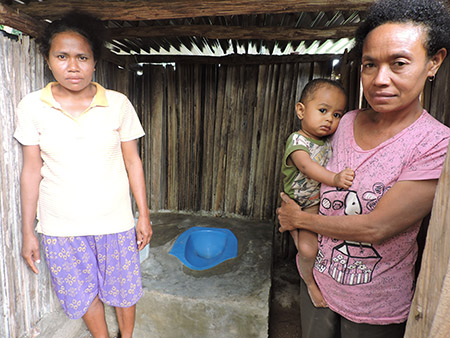
Oce (left) with community member Martha Nabuasa and her new latrine. Photo: CWS


One in three people worldwide lack access to a toilet.

Source: Water.org

“I am even more eager now to help my community realize the importance of good sanitation and healthy living.”

Oce Nabunome lives in Enonabuasa village, West Timor, at the far southeast end of the Indonesian archipelago. She has been a Health Post (Posyandu) worker (cadre) for six years. She cares a lot about community health and sanitation: she notes that when she first started as a Posyandu cadre there were still many families who were practicing open defecation or only had unsanitary latrines. That is, they did not have proper septic tanks and most of the time they were open, or only partially covered with corrugated iron sheets. As a result the neighborhood often smelled of urine and feces, there were a lot of flies, and many children suffered from diarrhea.   

Since becoming a Posyandu cadre, Oce has been determined to motivate her community to stop open defecation and build proper latrines. She has campaigned to improve awareness about the benefits of improved sanitation. In particular she is sharing information with mothers who join Posyandu activities.  

Recently, with CWS support, all cadres and community members in Enonabuasa, including Oce, learned about Community-Led Total Sanitation. CWS uses this model in several countries in Asia to assist communities as they increase the usage of sanitary latrines. According to Oce, “This information-sharing has really improved my knowledge; we learned not only about basic sanitation, but also about proper hand-washing with soap, food handling safety and household waste management. I am even more eager now to help my community realize the importance of good sanitation and healthy living. Since the training I have succeeded in encouraging three families to build proper latrines. I will keep motivating the other families in the village to follow in these families’ footsteps to build healthy latrines.”


Stories of Change


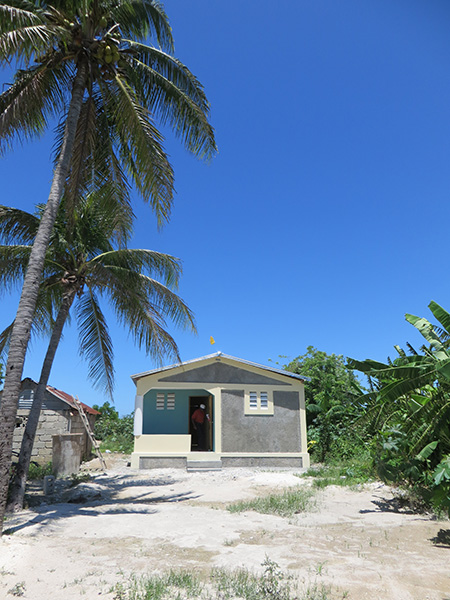
Yves Charles's new house in Boen, Haiti. Photo: CWS


CWS and other ACT Alliance members have repaired and rebuilt 222 houses in Ganthier and Boen since January 12, 2010.

New houses. New hope.

In Ganthier and Boen, Haiti, CWS leads an ACT Alliance program to improve living conditions for families by increasing access to dignified, safe housing and improved access to clean water and sanitation facilities. This program started in 2011 to help families who were living in camps following the devastating earthquake in 2010.

Fedline Fleuristal and her family found new hope as they helped build their new home:

“We have 7 people in the household; my husband and me, our four children, and a child of my sister. Our children are at primary and secondary school, two of them in Boen, one in Croix-desBouquets and the oldest one in Port-au-Prince. He comes home every weekend and already finished secondary school, but there is no money to pay for university, so now he is following a course studying French. My husband is a farmer, planting sweet potatoes, sorghum and other crops. I buy and sell sweet potatoes and plantains at the market of Croix-des-Bouquets.

The masons worked well at our house. They respected time, came early and left late, working hard. I prepared food for them, carried water, helped with manual labor, carried mortar. My husband also helped.  We used to rent a house in Delmas, but it fell down during the earthquake and then we came to Boen, where I am from. We started to rent a house in Boen, but now this new house was built on my mother’s land. Our oldest son got hurt in the earthquake when trying to run out of the house, with blocks falling on his legs and forehead.  

Today I will pray with my group before moving into the house. We did not have this hope, but God gave us a house. I am used to getting a lot of disillusions, but this shows what God can do. I like the house a lot, the way it was built.” 

Yves Charles, a beneficiary in Boen, had a hard time believing that his new house was real:

“We used to have a mud-and-stick house. We have 8 children. When they called me, I still couldn’t believe we were going to get a house. It was only when I saw the engineer come to mark the foundation of the house that I started to believe.

We are very satisfied and the construction went well. The engineer gave us time and we worked with the technicians as if we were a family. Other people also came to give us a hand. I went to get cement, rebar, tin roof and wood at the warehouse and helped during the construction.

I am a farmer. Depending on the season I plant corn, sorghum, beans, beets, and onions. My wife sells at the market of Kwabosal. What they gave us is not something little; it is big. We don’t know when we would be able to do this ourselves.”

Roserne Fils-Aime lives in a new house in nearby Ganthier:

“Before January 12, 2010, my husband and I were living with our children in a rented house, but the house got destroyed in the earthquake. Since we had no money to rent another one, we had to live in the camp. Although the circumstances were difficult, we lived with hope that one day God would help us get out of the camp. This has now been accomplished and I feel happy to have a house where I can live in peace and quiet with my family. I give thanks to God and the organizations and hope the program will continue so that many more people can benefit.” 


Stories of Change


Betty Joseph. Photo: CWS


CWS and other ACT Alliance members have repaired and rebuilt 222 houses in Ganthier and Boen since January 12, 2010.

In Haiti, new houses mean confidence and security

In Ganthier and Boen, Haiti, CWS leads an ACT Alliance program to improve living conditions for families by increasing access to dignified, safe housing and improved access to clean water and sanitation facilities. This program started in 2011 to help families who were living in camps following the devastating earthquake in 2010.

Betty Joseph is a beneficiary in Boen. Here is her story:

“I live together with my husband Lemon Demosthenes, our 5 children and my younger brother. I buy and sell products at the market of Croix-des-Bouquets; rice, detergent, soap; whatever I can get. We used to have a mud-and-stick house, but it got destroyed in the earthquake and then we had to live in the camp. Life in the camp was not good, but we had to accept it as we had no other option. The pastor told us to pray, but we did not believe.

Today I feel happy, as I have a nice house built with blocks, which marks a change in my life. Now we can sleep with confidence and security. I helped a lot with the construction; I carried bags of cement, mortar, buckets of water, and prepared food. In our old house whenever it rained we had to fix the walls, but now that we have a house of blocks there is no need for that anymore. The house is strong, it has a lot of cement and rebar. I asked for a middle beam in all the walls of the house when I saw they only added one under the windows.

This is a gift of God and I hope that everyone who was in the camp will have a house like the one I have now. We will pray before moving into the house.”

Betty’s daughter Samelie, had this to say:

“I am 12 years old. Thank you for giving me a house. We didn’t have a house, we were sleeping in an old shelter of mud and sticks, but you gave me a house. The rain is not making me wet anymore. When I was in the old house the rain would make me wet. We will pray to God for those who do not yet have a house so that they can also get a house. Thank you.”


Stories of Change


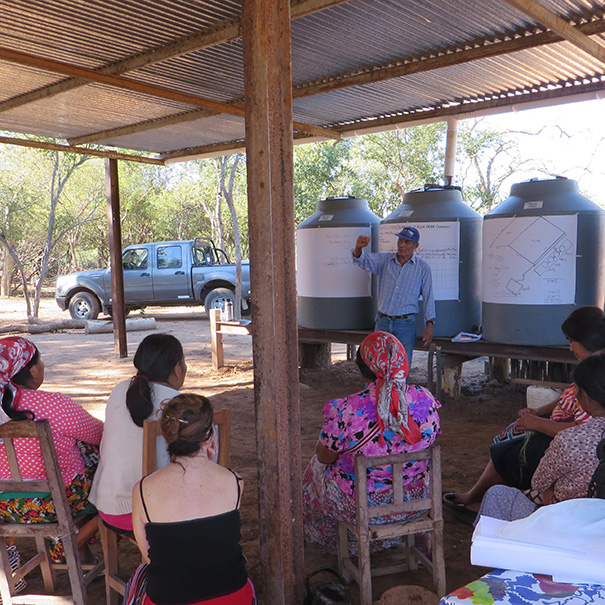
Anacleto Montes presents his family's cistern and water catchment system to a group of visiting Wichi indigenous women. Photo: Margot DeGreef / CWS


The South American Gran Chaco is home to 25 different indigenous groups.

Source: CWS Latin America and the Caribbean

The Montes family: rebuilding on reclaimed land

In the South American Gran Chaco, which spans parts of Argentina, Bolivia and Paraguay, many indigenous communities have lost their land titles to major corporations who deforest the land for the cattle and soy industries. CWS and partners accompany indigenous families in their struggle to reclaim their lands and then overcome hunger and a lack of clean water.

After a decade of waiting, the Montes family was finally able to occupy their family’s land near Los Blancos, Argentina once again in 2011. In order to make the land livable, though, they needed wells. Although the well water was salty, the family moved back as soon as the wells were drilled. “It wasn’t easy to come here,” said Anacleto Montes, the head of the family. “It has been very difficult. It took a long time to receive the land title papers. Our wish was to occupy this land and I was one of those struggling for the land. There was nothing here. Now we don’t need to be afraid of pumas anymore at night.”

Tremendous progress has been made in the last five years, including new water tanks and a cistern to catch rainwater and provide decent drinking water to the family. “We didn’t think the roof could really provide us with water,” Anacleto confessed. But provide water it does. A drip irrigation system connected to one of the wells also makes vegetable production possible in this dry area.

While the Montes family recognizes the role that CWS and partner Fundapaz have played in getting them this far, they feel both ownership and responsibility for their water system. In Anacleto’s words, “We have to work and maintain our resources. If something breaks, it is not the system that doesn’t function, but it means that we are not functioning.”

Despite the progress, there is still a long way to go in reuniting the whole family and thriving. There is no electricity yet, and access to the town for school and clinic use is difficult without transportation. Undaunted, the family is united and full of hope: “The process of regaining and occupying our land is difficult. It is normal to suffer in order to restart.”

The family is now a role model to others in the region. A group of Wichi indigenous women, in addition to staff from CWS and Fundapaz, recently visited the family’s land to learn more about the cistern and water catchment system. As one of the Wichi women said, “I am happy to see new faces that will share our story from this meeting with a group of indigenous women and make us visible around the world.”