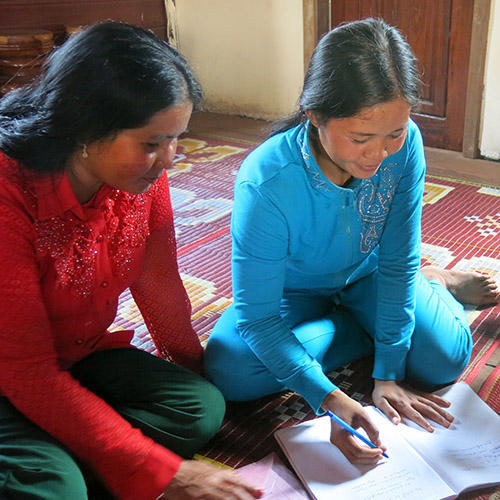
Leang facilitates a self-help group meeting. Photo: CWS
CWS efforts in Cambodia positively impacted 33,169 people in 64 communities in 2016.
Self-Help Groups mean independence in Cambodia
Koeun Leang, 28, lives in Sen Rung Roeung village in northern Cambodia with her husband, Chhin Tab, 29. Tab is a farmer who also works as a wage laborer. The couple has three children between four and nine, and the two older ones attend the village school.
Leang is a Village Health Volunteer, and she has been involved in CWS-supported activities since 2011. As a Volunteer, Leang has learned about maternal child health care – including antenatal and postnatal care – and chicken raising and vegetable and mushroom growing, especially to strengthen family diets.
Leang has also learned the benefit of having Self-Help Groups, and she was especially interested in helping form one. She believed that having a SHG would help promoted solidarity among the residents of her village. In her words, “We can save and help each other with low interest micro loans, and we are happy to use our mutual trust as collateral.” Before, families in need of money had to borrow from moneylenders or larger micro-finance institutions. Repaying these individuals or organizations was a challenge because of the high interest rates that they charge.
Leang worked with CWS staff and her village leader to form an SHG in 2013. That group now has 18 women and two men as members and a capital of $1,095! This sum has made it possible for members to borrow readily, and recently Leang said, “Even without CWS presence since June 2016, my group still functions well – all members understand and comply with group norms to save and also to repay loans. We meet regularly to update on account balances and loans – and to share ideas and information about our businesses and farming, plus social issues.”
This SHG has succeeded in all its aims. It has reduced dependency on moneylenders. It has enabled members to access loans readily – especially for health and medical situations. Leang is very proud that she has been part of this group since its beginning.
Saenam village in West Timor, Indonesia, is prone to a number of disasters, from drought to flash flooding. For remote villages like Saenam, though, there are limited services available when an emergency hits, at least early on. It is largely up to the community to mitigate disasters and to get through the initial response. With CWS support, and in partnership …
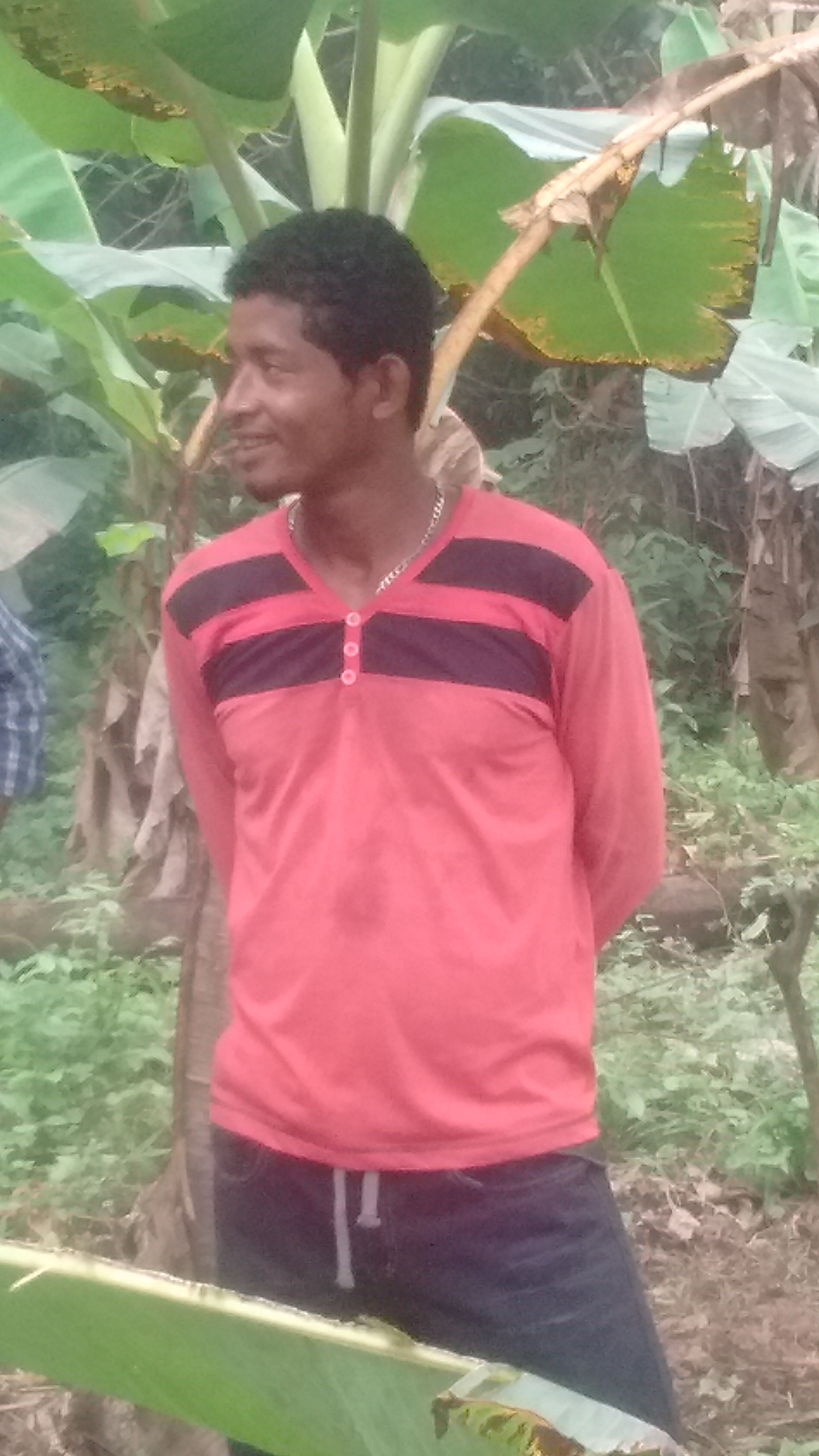
At only 22, Flores is the fourth from his community to graduate from the CWS-supported Community Agriculture Promoter course, an intensive 8-month program covering agriculture and business development. Photo: Martin Coria / CWS
CWS supports 38 communities in the Rio Coco region of Nicaragua through six training centers.
In remote regions of Nicaragua, growing bright futures
The Rio Coco runs west to east and divides Honduras and Nicaragua. The longest river in Central America, it runs through a beautiful, vast, hard to reach and scarcely populated area. Poverty is deep in this area, which is made up of 70% indigenous peoples and has only a minimal presence of government services.
The Rio Coco region of Nicaragua is also home to CWS’s largest food security program in Central America, which is implemented by Nicaraguan partner Accion Medica Cristiana with support from CROP Hunger Walks and Foods Resource Bank. CWS supports 38 communities through a “farmer to farmer” model. Six CWS-supported training centers are strategically placed throughout the region, and agricultural promoters and youth from nearby communities train at the centers and take what they learn back to their neighbors.
One of these youth is Flores, who is an inspiring example of youth entrepreneurship. At only 22, Flores is the fourth from his community to graduate from the CWS-supported Community Agriculture Promoter course, an intensive 8-month program covering agriculture and business development. In four years, 157 young adults including Flores have graduated from the course. Each workshop for promoters like Flores costs $350 to run.
During the course, Flores used his uncle’s plot to experiment. After graduation, he got his own piece of land to farm and worked as a day laborer to save up enough money for his first 40 plantain trees. Today, Flores has 369 plantain trees and sells his produce to a buyer across the river in Honduras. He plans to start a pig raising project next. Flores keeps in touch with the three other program graduates from his community to share ideas and to learn from one other.
In the nearby community of San Esquipulas, Mariana is a powerful and determined Miskito woman and is a role model for her neighbors. She is not one of the three agricultural promoters who studied at the training center, but rather she is one of 12 farmers who received intensive technical assistance from the promoters for a year. She has changed the way she farms as a result, particularly through crop diversification and post-harvest management. Mariana has been so successful that her neighbors now replicate the techniques that they see working on her land. She now also makes enough money that she can hire a neighbor to help her if needed.
Finally, there’s Olga. In the remote community of San Carlos, which is five hours by boat from a larger town, Olga is a teacher and farmer who has six children and 37 students. She says that she is responsible for 43 people. When CWS staff visited her in January, she was working on establishing a vegetable garden next to her home. From January through May she will grow pipian, tomato and cucumber, and the rest of the year she will grow plantains. She plans to bring her students to the garden to inspire them to start their own gardens at home.
Olga is one of 50 teachers in the region who received CWS-supported training to set up school vegetable gardens for their students. The seeds for one of these school gardens cost about $18. The gardens enable students to have healthy meals at school and to learn techniques that they can take home to their parents. In addition to the gardens at her home and school, Olga and her children also take care of a plot of land about an hour from the community. CWS-supported agronomists visit this land periodically to assist her with technical advice. Olga’s son told us that he dreams of starting to work on his own piece of land soon.
Across these isolated communities, the CWS food security program is having a real and significant impact. The program’s components work together and all contribute to community transformation. Training on better farming techniques and post-harvest storage, promotion of vegetable gardens, nutritional education for teachers, agricultural education for youth, water and sanitation improvements and coordination with the ministry of health to bring medical brigades into these remote communities are all part of building brighter futures in Nicaragua.
The Rio Coco program will continue through 2020. Your support of CWS, CROP Hunger Walks and Foods Resource Bank will enable the strong partnership between families, farmers, Accion Medica Cristiana, municipal authorities and the Ministry of Health to continue. This will mean that more families will have enough food year round, more kitchen and school gardens like Olga’s, more families with improved access to safe water, more entrepreneurs like Flores having the support they need to develop their businesses and more community leaders promoting a culture of peace.
Thank you for making this work possible.
Stories of Change
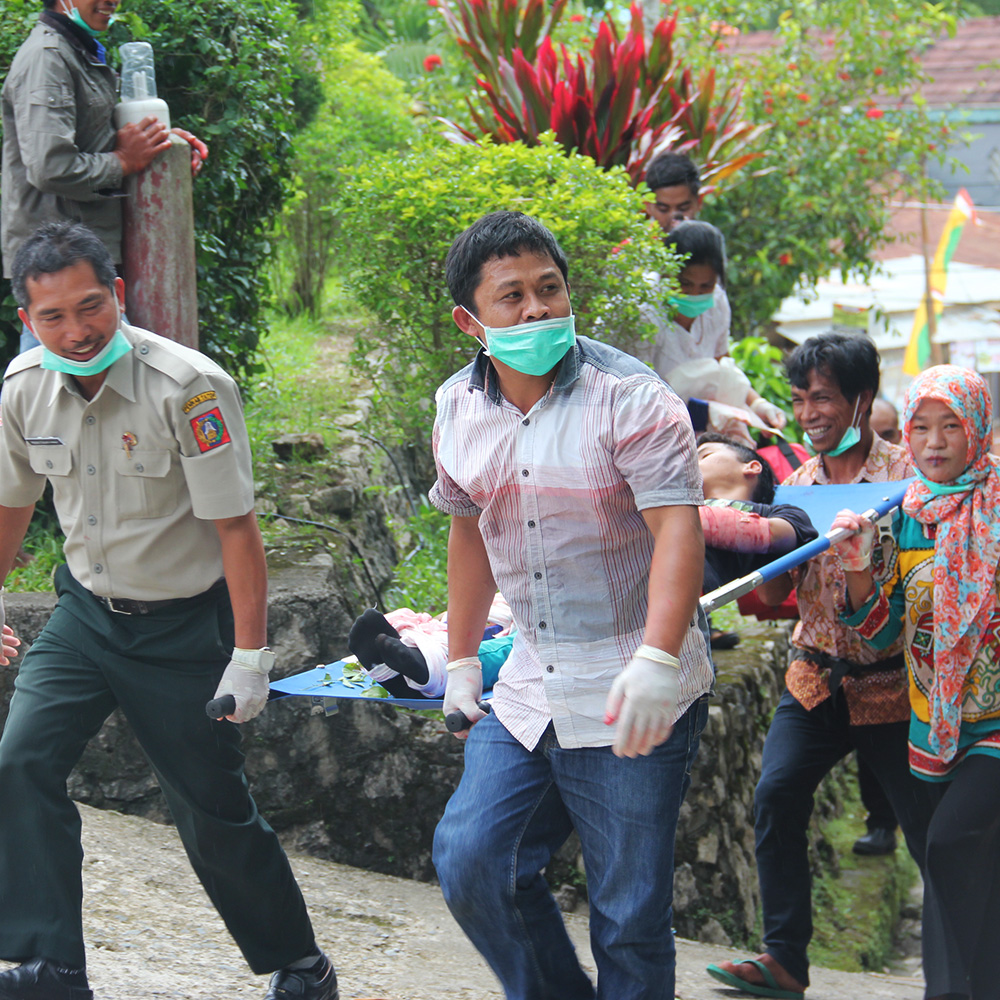
A first aid practice scenario during a CWS-led information session for residents of Tana Toraja. Photo: CWS
Tana Toraja is one of the most landslide-prone parts of Indonesia.
In Indonesia, ensuring that community first responders have the skills they need to be successful
In Indonesia, a Village Disaster Preparedness Team is a group of volunteers from a community who facilitate all activities related to disaster prevention, response preparedness (readiness) and any response needed.
Lembang Paku village in Indonesia’s Tana Toraja province is in a mountainous area about 50 kilometers (31 miles) from the nearest town. Landslides are a common occurrence in this part of Tana Toraja, and the remoteness of the village hampers the ability of government responders to efficiently reach the community when a disaster strikes. So, the villagers themselves – friends and neighbors joining together – are inevitably their own ‘first responders’ following a disaster, even though most have little knowledge or skills for this role.
That’s how CWS can help. When given the chance to have CWS support to establish a Disaster Preparedness Team in Lembang Paku, community members responded enthusiastically to broaden their knowledge and the range of skills they would need to be effective.
One team member, Tabitha, is a mother of three who works for the village and is active in women’s empowerment and community organizing. Her view that the community’s current disaster response readiness and management left much to be desired led her to join the Team. In January, she and 35 others participated in a CWS-supported First Aid training workshop where they added to their knowledge and skills to protect their community when needed. Important to Tabitha was the fact that, in addition to hearing and reading about theory, she and others had a chance to practice First Aid in scenarios and role playing activities. After this first learning opportunity, Tabitha said, “I realize now that we also need to have proper First Aid equipment in Lembang Paku. So I will continue to lobby for more support and assistance from the local government.”
Stories of Change
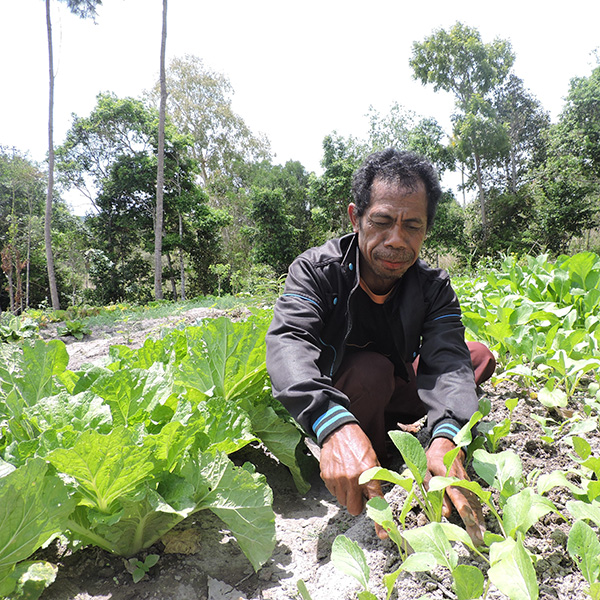
Hofmin Selan in the vegetable garden. Photo: CWS
CWS efforts in Indonesia positively impacted 21,212 people in 22 rural communities and one city last year.
When 14 farmers from Fetomone village in West Timor, Indonesia, established their Farmer Group in March 2016, members agreed that they would cultivate corn together on a new plot of land. Unfortunately, due to some mistakes regarding the land’s arability and a lack of proper attention paid to the plot, things didn’t go as planned. The harvest failed.
Undeterred, the team decided to learn from their mistakes and try again. They did so with continued support from CWS staff and the local government agriculture extension worker. The group decided to plant vegetables instead, and they had very good results. “The vegetables really help us a lot – when we harvest, our families can eat some and the rest we can sell and share the income among our group members. This additional income means we can buy rice, cooking oil and salt. The money also helps us pay school costs for our children,” Hofmin Selan, one group member, said.
With their good results the farmers next decided to start saving as a group with each member contributing 10,000 Rupiah (75 cents) every time they sold some of their vegetables. “Now we have 220,000 Rupiah ($16.50) as our group savings,” explained Hofmin, who is also the Treasurer. “In the future, when we have enough savings, we plan to buy more seeds and more tools to expand our plot, and keep growing our savings group into a loan group, too, which would really help our members. Of course, we know we could not have done all that we have without the support of CWS,” added Hofmin, “and we are really grateful for the chance to partner with them.”
Stories of Change
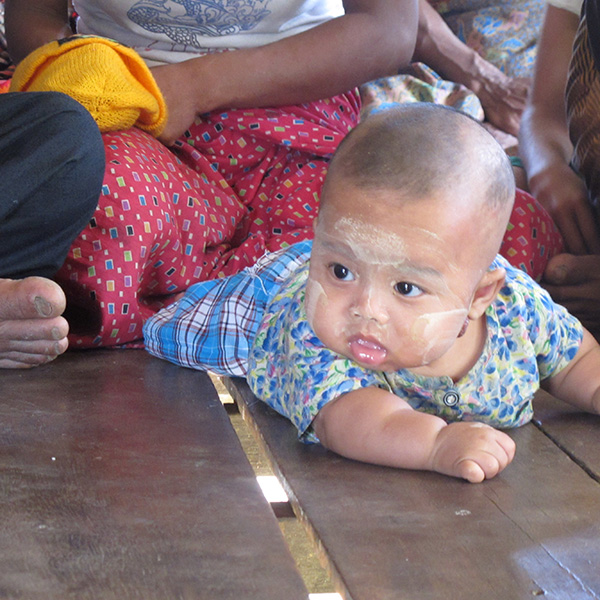
Shine Htet Lin and his family are facing a brighter future with support from CWS and Japanese company Aginimoto. Photo: Laura Curkendall / CWS
A young family with a brighter future: new opportunities start to pay off in Myanmar
Myint Myint Kyi, known as Ma Kyi, is 22 years old and lives in Inn Tae Su village in Maubin Township of Myanmar’s Ayeyarwady Region. She is married and, with her husband, Ye Lay, 31, she has two boys: Zin Myo Oo is five years old and Shine Htet Lin is six months old.
Both parents are daily wage workers: he earns 5,000 Kyat ($3.70 US) per day and she earns just half that for similar work. Though they are always willing to work, usually there are only 15 work days each month – and only for six months of the year because there is no work in the long rainy season.
This couple is quite similar to many other poor and vulnerable people: once they have spent their saved money from their day wages, they must borrow money from money lenders who charge quite high interest rate (10 percent).
To try to get out of this too-common trap, Ma Kyi has seized the chance to join a series of education and training sessions offered in a CWS nutrition project that is funded by a Japanese food company, Aginimoto. While Ma Kyi says she liked all the topics covered in the educational sessions, her favorites were the ones about basic nutrition and personal hygiene. She was also interested in learning about how to properly raise poultry and about how new possibilities relating to home gardening; after the trainings, she was given a rooster, three hens and seven types of vegetable seeds. These assets, combined with her training, set her on her way to more solid financial footing for her family.
Now, she waters the family garden every day and cares for the soil with natural compost. She says she has plans to make ‘green’ compost for her plants too. Also, Ma Kyi carefully feeds and waters her little brood of chickens and, like others in her group, she is hopeful to soon have more income from selling eggs and extra vegetables (after her sons have been well fed) and she plans to start to save some money for her sons’ education – as soon as she and Ye Lay pay off their debts.
Cveta was born in 1978 in Urosevac, Kosovo. She has seven sisters and four brothers. Their parents were illiterate, unemployed and lived mainly assisted by welfare. As children, Cveta and her siblings tried to provide for the family by taking on several jobs, but – like most Roma families – they still remained very poor. When Cveta was nine, she and her …
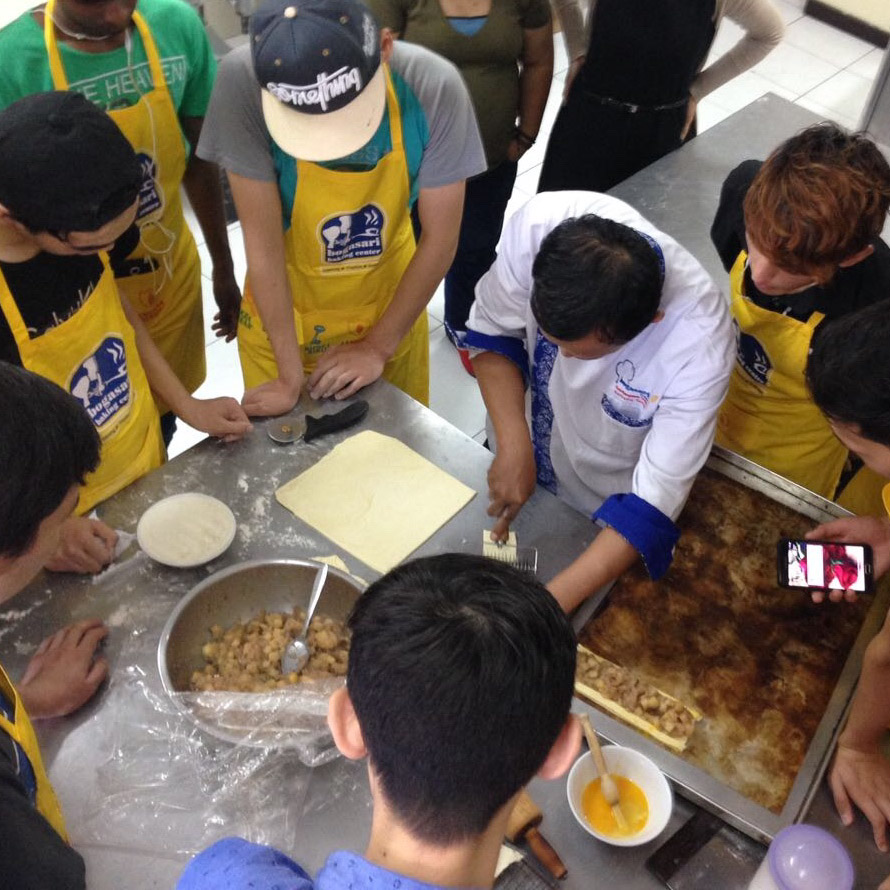
Young refugees during a baking class at the Bogasari Baking Center. Photo: CWS
CWS helps to support hundreds of refugees and asylum seekers in Jakarta, including nearly 100 unaccompanied and separated children.
Ingredients for a new life
Toward the end of December 2016 a group of 14 unaccompanied asylum-seeking children from Afghanistan, Sri Lanka, Ethiopia and Somalia gathered in a large kitchen in south Jakarta for an intensive, three-day baking course. This was a welcome break from the long, routine days and weeks the boys spend in their CWS-supported group homes. Since the boys have a lot of idle time, CWS staff are always looking for ways for them to have interesting adventures and learning opportunities – like last year’s design course with a local firm and an excursion to a concert. Their visit to the Bogasari Baking Center in Jakarta, which is a unit of Indonesia’s largest integrated flour mill, was a very special treat.
On the first morning the course got underway rather quietly as most of the children did not feel confident to speak up, not least because none of them knew anything about baking and pastry-making. But, almost immediately, one thing was very obvious: they were all very eager to learn!
“I am thrilled to see the children being excited about the course,” said Chef Heri, the instructor. “Maybe we do not speak the same verbal language; but one of the great things about baking is that speaking and hearing is not essential; teaching people to bake can be done by demonstrating – up to 80 percent of what we teach is hands-on, so we don’t need a lot of language for this.”
One of the baking class participants was Ali* from Afghanistan, who arrived in Indonesia in mid-2015. And, as he waits to be officially recognized as a refugee and to be resettled to another country, one of the ways he manages is frustration has been cooking , and now he can bake pastries and cakes at his house, where he lives with other unaccompanied children. Theva*, the only Sri Lankan among the children, joined the course with a resolution: “… to make a Christmas cake for Ibu Dewi, one of the social workers in the our group home”. Theva made good on his promise to Ibu Dewi; and, every day, he and other boys brought their bakery creations back to their group homes where they were eagerly awaited by their friends.
Besides being a diversion from their daily routines, the course and time away from the group home gave the boys from four different group homes to get to know each other, learn about each others’ cultures and form new friendships.
At the end of the course Amir*, a 16-year-old Afghan, said this, “The baking course has given me confidence that I have skills – to bake, to make something. To me it is beyond the baking skills, it gives me hope about the future.”
*Names have been changed to protect the identities of refugee minors.
Stories of Change
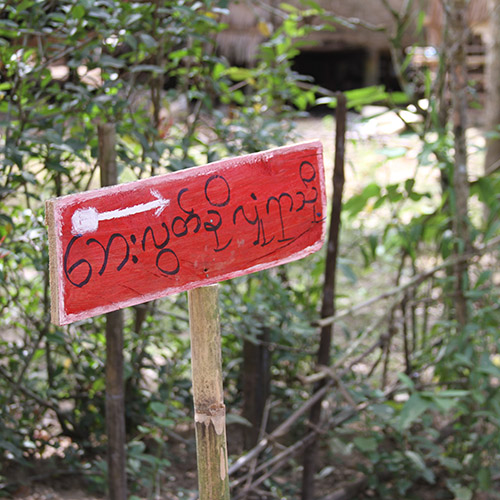
An emergency evacuation route sign in Kyauk Tan village in Myanmar. Photo: Andrew Gifford / CWS
Kyauk Tan has faced a variety of disasters in the past, from frequent flooding to Cyclone Nargis in 2008 to annual fire and drought risks in the dry season.
Working with communities in Myanmar to weather the storm
Flooding. High winds and cyclones. Fire. Drought.
Communities in rural Myanmar, or Burma, need to be prepared to face many emergency situations, both small and large. And, in remote villages, disaster response is almost always up to communities themselves. Emergency aid, including fire brigades and medical services, are essentially nonexistent. Hospitals and clinics are in distant larger towns.
Kyauk Tan village is on the Pathein River outside the town of Ngapudaw in Myanmar’s Ayeyarwady River region. Our team visited the village to learn more about how its residents are preparing themselves to better respond to future emergencies.
When you arrive in Kyauk Tan, you disembark onto a concrete jetty, which CWS helped the community build. This jetty is much sturdier than the wood versions that came before it, and it ensures that people can safely get in and out of boats. This is especially important when elderly or sick people, or children, need to be helped into a boat for travel or for emergency or routine health care.
After we disembarked onto the jetty and headed into the village, we met with community members who had recently taken part in what is called a Training of Trainers workshop. With donor support, CWS joined with our partner YMCA of Myanmar to host the workshop, which included a variety of education sessions for community volunteers chosen by their neighbors to help them when they need to respond to an emergency. During the sessions, volunteers join those from nearby villages to learn and practice how to take the lead in sharing information before or during an emergency and also how to put together a team to help them in the village.
Ma Gay is the Outreach Worker in Kyauk Tan, who recently joined a seven-day Training of Trainers workshop in Ngapudaw where she learned how to help her village prepare a disaster prevention plan, how to put together committees of others to help and how to respond to small scale disasters, including health-related ones like diarrhea outbreaks.
Kyauk Tan village now has a main Disaster Risk Reduction committee and three sub-committees. “Disaster Risk Reduction” is a common way to describe what we may think of as emergency preparedness. Often, people just say “DRR” and know that it refers to all of the work that goes into understanding disasters, trying to lessen the damage that they can cause and responding when they do cause damage.
One of the first tasks of the DRR committee we visited had been to survey their village. The result is a map of Kyauk Tan that shows where the hazards – such as low-lying or fragile buildings – are and where there are resources. For example, the church and town hall are on high ground in the middle of town, which makes them resources, so the community keeps dry food and some supplies there for emergencies.
Another part of the assessment was to create a calendar. This is a month-by-month list of well-known risks and disasters so the community can plan accordingly. For example, Kyauk Tan has faced a variety of disasters in the past, from frequent flooding to Cyclone Nargis in 2008 to annual fire and drought risks in the dry season. So, these types of risks and when they are likely to occur are noted on the calendar.
We were surprised to learn that, despite the fact that Kyauk Tan is on the banks of the Pathein River, drought is a major concern here. In the rainy season, families collect as much rainwater for drinking as they can. And, when individual family supplies run out, the rain-fed community pond becomes the only source for drinking water in the dry season. But sometimes the pond water isn’t enough to last through the dry season and families face water shortages. When we asked about ways to change the situation, we learned that they can’t expand the pond because there is a rock slab under it that they can’t dig around. And even if the families wanted to boil and filter the river water to drink it in the dry season, it is too salty because of the village’s location near the river delta.
In talking further about this situation, Ma Gay told us that during droughts, since safe water is harder to find, people go ahead and use unclean water, so diarrhea is more common.
She told us that some families used to eat less during water shortages because they were afraid of diarrhea from food prepared with what they know is dirty water. This leads, she explained, to people becoming malnourished and ending up in the hospital in Ngapudaw. To start to confront this problem, Ma Gay decided to use information she received in a CWS-supported education session. She had learned how to prepare certain types of liquids, referred to as oral rehydration solutions, that can help treat diarrhea, and she learned that patients can have soft food. This means that patients can keep eating and drinking and not make themselves even more sick from hunger and dehydration. She has shared this knowledge with her neighbors, and she tells us that residents are now less scared to eat during water shortages.
As for larger natural disasters, community members told us that they are now better prepared to handle them because DRR committee and subcommittee members have specific jobs they are prepared to do when needed. One member is responsible for making sure that there are basic supplies and dry food at the shelter locations. Another is responsible for making announcements on the community loudspeaker to keep the public informed. Members of the Search and Rescue subcommittee make sure they know who may need extra help in an emergency, such as elderly people living alone or neighbors with disabilities. In the event of a disaster, these subcommittee members are responsible for helping the identified residents.
In her role as Outreach Worker, Ma Gay works hard to ensure that everyone in the community is better prepared for all kinds of emergencies. She often makes announcements in church and works with youth groups.
Kyauk Tan, and many villages like it around the world, faces a variety of natural disaster risks. With support from CWS donors, staff and partners, though, they now have the training, resources and organization needed to weather the storm in whatever form it comes.
Stories of Change
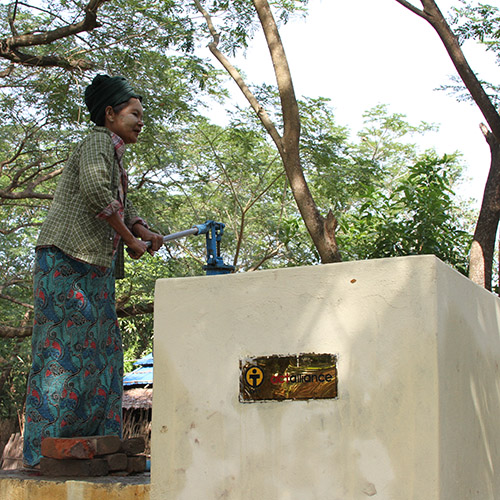
A resident of Inn Ma Su village uses one of the newly elevated hand pumps. Photo: Andrew Gifford / CWS
Elevated hand pumps mean year-round clean water access in Myanmar
In the heart of Inn Ma Su village, there is a huge, sturdy tree in the middle of a large clearing. There’s a sign on the tree that makes very little sense for many months of the year. It asks that you drive boats slowly in the vicinity.
During the rainy season, though, the importance of that sign becomes clear. Flooding isn’t a question during the rainy season in this small riverside town. It’s a way of life.
In the Ayeyarwady Region of southwest Myanmar, the massive river system is critically important. It is a highway for both transportation and information sharing that allows remote villages to communicate and travel year round to reach public services, like clinics, as well as work and other opportunities in larger towns.
One thing the river is not, though, is potable. River water is not safe for drinking. It is contaminated by many things, including runoff from latrines.
When the Ayeyarwady River flooded early last year, donor support meant that CWS and partners could bring household water filters to affected villages to help ensure that families had clean, safe water while they waited for the flooding to recede from around their hand pump well.
In the fall of 2016, however, our CWS team and partners worked with the people of Inn Ma Su to create a more permanent source of safe water. Together, and with donor support, we built concrete platforms with stairs for four hand pumps. Each platform also has a small water tank. Water is pumped into the tank and then can be used to easily fill buckets using the spout in the side of the platform.
Before the platforms, the community’s hand pumps were at ground level, similar to this one in a nearby village. That meant that they were often flooded and unusable in the rainy season, and they were almost always muddy.
Now, even in the dry season, the new platforms ensure cleaner, dryer areas around the pumps. And in the rainy season, they guarantee access to safe, clean water – even when getting to the platforms means using a boat.
Interestingly, many of the hand pumps are on private land, but it is customary for families to allow free access to their yards so their neighbors can also collect water from the pump. During the dry season, three or four households use a hand pump daily. In the rainy season, though, as fewer hand pumps are accessible, more families will rely on the now-elevated pump.
Apart from the wells CWS and Week of Compassion donors have just helped improve, the challenges facing Inn Ma Su are numerous. The nearest school is a 30-minute walk away, which is long enough in the dry season. In the rainy season, many students stop attending school due to flooded fields, muddy footpaths and a dangerously weak bridge. Also, the villagers want to prioritize finishing their work on a new monastery which, critically, doubles as a village shelter in the event of cyclones or other natural disasters.
With improvements to the four hand-pump wells now done, the partnership between Inn Ma Su and CWS is not over, and we are proud to reach this milestone of ensuring better access to potable water.