Chickens and vegetable seeds improve nutrition and health in West Timor
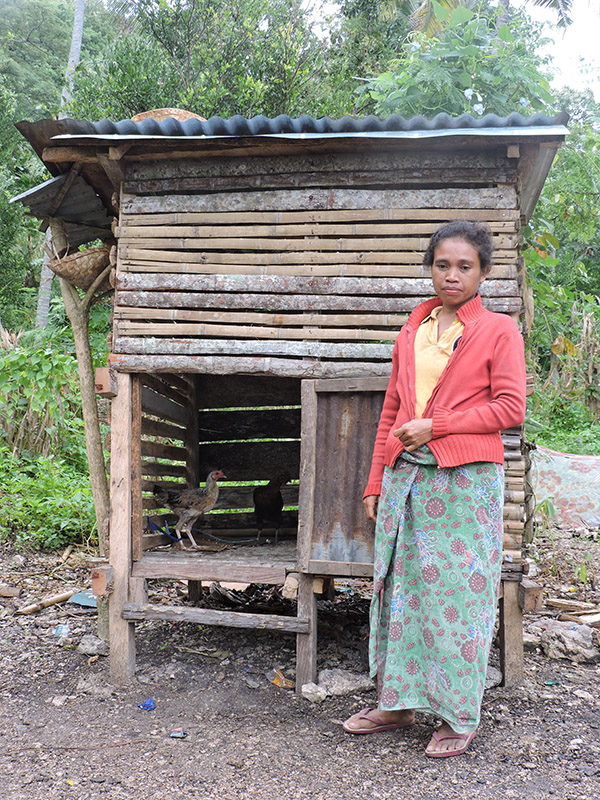
Orance Nenoliu lives in Saenam village in West Timor, Indonesia, with her husband Yakobus Tualaka and their two children. With support from CWS, 33-year-old Orance is learning about home gardening and raising chickens so she and her family can have more food and a more diverse diet, which leads to improved health. CWS has partnered with Orance and others in her village to distribute vegetable seeds to families along with information about organic fertilizers to ensure that vegetables can thrive once they are planted.
Orance has also learned about the benefits of keeping her chickens in a coop, which her husband built with advice and help from CWS team members. “We used to let the chickens roam free,” explains Orance, “and sometimes they were stolen or contracted diseases that killed them. Some were eaten by wild animals. I really like the idea of putting the chickens in their coop at night to keep them safe.”
“I also am glad we know more about how to keep our chickens healthy so they grow better. When my husband built the coop in March, he also learned about vaccinations and how to properly feed the chickens,” Orance told us. “Now I hope that growing vegetables and raising more, healthier chickens will also help improve our children’s health because we can feed them more nutritious foods.”
Stories of Change
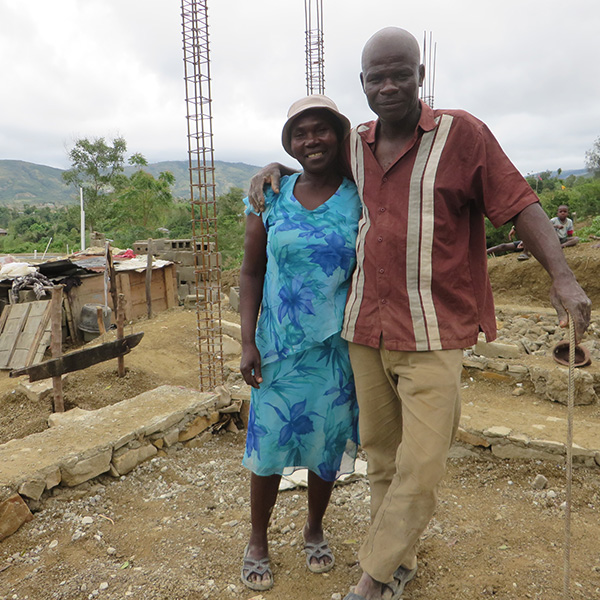
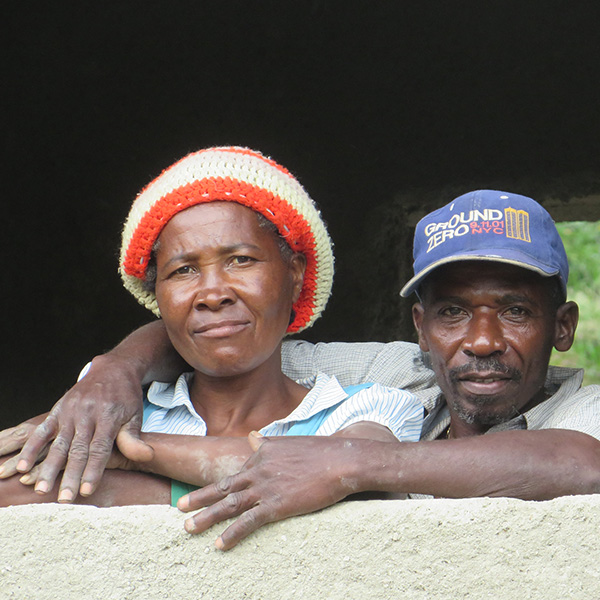
Roger and his wife at the construction site for their new home.
Following Hurricane Matthew, which struck Haiti in October of 2016, CWS and local partners have distributed seeds and repaired or rebuilt houses in the Northwest Department.
New house, less fear
The commune of Jean Rabel in Haiti’s Northwest Department was hit hard by Hurricane Matthew in October. CWS and partners are helping families rebuild, often literally. CWS is working with the cooperative KOFEJ to repair and/or rebuild four houses. KOFEJ is one of the agricultural cooperatives that CWS supports through our ongoing food security programs in the Northwest Department.
Roger Doris and his family will be living in one of the houses that is being constructed. Roger and his wife have four children between the ages of 17 and 27. Two are studying in Port-au-Prince, one is a teacher and one is a secondary school student. One of their children is studying civil engineering and actually drew up the first draft of the plans for the family’s new house. CWS engineers updated the plans and took them into account when creating the final plans.
The family’s house was built in 1989. In 2000 and 2001, the family replaced the walls with concrete blocks and added a tin roof. However, Hurricane Matthew did extensive damage to the structure. It shook the walls, cracking them and leaving them in bad condition. The support columns had been made of wood and weren’t sturdy. The family continued to live in the home, but they were afraid.
The new house is being constructed in the same space as the old one. While that is happening, the family is facing tough living conditions. Their daughter who normally lives at home with her parents is temporarily living with an aunt during construction. Roger and his wife stacked some concrete blocks together until they were about knee height and covered them with tin roof sheets. That is where they are sleeping. You have to crawl into their shelter. The need for expediency is obvious.
Luckily, construction is well underway. Roger has training as an iron worker and carpenter, so he has been helping with the construction. He and his wife also contribute by paying to have the foundation dug, breaking gravel, providing food to the workers, fetching water and paying for other supplies. They have confidence in the work that the CWS engineers and the team are doing. Roger says, “Now we won’t be afraid anymore, with the work the engineers do.”
The family has been part of KOFEJ for a long time and has previously had small business loans from the cooperative. At the time of the hurricane, they didn’t have any crops to lose. They did, though, lose two donkeys as well as goats and pigs. As they rebuild, they have received seeds for black beans, lima beans and corn from KOFEJ. In Roger’s words, “God takes care of us. This is a miracle, the house as well.”
The hope inspired by the new house can be felt in this powerful statement from Roger: “Thank you for the engineers who take us out of this situation. We won’t die in bad shape. We do everything the engineers ask of us.”
Stories of Change
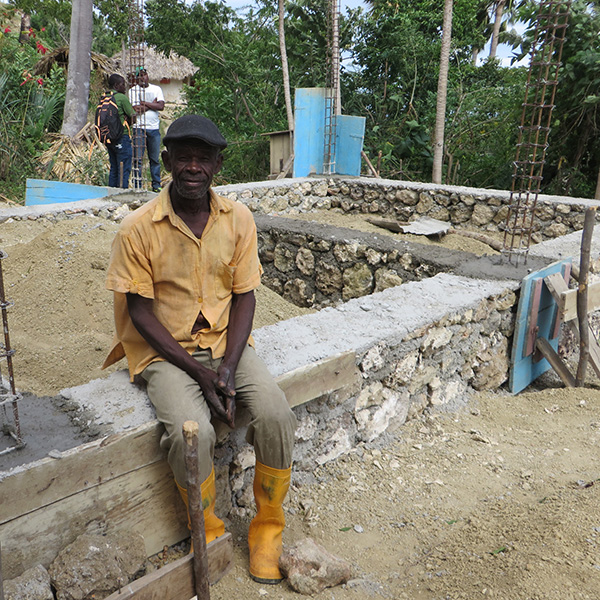
Merantier sits on the foundation of his new house that is under construction.
Following Hurricane Matthew, which struck Haiti in October of 2016, CWS and local partners have distributed seeds and repaired or rebuilt houses in the Northwest Department.
Neighbors unite to build a family’s new house
The commune of Jean Rabel in Haiti’s Northwest Department was hit hard by Hurricane Matthew in October. CWS and partners are helping families rebuild, often literally. CWS is working with new partner AGEHPMDNG to repair and rebuild six houses and to distribute seeds to families who lost their crops in the storm.
One of those houses belongs to Mérantier Destin and his family. Mérantier and his wife have five children, four of whom are married and no longer living at home. Their youngest daughter still lives with them. When Hurricane Matthew hit, the three of them were living in a mud and stick house. The home was severely damaged; wood was broken and walls were damaged.
AGEHPMDNG is helping Mérantier build a new house on the same spot that their old house stood. Mérantier worked with his son, neighbors and AGEHPMDNG to demolish the old structure and prepare the space for the new house. The family is staying with one of their older children while construction is underway.
While the AGEHPMDNG technicians are working on construction, Mérantier is busy assisting. He dug the foundation of the house, contributed rocks, carries concrete and other materials, fetches water from the river and prepares food for the crew.
This process is really a team effort among the community members. Mérantier’s neighbors have lent animals to help move supplies, and they have even carried materials themselves. This is happening despite the fact that some neighbors also have damage to their homes.
The new house promises to be much sturdier than the old one, since it has a solid foundation and is built of rebar and cement. The extra effort and care happening now will ensure that Mérantier and his family can better weather future storms.
Mérantier is a farmer and also received seeds through the CWS-supported distribution. “My gardens are looking good,” he says, despite the fact that Hurricane Matthew destroyed all of his crops. He grows bananas, plantains, sweet potatoes, corn and beans. All of these are for both consumption and income. He received a can of corn, a can of lima beans and 100 plantain trees in the CWS-supported distribution, and then he also bought black and white beans to plant.
Stories of Change
Lionel and his wife stand in the window of their new home.
Following Hurricane Matthew, which struck Haiti in October of 2016, CWS and local partners have distributed seeds and repaired or rebuilt houses in the Northwest Department.
A new house means new hope in Haiti
CWS and partners are helping to repair and rebuild houses that had been damaged or destroyed by Hurricane Matthew in the commune of Jean Rabel in Haiti’s Northwest Department. Local partner ICEDNO, located in the town of La Reserve, is leading the ongoing repair and reconstruction of 10 houses.
One of the houses that is being entirely reconstructed is that of Lionel Pierre and his family. Lionel, his wife and two of their children lived in a house built of rocks that was 18 years old when Hurricane Matthew hit. It was not a sturdy house; it had already needed to be rebuilt twice following storms.
Lionel said, “I did not understand how to build a house – it is ICEDNO that taught me. It is the first time in my life that I understand how to build a house. We don’t have enough money to build such a house, nor was there an engineer. When we felt that our lives were in danger we looked for refuge at the school [run by ICEDNO], to protect our lives. The wind was blowing and the rocks of the house fell down. The house was 18 years old. It had already collapsed two times before in strong wind (including hurricane Jeanne) and then I rebuilt it again. With these materials the house will not fall down.”
[Editor’s Note: The school run by ICEDNO was built by CWS following the Haiti earthquake in January of 2010. It served as a shelter following Hurricane Matthew.]
The foundation of the old house had been made of rocks placed on the ground – they were not dug in. That made the walls very fragile and caused the three collapses in wind. The family had also built a house of mud and sticks, which is where they are living during construction.
The team of engineers has helped ensure that this new house will weather future storms. It is being constructed in partnership with Lionel and his family, who have contributed labor, water and the digging of the foundation for the house and latrine. Lionel helped carry rocks and other materials from the main road where the truck unloaded them to the construction site. He gathered rocks to make gravel, and ICEDNO paid to break the rocks to make gravel.
Unfortunately, the new house is just the beginning of the rebuilding process for the family. They lost a mule, seven goats, a horse, a donkey, a cow and chickens as well as crops in the hurricane. Lionel’s wife used to go to the market to sell produce, but without a donkey to carry plantains that she used to buy and sell, that business has ended. The price of livestock has gone up since the storm, so the family can’t afford to replace what was lost.
The family now has more limited options; they must make charcoal and work their land in order to manage. They lost their crops and have prepared land for pigeon peas, lima beans and peanuts although they haven’t been able to purchase the seeds yet.
As construction continues, so does the relationship between the Pierre family and ICEDNO. In Lionel’s words, “The engineers tell us to be careful with our lives. They give advice and come often. I give God thanks because CWS protects people’s lives.”
Stories of Change
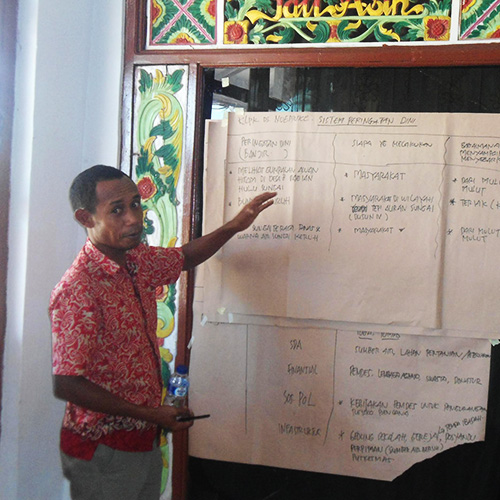
Deki facilitates a session on the Noemuke village Early Warning System. Photo: CWS
Preparing to better weather the storm
“Before I joined a gathering in my village, I didn’t know anything about disaster risk reduction,” said Deki Baker from Noemuke village in West Timor, Indonesia. “I only knew that my village floods every year, and that floods affect our community badly”.
“Disaster Risk Reduction” refers to programs that ensure that communities will be more prepared for an more resilient in the face of disasters. In small and remote villages, first response in the event of an emergency often falls to the community members themselves.
Today, Deki is a disaster resilient village (DESTANA) facilitator in the CWS-supported SOLIDARITAS project, and in this role he engages in many preparedness activities. Often, taking simple steps to prepare a community can make a big difference. One activity Deki facilitated was to establish an early warning system and evacuation routes because, in his own words, “I now know that we can reduce disaster risks and impacts by preparing beforehand, and one easy way to do that is to map out evacuation routes to safe places. So, with others, I have made and posted 33 evacuation route signs to two evacuation sites in the village.” And now Noemuke can avoid some of the worst effects when the next flood, or other disaster, comes.
Stories of Change
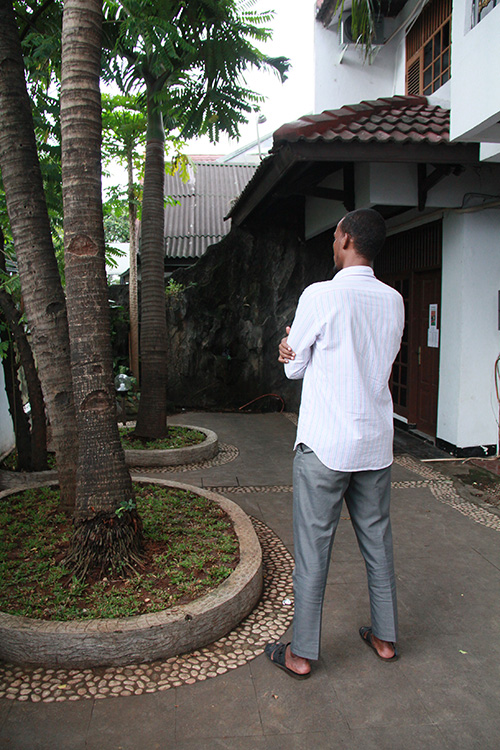
Feisal. Photo: CWS
CWS helps to support hundreds of refugees and asylum seekers in Jakarta, including nearly 100 unaccompanied and separated children.
In adversity lies opportunity
Feisal* has no memory of his parents and siblings.
He was barely a year old when they were killed in their home in Somalia and his grandmother fled with him to safety and to raise him on her own.
Then, a few years ago, when he was 20, tragedy struck again. “One day, the only parent I had, who had nurtured me since I was a baby, was shot; with my own eyes, I saw my grandmother killed, Feisal recalls, “At that moment I thought that the world was against me and that there was no hope at all for me.”
But, Feisal has proved himself an optimist – and a survivor. In time he managed to leave Somalia and found safety in Indonesia, where he heard about CWS and sought help. Now, after just a few years in Jakarta, Faisal volunteers teaching Indonesian language to other asylum seekers and refugees in the UNHCR-funded PURE project.
Life goes on, and recently Feisal and his wife welcomed a baby. “I really appreciate that CWS helped us access a hospital and pay the bill,” says Feisal, who, like other refugees, is supported for essential health care though the UNHCR-funded PURE project. From his own life Feisal surmises, “that in adversities lie opportunity; so I am always optimistic. I hope to be resettled to a third country one day and to build my good future there with my wife and son. I am grateful to CWS, UNHCR and all the organizations that have been here for us.”
*named change to protect identity
Stories of Change
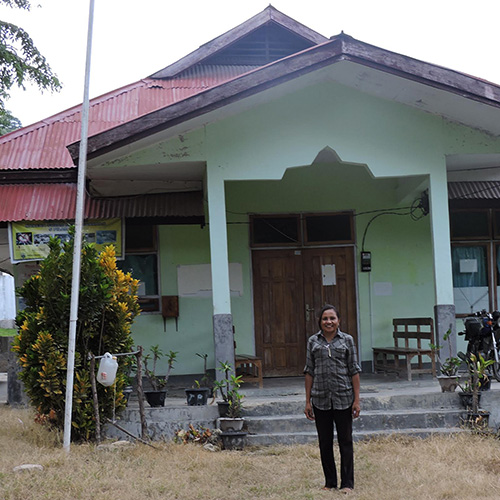
Vera Kuli stands in front of the Puskesmas in Oekam village, West Timor, Indonesia. Photo: CWS
Last year, CWS-supported nurses at the TFC treated 101 young children suffering from severe, acute malnutrition with high-energy milk and nutritious food supplements.
In West Timor, preventing and treating malnutrition
The Community Health Center, or Puskesmas, in Oekam village, West Timor, Indonesia is vital. It is the only clinic for people from 10 villages in Timor Tengah Selatan district.
Vera Kuli has been working at the Puskesmas for the past six years. One element of her job is to monitor the nutritional status of children in all 10 villages. In this role, she works closely with the nurses who work in the CWS-supported Therapeutic Feeding Center in nearby Soe. When Vera finds a child suffering from severe acute malnutrition – known as SAM – she refers them to the TFC for treatment.
“We have so many cases of malnourished children in the district”, said Vera, “and, they need very special care that only the TFC can provide”.
Vera continues to monitor the children once they have been successfully treated at the TFC and are back home in their villages. This usually happens after about three weeks. Vera works with mothers and other caregivers to make sure that the children do not slip back into malnutrition or other illnesses. While Vera is grateful that the much-needed TFC exists and is supported so strongly by CWS, she is also happy for other aspects of her job – like nutrition education and support for families so their children do not develop SAM and other conditions that come from poor well-being.
Stories of Change
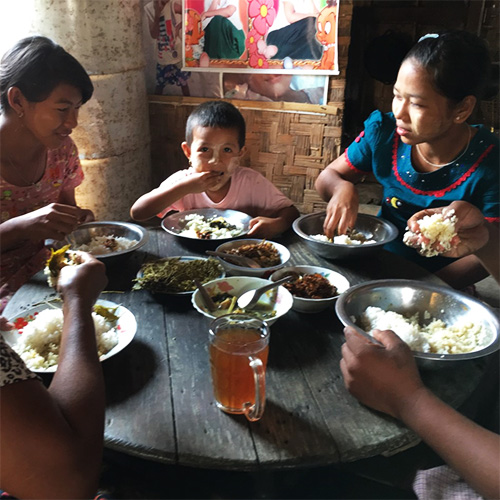
Ma Nang and her family enjoy lunch together. Photo: CWS
CWS efforts in Myanmar positively impacted 28,685 people last year.
In Myanmar, providing for “our children, who are our hope and our future”
Nang Aye Khaing – commonly referred to as Ma Nang – is 38 and lives in Auk Htone village in Southwest Myanmar with her husband U Aung Min. They have three children: a 17-year-old daughter and 11- and five-year-old sons.
The family runs a small grocery store and basket weaving business from their home which, alarmingly, has lost six acres of arable land due to erosion caused by the Ayeyarwady River. This means that the family has become quite poor and, because of their situation, Ma Nang was invited to join newly introduced CROP development activities for especially vulnerable families in her community.
A key introductory activity was one that Ma Nang could have benefited from a long time ago for her older children: information sharing on nutrition. She is still happy to learn now and apply what she is learning to help her five year old, who is already benefiting. She says, “I have learned more about how better nutrition is important for child growth and development at all life stages, and of course I want my children to grow up healthy. So what I have learned about disease prevention and personal hygiene, in addition to what I now know about good nutrition, is also all important to us all. I have shared new information with my whole family and we practice being more healthy at home: hand-washing before and after meals and after using the toilet, for example. And we eat as well as we can, especially now that I am part of a Self Help Group for home gardening and chicken raising – thanks to help from CWS.”
As a Group leader, Ma Nang has big plans to organize monthly meetings among 26 mothers in her village and to reinforce the good hygiene and nutrition lessons she has already learned for, as she told us, “our children, who are our hope and future”. She also said, “We are committed to continue home gardening and chicken-raising and to share our knowledge and skills with other families.”
Stories of Change
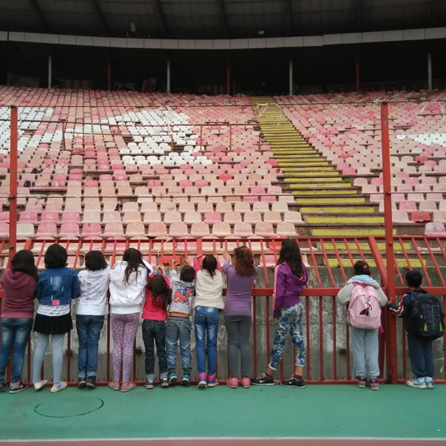
Drop-in Center attendants during one of the many CYI outings, in this case visiting a sports stadium. Photo: Center for Youth Integration
Literacy practice and homework assistance activities are conducted daily for the 50 to 70 children who come to daily drop-in shelters.
In Serbia, helping kids be kids
The CWS Children on the Move program is designed to provide care and social and educational inclusion for children living or working on the streets or other extremely vulnerable children in Serbia. This is implemented through our local partner, Center for Youth Integration. CYI operates drop-in shelters for these children. This is the story of a family whose children have benefited from that shelter.
The family of nine live in a house that is just over 320 square feet and has no bathroom. The family includes a mother, father, grandmother and six children. The family now sends four of its children daily to one of the drop-in shelters. But prior to finding a safe space within the shelter, the children had worked on the street for years, usually re-selling tissues and other cheap goods.
At the beginning, it was very difficult to approach the family. They were suspicious of outsiders. Adults and children often avoid any contact with “outsiders” for fear of them being representatives of state institutions and the risk of children being taken from the parents or being otherwise reprimanded. The father and grandmother were thus always present while children were working to keep an eye on them.
The children were afraid and mistrustful every time outreach workers visited them on the street where they worked. But the children were also ashamed if their schoolmates saw them working or if it was talked about in front of other students at school. It was very hard for them to find a place and time to feel safe and secure. They were constantly worried about the family’s finances, which no child should need to worry about. Because of this financial responsibility, they often missed school and every time they showed up in school it was even harder than the last time – having to catch up on the school curriculum and always lagging behind while other pupils were making progress. It was really hard for them, and they often felt excluded. They were constantly at risk of dropping out completely.
It took the outreach team more than 15 months of weekly visits to spots where the kids used to work until they succeeded in getting the children to visit the drop-in shelter and convince the parents to allow them to come. From that day until now, the children are coming to the shelter every day. With support from CYI staff, they are coping with homework, peer relationships and conflicts, and they are dreaming about a brighter future.
Ljupka is a really friendly 12 year old girl, and she has a few best friends in the shelter. She likes to take walks with her friends and to visit the concerts that are organized in a shopping mall in their neighborhood during weekends. She also likes fashion and hairdressing. Ljupka takes good care of her younger brother and sisters when their parents are not around.
Tanja is 11 years old and is their mom`s favorite. Or at least that’s how she tells it. She is a good friend and likes to be appreciated for that and for her outstanding sense of justice. She is regular at school and, like her classmates, she is trying to understand geometry and learn musical scales.
Joka is the youngest of the four. She is nine and looks up to her older brother and sisters who help her with homework because she takes school very seriously. Every time she comes to the shelter from school she is so excited to tell us daily news in detail.
Bole is a 14 year old who loves computers and IT. Now he is regular at school and would like to be a software developer. Thanks to our volunteers and supporters, Bole got an offer for a scholarship to a prestigious IT high school. He will be the first child among all beneficiaries of the past 10 years to attend such a prestigious school and one of the rare kids that will continue with education after primary school. His mother says that he is her prince.
Today, the parents are taking care of the financial needs of the family while the children focus on school and being children.
Stories of Change
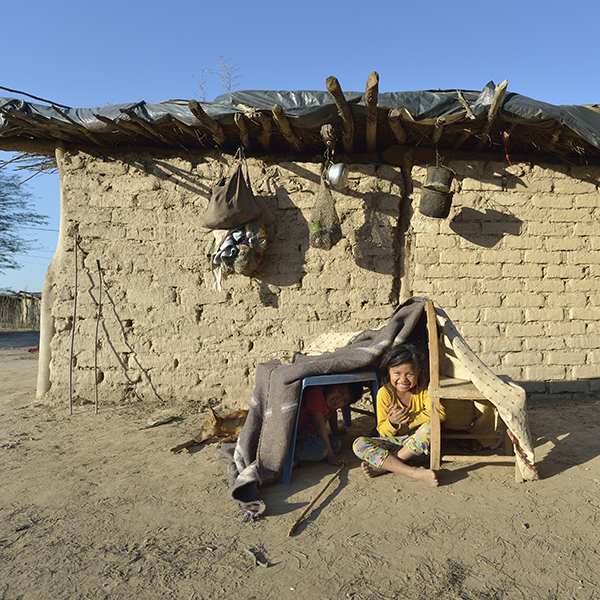
CWS and partners are helping to ensure water access for remote communities in the arid Gran Chaco region of South America. Photo: Paul Jeffrey / CWS
At any time, about 50 communities are participating in CWS-supported programs in the Chaco.
Water in the Chaco
Twice the size of California, the South American Gran Chaco is the second largest forest reserve in South America. It is an immense and scarcely populated region, many parts of which are dry and arid. The residents of the Chaco include campesino, or farmer, families and indigenous communities. The small and dispersed communities often face deep poverty.
CWS has worked in the Gran Chaco since 2005 to build the skills and expertise of indigenous men, women and youth to advocate effectively for their basic rights and their ancestral lands. These rights include water, education, health, food and a life free from violence and discrimination.
Meeting after meeting and visit after visit, one top priority emerges from residents in the Gran Chaco, particularly its women. Water.
Securing access to potable water for all campesino and indigenous families in one of the driest districts of the Gran Chaco requires overcoming a number of challenges. The largest is drought – the region faces up to six months without rain each year. When rain does come, it is torrential and short-lived. The underground water sources are scarce, salted and have high levels of arsenic. They are unsafe for human consumption and are insufficient for animal or crop production. When underground water sources aresafe, digging wells is expensive work. With the population scattered in tiny rural communities, distance becomes a challenge, and it is impractical to think large-scale solutions like one water system or well can effectively serve multiple locations.
There are rivers in the region, but they are miles away and with erratic streamflow. For the 2000 people in the town of Los Blancos, for example, the nearest rivers are the Bermejo River, located 30 miles away and the Pilcomayo, which is 62 miles away. For years there has been talk of channeling the Bermejo to serve the community, but this would be a large scale and expensive undertaking with lots of opportunities for corruption.
The recently formed Water Roundtable of Rivadavia in Argentina’s Salta province is a government and civil society partnership aimed at addressing these challenges and prioritizing access to clean water in a transparent manner. The CWS-supported local organization of Fundapaz is a driving force behind the roundtable, and CWS is one of two international observers invited to accompany the process.
The first step in securing clean water access is to understand where current water assets like cisterns, wells and reservoirs are and where there are needs. Fundapaz uses participatory mapping, GPS and Geographic Information System, or GIS, technology to create the needed maps together with the communities. So far, Water Roundtable members have mapped more than 1,000 locations where water systems are needed.
Enzo is one of those who are in charge of the mapping project. He loves to spend time in the communities teaching youth how to use the GPS equipment and programs like Google Earth Plus to create maps of existing water assets, forest reserves, grasslands and the sites of current and future schools, clinics and houses. Community members have used these maps to negotiate with authorities regarding issues such as road maintenance, water reservoirs and rural electricity.
One water system stands out from other options as a small-scale, durable and high-impact investment: rooftop rainwater catchment systems. This area receives 19-23 inches of rain each year in a short burst of precipitation. With better systems in place to capture and store rainwater, many water needs would be addressed. For every 10 square feet of harvesting surface, 19-23 gallons of water can be captured. With basic maintenance and management, the stored water is safe for consumption.
With support from CWS and Foods Resource Bank, Fundapaz will build systems that can hold more than 4,200 gallons of water each. In the next two years, these systems will be built for eight campesino families and four indigenous communities. Additionally, broken systems on schools and community centers will be replaced. In part with CWS and FRB support, Fundapaz and other Water roundtable members have already completed or repaired 25 rooftop rainwater harvesting systems to increase the harvest and storage capacity by 160,000 gallons. Cisterns are built by local crews of both campesino and indigenous workers, who are trained by more experienced builders. Each time a cistern is built, a local community team learns to replicate the process so they can build cisterns on their own. Peer learning opportunities are also a staple of this program.
Bautista is 20 and lives in a small community of only 70 people that just built its first rainwater catchment system. When asked which water he prefers, the water from the new system or the water that used to be brought in and stored in plastic tanks, he smiled and replied that he likes water from the new system better. In his words, it is sweet and cool. Communities contribute to the new systems that Fundapaz builds, and Bautista’s was no exception. He and a neighbor walked several hours to get posts to hold up the roof over the system.
This kind of neighborly cooperation is common in these projects, but that hasn’t always been the case. Historically, tensions have been high between campesino and indigenous communities because of struggles for land tenure and natural resources. Now, they often work together for a common goal. During the last roundtable meeting, an indigenous leader said, “We all have the same right to water.”
Rooftop rainwater harvesting is not a silver bullet for meeting water needs in Salta and throughout the Chaco. There isn’t one. But when systems like wells, reservoirs, drip-irrigation and rainwater catchment are used in conjunction, real change is possible. We can make sure that more families across the Gran Chaco region have the systems and training that they need to have enough water year round. We have made tremendous progress already, and we’re continuing the momentum thanks to our partners and supporters.