Stories of Change


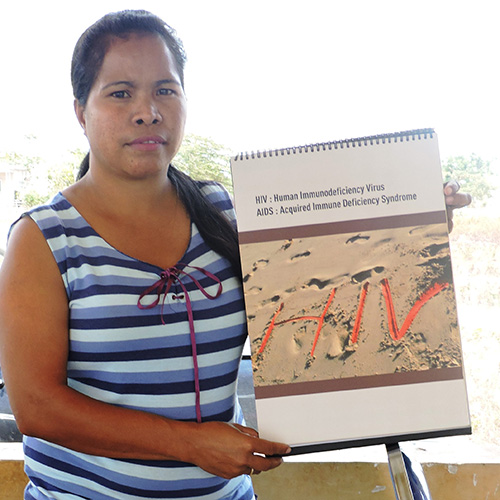
Ana Monica da Silva.


CWS's HIV prevention education and action program reached 1,970 people in 11 communities directly in the last year. It reached hundreds more in cities where World AIDS Day events were held.

Spreading the word

Ana Monica da Silva is married to a Timor Leste soldier, and they live in a military housing complex in Baucau, which is the country’s second largest city with about 16,000 people. In September, Ana joined 25 others for an HIV prevention information-sharing session led by Pvt. Monica Freitas Belo. Pvt. Belo  had earlier joined a CWS-supported Training of Trainers workshop so she could facilitate HIV information-sessions for her fellow soldiers and their families.

“The first time I heard much about HIV and AIDS and other sexually transmitted infections was a year ago,” Ana recalled, “and I got my information from the media and from a CWS-published brochure. I’m happy that our army now has volunteers like Pvt. Belo to share details about this important information with soldiers and our families. More spouses now have access to this information, as do their siblings and our older children – not just about HIV and STI, but also about sexual and reproductive health, which is great.” And, “since some of my neighbors have not heard this important information yet, I have started to share what I now know with them to help them protect themselves and others from HIV and other STI, too.”


Stories of Change


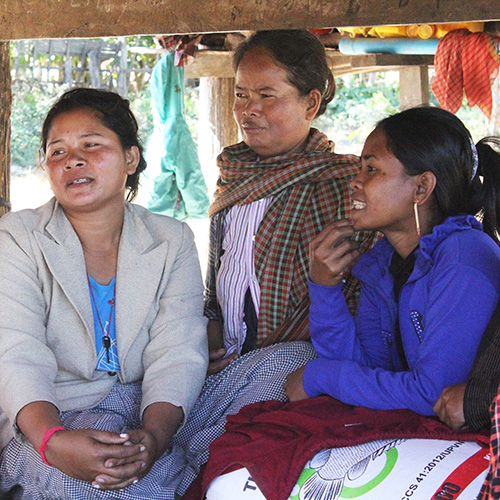
The women of Robonh Samaki during a group meeting.


This year, CWS programs in Cambodia reached 21,373 individuals in 83 communities.

Building each other up, one month at a time

In northern Cambodia, where CWS team members support our Promoting Better Lives project, a group of women have been meeting monthly for several years now to review and discuss their shared savings through Robonh Samaki (“Village Solidarity” in English), which is one of 49 similar groups that CWS supports.

When families in the village need cash, they know there are money lenders and even local microfinance institutions to approach. But most people dislike both options because loan terms are onerous and they feel it is too risky to use their scarce assets – a cow or their land – as collateral.

To help address this challenge, which is a perennial one in Cambodia, CWS has worked through the years to help villagers, women and men alike, start savings and lending groups which use mutual trust as their collateral.

Robonh Samaki was formed when the Village Development Committee members shared information about the possibility and benefits of such a group, and then called for volunteers to form groups. The group members learned from CWS how to run the group: setting rules, learning basic bookkeeping and electing leaders. The women who formed Robonh Samaki wanted the chance to learn more about ways to save. They also wanted to have the opportunity to borrow money to start or expand their micro businesses and home gardens or pay for their children’s education or an emergency. Some wanted to save for a ‘rainy day.’

With the closest bank being more than an hour away – and even if they went to bank, it wouldn’t offer affordable loans – the group also gave the women a low-cost alternative to earn interest on their savings. There is no minimum amount to join the group, but then each member must deposit the equivalent of $2.50 to the group on the first of each month. The group savings pool then earns interest on the total deposits and loans out to members. For example, if someone borrows $25 for three months she repays 50 cents interest each month to the group savings pool, and the $25 at the end of the three-month loan term. Term lengths can vary, but the interest rate stays the same.

The 13 founding members of Robonh Samaki have built security nets for their families and made money available to invest in improving their livelihoods and well being. The group happily reports that they have never had any one default on their loans.


Stories of Change


Chanrith near her home in Anglong Thma.


This year, CWS programs in Cambodia reached 21,373 individuals in 83 communities.

For family, and for community

Ngin Chanrith, 50, lives with her husband Bun Heang in Anglong Thma village in central Cambodia near their two sons and two daughters, who have families of their own. Heang is the village Chief, while Chanrith drives a motorcycle taxi to earn about $5 a day to supplement their income. To help her community and extended family, Chanrith also joined the CWS-supported Village Health Support Group to raise awareness about health issues affecting the community and, importantly, the value of using available care to address concerns of maternal child health, primary health and nutrition.

With information and support from CWS staff and government health workers, Chanrith visits her neighbors and other community members to share her knowledge and give people the chance to ask specific questions and learn at their own pace.

When asked about the impact of the Anglong Thma—CWS partnership, Chanrith noted, “There are many improvements we can see in the village since we began the Village Health Support Group. People have received good information, and both personal and household hygiene have improved. Now we do not have as many cases of diarrhea as in the past, as families know to wash their hands frequently – and with soap – and to drink filtered or boiled water only. Also, young child health has improved and, according to the regular growth monitoring, there are no underweight children.” This is due in part to lower diarrhea incidence (from better hygiene) and also from improved diets and healthier meals, which mothers have learned with CWS support and group teaching-coaching.


Stories of Change


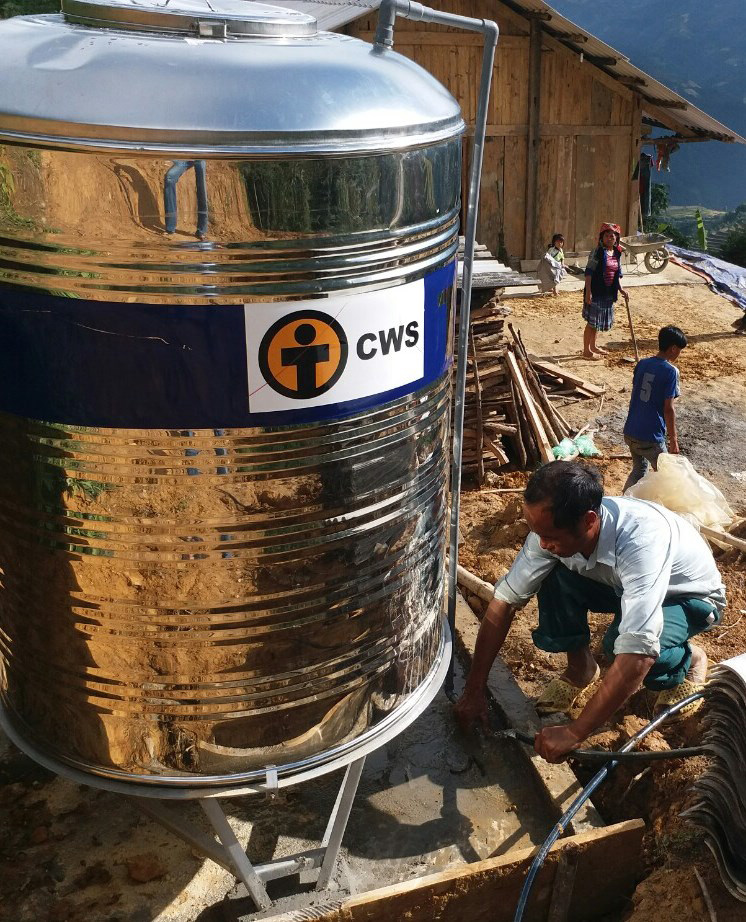
The new water tank at Xay's family's house.


Between July 2016 and June 2017, CWS responded to emergencies in Haiti, the United States, Japan, Myanmar and Serbia.

Building back better after flash flooding in Vietnam (2)

Thao Thi Xay, 37, lives with her three children in Yen Bai province in northern Vietnam. Her husband works as a day laborer away from their remote mountain village. That meant that he wasn’t with his family on the morning in early August when flash flooding devastated their lives.

Xay recalls hearing an unfamiliar rumbling sound that morning. Then she saw the water. It was rising rapidly all around her house, and then it flooded into the home. She and her oldest child had just minutes to scoop up the younger children and climb a nearby hill for safety.

From the hillside, Xay could do nothing but cry as she saw the house and all their property swept away. And, having lost everything, she and the children had to take shelter along with many others in a school for more than three weeks. The place was safe, but several families shared each classroom, and there was no place to cook and no clean water except rain water for drinking.

Still, Xay felt lucky jut to have survived. And before too long, her husband was able to return home to the family. They received help from relatives and outsiders to rebuild a new house in the high mountains. Once they had their new house, Xay was even happier when our CWS team visited to share a hygiene kit and also to offer more long-term support – a 1,000-liter water tank, which will help her and the children have a better home life in the future.


Stories of Change


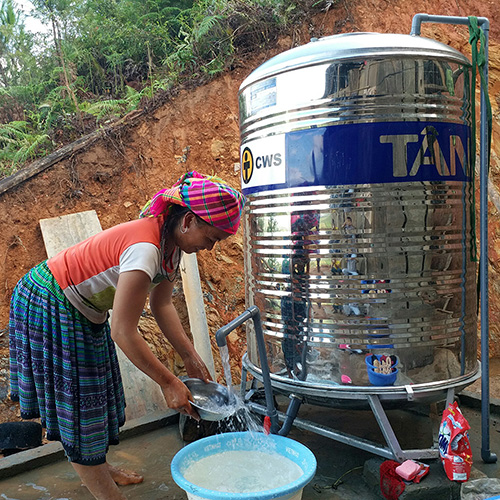
Vau using her family's new water storage tank, which was provided by CWS.


Between July 2016 and June 2017, CWS responded to emergencies in Haiti, the United States, Japan, Myanmar and Serbia.

Building back better after flash flooding in Vietnam (1)

“Since we have this water tank, our family always has enough water to use whenever we need it. Also, I love bathing here at home after working in the field and not having to wait until it gets dark so I can go to the stream for that.” – Sung Thi Vau

Like many H’Mong couples, Sung Thi Vau and her husband made a small wood house and settled in to live in a small village near a stream in Mu Cang Chai in Vietnam’s northern Yen Bai province. They have two sons who, besides taking time and being lucky enough to go to school, often help their parents working in the field. Their life is hard, but peaceful.

That is, it was peaceful until one night in early August, when Vau awoke with a start. She heard a loud noise and then saw water rushing under her bed! Vau and her husband had just enough time to pull their sons out of bed, too, and then the whole family ran up the nearby hill.

When they looked back, their house was collapsing under the furious flash flood.

All they could do was weep at seeing everything they owned swept away in an instant. Their stored rice and corn were gone. So were their animals; they lost two buffaloes, four pigs and a flock of chickens that night. The family was fortunate to stay with their relatives for some time, and thanks for support from relatives and neighbors, they have now made a new house in a safe place on the hillside.

Life is now getting back to normal for the family, and CWS support is helping them build back better. First, it was a simple hygiene kit. Then it was a 260-gallon water tank. Having noted the clear benefits of having a water storage system that is safe and close at hand, Vau was eager to hear from CWS WASH Officer Nguyen Van Ty about now to make a sanitary latrine so her family can also stop open defecation and continue to make positive progress.  Despite all the loss – which will take a long time to recover from – we are proud to have brought the family a measure of hope.


Stories of Change


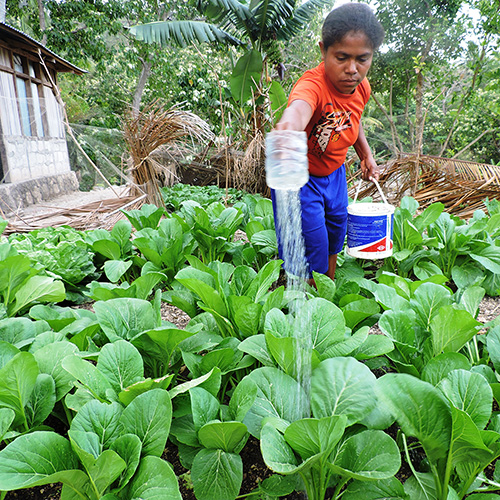
Abdonia in her garden.


Through the CWS Timor Zero Hunger program, 348 families with children under five have improved caring and feeding practices for these children in the last year.

One small part of the “Zero Hunger” equation

Abdonia Liufeto is a young farmer in Saenam village in West Timor. She and her husband, Absadon Tefa have a daughter, Anisa, who is almost two years old. Saenam, like most villages in this remote part of eastern Indonesia, is prone to polar opposite natural disasters each year: drought and floods.

Additionally, many people don’t have access to clean water, and there aren’t many latrines in the community. Open defecation is common. Other conditions of rural poverty and isolation are evident in the area, too.

Of concern to Abdonia and Absadon is the way that all these things lead to malnutrition in young children, and so they worry for Anisa. By joining activities in the Timor Zero Hunger project, though,  Anisa’s parents are now raising chickens and planting a variety of nutritious vegetables for her.

“We used to plant only cassava and papaya, with those leaves our only vegetables,” remembers Abdonia. “We now have many different vegetables, and we also know how to plant and care for them well by making and using organic fertilizer and using our water wisely. Since we started our garden just six months ago, we have already harvested four times, and what we don’t eat ourselves I have been able to sell in the market to earn almost $40, which I’m saving to protect Anisa’s health even more by improving our latrine.”


Stories of Change


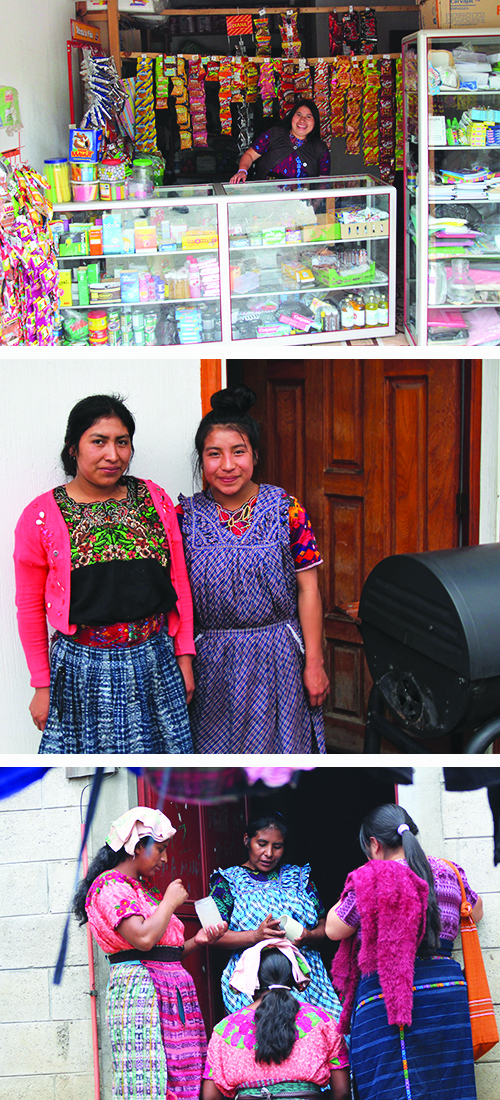
Lucia (top), Juana and Catarina (middle) and María Francisca (bottom) at their businesses. Photos: Bethany Beachum


CWS and CIEDEG helps support 700 members of local indigenous associations in Guatemala.

Business training supports women, families, neighbors and communities in Guatemala

In much of Guatemala, men and women are treated very differently, particularly in indigenous communities. Women don’t share their opinions in public meetings, and they are responsible for maintaining their households but not earning income. They have very little power.  

With generous support provided by Foods Resource Bank, CWS and partner CIEDEG are working to provide women with more opportunities to provide for their families, earn income and have their voices heard. In 2014, CIEDEG held a business training workshop for indigenous women so that they could open additional channels of income for their families and become more self-sufficient. The workshop covered marketing, calculating direct costs and indirect costs, investing and the characteristics of entrepreneurs. There was also a “context analysis” portion of the training where the women focused on their own communities: what needs are there in my community? What type of business generates profit here?  

Three years later, that training has been the bedrock of new businesses and brighter futures for the participants. Lucía Lòpez Lòpez lives and has her business in the community of Toj Mech in the region of Quetzaltenango. She opened a store a year ago with her sister as her business partner. The women invested in shelving and converted the front space of their home into a convenience store that sells refreshments and household products. They recently expanded the store to include a section for school materials like pens, paper and pencils. 

Six months ago, Juana, Catarina and Santa Lopez Garcia – sisters who also live in Toj Mech – opened a restaurant. Juana participated in that CIEDEG training, and she has put into practice the skills that she learned. The restaurant is on a corner of the central street in Toj Mech and serves a variety of meals and snacks that the women make. Juana tries new recipes from the internet for their restaurant, which they have named Antojitos Lopez. 

María Francisca Pérez Aguilar is also running a thriving small business. She was not part of the CIEDEG training, but she received her training from someone who was. This new information and skill-building ripple out into the community. María Francisca lives in the town of El Rincon and is a single mother of five children. She makes and sells soap and hair gel. Most of her clients are neighbors who hear about her products by word of mouth, but recently a beauty salon began to stock her hair gels. She started experimenting with hair gel because it is much faster to make and sells for more money than the soap. The shop income is vital for her family; she has used her earnings to buy pigs and then sell them a few months later for profit and a plot of land where she is growing vegetables from seeds also provided by CIEDEG. 

The women that we have talked to report that they use their earnings to pay for expenses so their children can go to school and grow up healthy and strong. The impact of each training increases exponentially as it begins to lift up women, their families, their neighbors and whole communities.  


Stories of Change


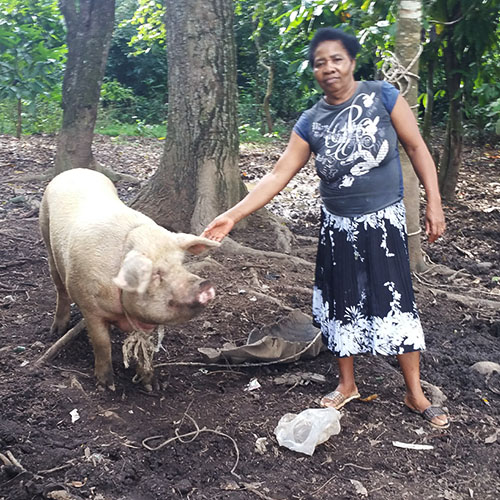
Juliana with her pig. Photo: SSID


This program reached 465 families in 22 communities.

Pigs: a gift with a ripple effect in the Dominican Republic

Sometimes a single gift can have a ripple effect. That is certainly the case in the Dominican Republic for families participating in a CWS- and Foods Resource Bank-supported program. Through a partnership with Servicio Social de Iglesias Dominicanas, this program reached 465 families in 22 communities in a three-year period.  

So what was the gift that kept on giving? In this case, it was pigs.  

Families who received pigs paid for them by giving piglets to their neighbors and thus enabling more families in their community to raise and sell pigs. Ramona Mota is a widow with three children. She first received a pig five years ago. When 13 piglets were born, four were passed to neighbors. One died, and the remaining eight were sold for $42 each. She used that money to invest in more animals. She says that she has now sold more than 50 animals and made more than $4,000. All from the gift of a single pig. 

In the nearby community of La Maya, Juliana de León is also a mother of three. She was also given a pig through the program, and she has been able to sell 23 of the pig’s offspring for $27.50 each. Plus, she gave piglets to six neighbors to raise for their own income. She has made $620 from selling pigs, which she has used to buy pencils, notebooks, uniforms, backpacks, shoes and transportation for her sons to attend school.  

For both women, the impact of their income goes beyond just the supplies they can now buy. For Ramona, it means independence despite being a widow. As project agronomist Silverio Agramonte says, “Becoming a widow did not prevent her from growing her business with the help of her three children and neighbors that she hires as day laborers when she needs extra help.” She now has nearly 100 animals.  

For Juliana, the pigs have brought her home. She used to work as a domestic worker in the Dominican capital of Santo Domingo and commute back to her community on the weekends. Now, she is able to stay home with her family. Like Silverio says, “Pigs brought Juliana back to her community.”  

In the same way that Ramona used her income to invest in additional animals – and thus additional income – Juliana also uses some of her income to invest. “I used some of the money to solve household problems and also to stock a little store I have at home,” she says. Silverio explains, “Juliana’s husband helped her to open a family store, so with the income from pig-raising and the small store she makes as much or sometimes more than what she was making as a domestic worker in the nation’s capital.”  

Two mothers and two mother pigs. Together, they reunited a family, started a store, enabled two boys to go to school, yielded more than $4,600 in income and helped a business grow and thrive. They also afforded the same opportunity to 10 other families – and those gifts will keep on going. 


Stories of Change


Cilio looks at a fruit tree on his property. Photo: SSID


This program reached 465 families in 22 communities.

The resilience of diversity in the Dominican Republic

For many rural families facing food insecurity, livelihood diversification is the key to building resilience. If a family has more than one source of income, an upset in one stream will be somewhat mitigated by the income from the other. If they are growing multiple crops throughout the year, a single bad harvest or tough season won’t be as devastating.

This is the philosophy behind much of a CWS and Foods Resource Bank program in the Dominican Republic, which is implemented by Servicio Social de Iglesias Dominicanas. We partner with families to give them chances to work together and learn from one another, to better market crop surpluses, to start micro-enterprises through livestock and to access information and training on health and nutrition. We’re hearing from families that this diversification is making a big difference.

Emilio Fivena, from the community of Los Jovillos, had a tough year because of circumstances beyond his control. He is part of a farmer’s group in the program and has diversified his crops to include cassava, corn, potatoes, bananas, Gandul and chinola. The weather was not on his side this year, though. First it was heavy rains that damaged his field, and then it was prolonged drought. He was able to sell very little of his produce.

However, Emilio also received 10 hens through the program. He cares for them and uses the eggs to feed his family. In spite of the tough climate conditions, Emilio says, “I need to acknowledge and be thankful because with the little production I had plus the egg production project, I had enough for me and my family.”

For Cilio Idovi in the nearby community of Bermejo, diversification has led to greater prosperity. Project agronomist Silverio Agrimonte says, “Cilio inspires his neighbors, as he was very open to diversifying his plot with cacao, plantain, ñame, malanga and a variety of fruit trees. Today he has a quite diversified agro-forestry farm.”

Cilio, a father of four, cares for three acres of land. One and a half are his, and the rest belonged to his father, who passed away recently. Now he cares for the land for his mother. “I see in my plot the result of the training and ongoing advice from the project´s agronomist. I have enough to feed my family, sell and even share with my neighbors. Thanks to God my land always gives me enough to feed my family. Thank you very much for all that you have done for my benefit and for all the farmers of this community, because through your intervention, our families do not suffer from hunger,” he says.

When times are good, livelihood diversification means having enough to share. When they aren’t, it can mean the difference between having enough to get by and being left empty-handed. For Emilio, Cilio and hundreds of other families across the Dominican Republic, a partnership with CWS, FRB and SSID means building both diversity and resilience.
Stories of Change


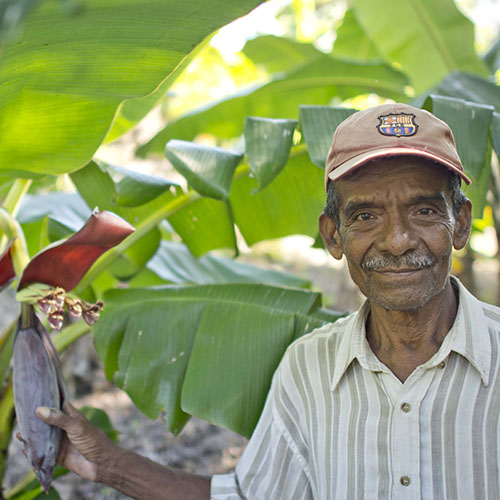
Felix, another farmer in the program, on his farm. Photo: Alex Morse / Foods Resource Bank


Led by Church World Service with local partner CIEETS, the Foods Resource Bank Nicaragua Mateare Carazo Program encompasses 8 communities, 220 households and 1,251 individuals.

Source: Foods Resource Bank

Faith and farming empower communities

This story was originally posted by our partner Foods Resource Bank. 

Pastor Santiago is the spiritual and community leader of a place called Las Cabeceras. A farmer himself, he uses his influence with his deeply devout community to address water scarcity and prolonged drought and bring about real improvements in people’s lives. As he puts it, “We are all responsible for caring for Creation.”

Program communities are often cut off from the rest of the world by distance and impassable roads, so people depend on each other for their survival. Santiago is one of 20 active community organizers and promoters in the FRB food security program, and encourages neighbors affected by the three-year drought to find ways to become more resilient.

Santiago came to Las Cabeceras 15 years ago because of the good conditions for agriculture – fertile soils and plenty of rain. However, in the last six years, yields have been declining as result of the combination of very high temperatures and poor rain patterns, which in turn have resulted in severe economic losses.

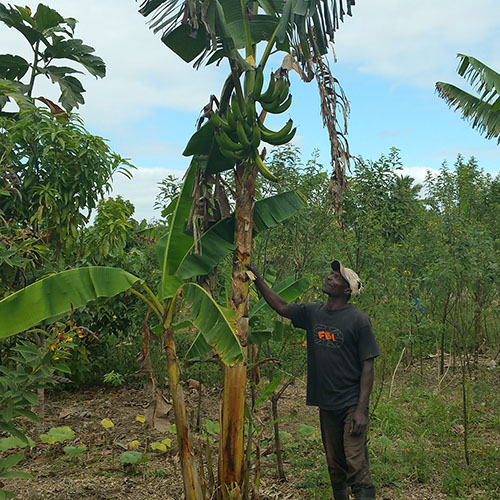
Since Santiago joined the program, he’s better able to support his family economically with his “diversified farm,” growing maize, beans, sorghum, banana, cassava and more so that he still has food if one or more crops fail. Farmers are finding solutions to water scarcity, improving soils, protecting their watersheds, engaging in reforestation, and experimenting with a variety of climate-specific seeds and seed banks.

He says, “The hands-on Farmer Field Schools in the program are important because they allow us to come together and look for a solution to a common problem like the drought. We share our ideas and experiences and reinforce the need for everyone in the community to seek compromises and solutions.”