Stories of Change


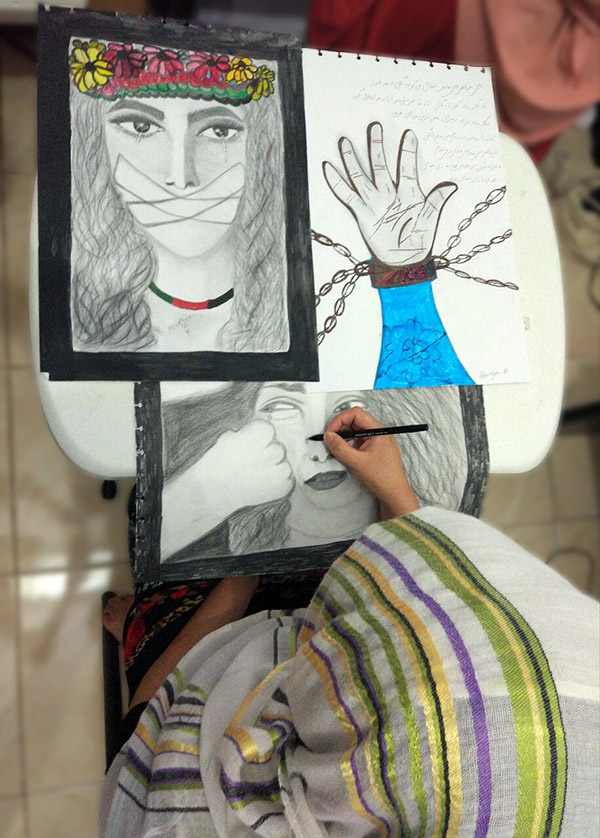
Laila works on her sketches for the 16 Days of Activism campaign.

A young asylum-seeker is raising her voice for her sisters through art and poetry

“This issue gets worse day by day, and I hope my story will not just raise awareness but will give strength and hope to victims.”

Laila* is talking about gender-based violence, which she experienced in its most horrific form a few years ago.

The oldest of seven children, Laila grew up in the isolated and conservative central highlands of Afghanistan. In her community, girls are discouraged from going to school. Traditional thinking and local leaders still insist that women should not have the same rights as men.

Luckily, Laila’s own family was more open minded. Her father is a teacher and an advocate for women’s and girls’ education. Because he spoke up about this, his family received threats. One afternoon a few years ago, those threats turned to action. Laila was kidnapped when she was walking home from school. For three months, she suffered unimaginable abuse. Finally, one evening, she was able to escape. The men who were supposed to be watching her got into a fight, so she seized the opportunity to sneak out of the house. She recognized the neighborhood as one about two hours from her home, so she ran back to her house. Her family was amazed and relieved to see her, but they knew that it wasn’t safe for her to stay with them. As countless fathers of children in danger have done before him, Laila’s father arranged for a smuggler to get her out of Afghanistan to India and then on to Malaysia and eventually Indonesia.

When she arrived in Indonesia, Laila made her way to the United Nations High Commissioner for Refugees to register as an asylum seeker. After she registered, she was directed to a CWS-hosted group home in Jakarta, which is operated with generous support from the Australian government.

For the first time in her teenage life, Laila felt the tension leave her body.

“I felt free, which is such a great feeling. Everyone is respectful towards one another. I’m feeling so relieved because I’m in a respectful society where men and women are seen as equal.” In her new home, Laila, 17, is with other Afghan girls as well as women and girls from other countries, too. “It is nice to live in a multicultural home, learning about and respecting other cultures. I am missing my family a lot, and I cry many nights. On these nights, even the non-Afghan girls from Somalia, Ethiopia and Iraq all comfort me, and this shows me one thing: that we are in this together regardless of our background,” she says.

Laila is on a path to healing in the CWS home. As soon as our team heard her story, we worked with counselors to find a way to support her. “The first thing that CWS did after I shared my story was to send me to a psychologist,” she says. “And it helped me so much. The psychological counselling, and the daily comfort and assurance from my Social Workers helped me get my mental state better every day. I talked a lot to my Social Workers, too! They are both so kind and understanding. Coming from my area, it was hard to trust anyone, but I trust all of them absolutely and will do whatever they said is necessary, because I know their intention is good, and that is to help me recover. I am grateful.”

The 16 Days of Activism worldwide campaign runs from November 25 through December 10 each year – from the International Day for the Elimination of Violence Against Women to International Human Rights Day. CWS encouraged all of the children and women living in the group homes that we host to participate in the campaign. Laila created three pieces of art and wrote a poem for everyone who face, survive and overcome violence against women and girls.

This was her poem:

For all women, do not keep quiet.
Raise your voice, because your Rights are equal.
It is time to find yourself, because you are not someone that just does whatever a man says.
Women too are powerful.
Raise your hand and make your future better.
Do not keep quiet, even when they have handcuffed your hand.
Being a woman is not a crime.

Laila started writing poetry when she was eight years old. She saw too many tough moments around her, such as girls being forced to marry at young ages and girls who weren’t able to go to school. For Laila, her poetry was a way to escape. She writes poems to express “the pain of others, and things that she saw and experienced.” She says, “I want to be the voice of all women who can never speak up, those who keep their pain inside, and for those whom will get punished and excluded for speaking up.”

Laila wants to share two of her poems and the stories behind them:

—-

Afghan Women’s Pain

Thousands of words are captive in their throat
I am a woman, the piece of Farkhunda’s body I am

I am a woman, the generation of aggrieved Farkhunda I am
I have been under violence for years

I am a woman, from the poor, pity generation I am
I am a woman on the awestricken road I am

I am a woman, the generation of Aisha and burnt Farkhunda I am

I have been under perverted eyes for years
I am screaming but nobody hears me, I am a woman

Yeah! The generation of poor Farkhunda I am

Laila explained to our team that this poem is about two real Afghan women, Farkhunda and Aisha. A Mullah falsely accused Farkhunda of burning the Qur’an. The gathering crowd, not understanding what was happening, sided with the Mullah after the Mullah yelled to the crowd that Farkhunda had just burnt a Qur’an and thus must be killed. The angry crowd savagely killed her. Later investigation revealed that Farkhunda did not burn the Qur’an. Bibi Aisha case is slightly more well-known, as she appeared in the cover of TIME magazine. Aisha’s face was mutilated by a Taliban, after her father ‘traded’ her for marriage to a Taliban fighter in compensation for a killing that her family did. Aisha managed to run away and returned to her family, but her father returned her to her husband’s family. As a punishment for running away, they brought her to mountain side, cut off her nose and left her to die. Luckily, she was found by aid workers, managed to heal and is currently living in the US.

—-

Afghan Women

Gloom of a woman has stories
Being a woman in my country is harrowing
Pains of tears after tears, being a woman is harrowing in my country

Afghan women have silent and bitter songs
Their life has thousands of journeys
In my country, how else can women suffer?

Laila interprets her poem like this:

– Being a woman in Afghanistan means that you likely won’t be able to access education or participate in society.
– Being a woman in Afghanistan is like being a bird, which can sing and make music. But in Afghanistan that song is sorrowful.
– Being a woman in Afghanistan means your voice is always silenced and you can’t sing your songs.
– Being a woman in Afghanistan means a thousand rough “adventures” but not being able to speak about it. On the inside, they are burning.
– Violence towards women in Afghanistan is widespread, even today.

“I want to be the voice of all women who can never speak up, those who keep their pain on the inside and those for whom if they speak up will be stigmatized,” Laila says.

*Name changed to protect identity.

Stories of Change


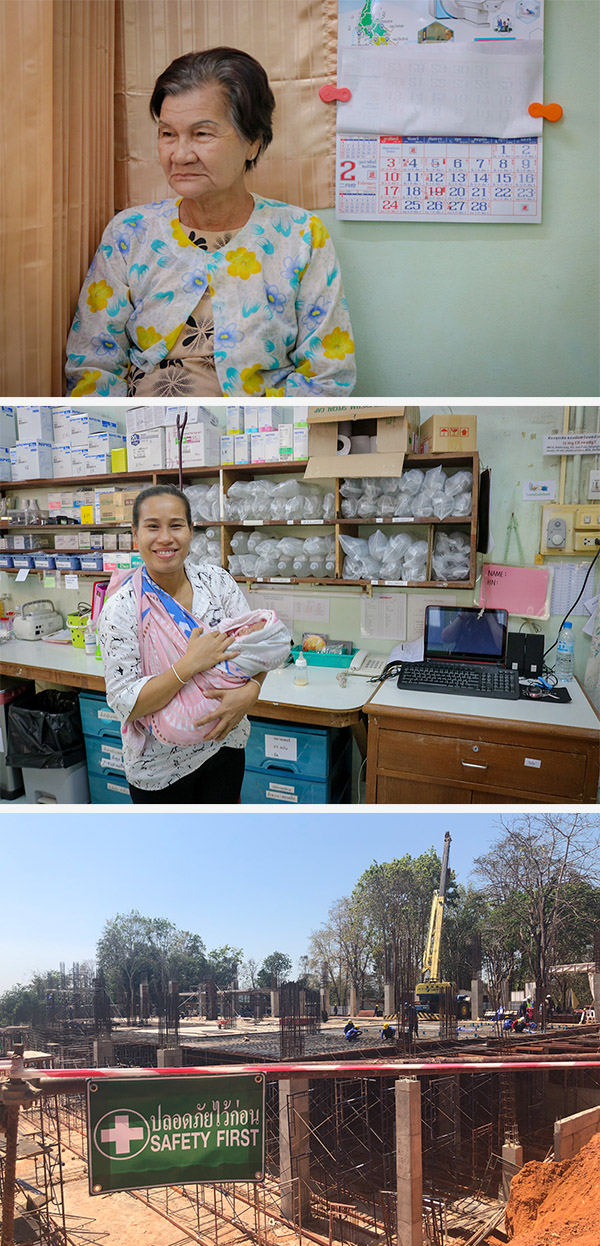
Top: Saw Myint says her whole family has come to Kwai River Christian Hospital for decades. Middle: a new mom and her 3-week-old daughter in one of the hospital's exam rooms. Bottom: Construction is underway of the new Kwai River Christian Hospital location.

A Day at Kwai River Christian Hospital

It’s another busy day at the rural Kwai River Christian Hospital in Thailand, near the border with Myanmar. It’s a small facility with a big job: taking care of people with lots of different needs.

The hospital receives about 20,000 visits each year, which is more than 50 a day. Some of the patients are Thai and live in the community around the hospital. Others are refugees from Myanmar who live in a nearby camp; when someone from the camp needs advanced care, they come to KRCH. About 20 miles away KRCH staff are working in a border clinic, screening new arrivals from Myanmar and sending them on to the main hospital if they need more care.

Saw Myint came to the hospital today because she is experiencing bad back pain. Originally from Myanmar, she moved to this part of Thailand more than 50 years ago. She comes to KRCH often, and so does her whole family. Saw Myint says she especially appreciates KRCH because the staff prioritize taking care of their patients, and everyone working here is kind.

Down the hall, a new mother beams while talking about her 3-week-old daughter. They live a couple of miles from the hospital, and their whole family comes to KRCH when they need care. The team here really cares about their patients, she says. If you miss an appointment, they will follow up with you to make sure you can still get the care you need.

Sirikanlaya Prakunwiset is a pharmacist on the hospital staff. She remembers an older patient who had a number of medical conditions. One day she came in with a new problem: her leg was swelling and was very painful. The problem was that the usual medication that would normally be prescribed was too strong due to her other conditions. The doctor was able to find her a different medicine, and she got better. For the team at KRCH, finding the right care for each patient is a top priority. In fact, Dr. Yotsapat Kwonkerd says that it’s his favorite part of his job. He says he enjoys monitoring each patient to make sure their treatment is working.

A few miles away, in the larger town of Sangkhlaburi, there’s another flurry of activity happening for the Kwai River Christian Hospital team.

A larger, more modern hospital is under construction here with support from CWS.

Patients and the hospital team are eagerly anticipating the day when the new hospital opens. It will enable this hardworking team to deliver even better care for patients. Sirikanlaya is looking forward to new and expanded technologies. Yotsapat anticipates having larger stocks of medications, more beds and a larger team. Plus, he expects to have new instruments for monitoring patients, enabling him to be even better at the job he loves.

“We will develop our capacity very much,” says hospital director and manager Pranote Buskornreungrat. Right now, KRCH is the only hospital in more than 150 miles on either side of the border to have a full-time surgeon. When the new location opens, it will have the first Intensive Care Unit in that same range. It will also have equipment for minimally-invasive surgery, which isn’t possible in the current location. Because of its proximity to the border, KRCH has a higher birth rate than most rural hospitals in Thailand. In the new location, the maternity ward will have a nursery for the newborns.

In their current location, the Kwai River Christian Hospital team is delivering loving and high-quality care to thousands of their neighbors from all walks of life. We’re excited to help launch the next chapter of their story, in which this capable team has even more resources at their disposal.


Stories of Change


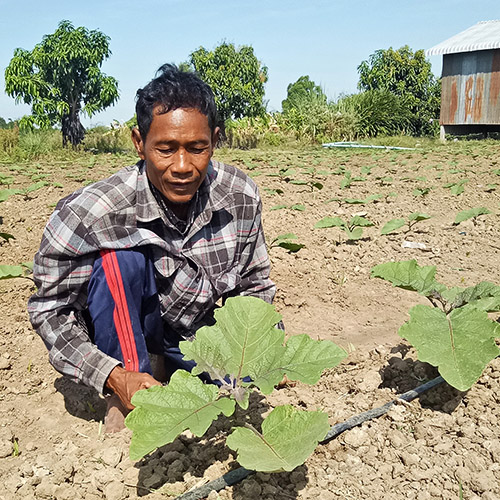
Khoeun with some of his vegetables.

Water conservation changes a family’s life in Cambodia

There are a few things that all farmers need in order to succeed. They need land to plant, seeds to grow, good weather conditions and, of course, water!

But what happens when you’re a farmer without enough water?

That’s the reality that Chum Khoeun and his family faced just six months ago. Their seven-acre farm in western Cambodia faced frequent water shortages, but the family relied on growing rice both for food and to earn money.

So there just wasn’t enough.

They couldn’t plant and harvest enough rice to even meet their own needs during the year, let alone rice that they could sell to pay other bills. Khoeun and his family members – he lives with his wife Neang Nim and their three children – would work as day laborers. It was one of very few ways that they could earn extra money to buy rice and other food.

Things changed in the middle of 2018, when Khoeun and his neighbors began to participate in a CWS program focusing on home gardening. Khoeun suddenly had access to new ideas and information that he could use to improve his farming. He now had a support network of other farmers where he could share ideas and ask questions. Plus, he learned about how to set up a drip-irrigation system that would stretch each drop of water further on his land. He received seeds to diversify his crop and the materials he needed to build the drip-irrigation system, and he got to work.

In the six months since he joined the CWS program, things have already changed drastically. Khoeun can provide better for his family. They have vegetables to eat and enough to sell In the first planting and harvesting season, which ran from September to December, Khoeun harvested twice. He earned almost $500, which he used to buy seeds for the next planting cycle and to buy rice and other staples. His family now has a much better diet and doesn’t face the food shortages that they used to.

“I am so happy for the opportunity to have joined these activities,” Khoeun says. “I have new knowledge and practical experience to grow vegetables safely; and, with my producer group support, I believe I can grow even more vegetables to sell in the future.”


Stories of Change


Miriam.

Learning by example, leading by example in Nicaragua

Miriam Martinez regrets that she never got to go to school. Her parents couldn’t afford it when she was little.

Miriam was raised in Krin Krin, one of many small villages scattered along the Coco River, which makes up the border between Nicaragua and Honduras. When she was 20, she set off for the biggest town on the river, Waspam. She found work as a cook.

Two years after she arrived, she got married and returned to Krin Krin, where she had eight children.

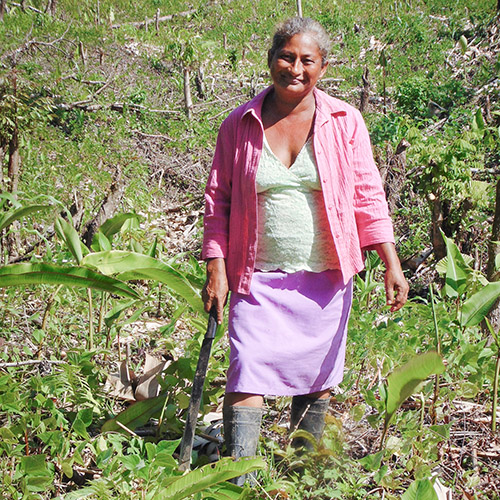
“I had no experience in working the land,” Miriam says. “I started after I got married because my husband was lazy.” While she may have started out with no experience, Miriam has become a successful farmer. Her family has about 120 acres of land, about 75 acres of which are under cultivation with banana and plantain trees, fruit trees, tubers, beans and rice. The rest is still forested. Miriam also has chickens, pigs, cows and horses.

Miriam grows her family’s food, and she sells extra produce to put her children through school. Her children won’t have the same regrets that Miriam does. Two of her eldest are studying far away from home in the city, one of them in the field of veterinary science.

“A couple of years ago, our community leaders chose me to be an agricultural promoter to further my skills and help my neighbors,” Miriam says. Agricultural promoters like Miriam participate in classes and information sessions at local training centers, where they also use sample gardens to test different ways of cultivating plants. They learn and experiment with different techniques for growing crops, and then they can put what they learn into practice on their own land. Plus, each promoter commits to sharing what he or she has learned with at least two neighbors so that the whole community can begin to benefit. For her part, Miriam is happy to be an example for other farmers – both men and women – in her community.


Stories of Change


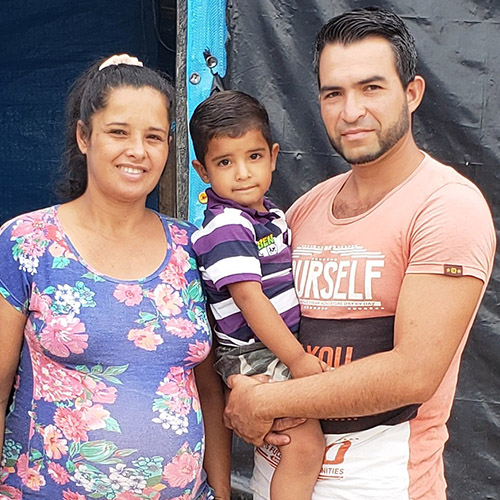
Flor and Miguel. Photo courtesy Lutheran World Federation.

A boost for a family figuring out their next steps

She was a lawyer. He was a decorator at an event venue. Now, their country is in crisis and they’re living in an informal settlement across the border, trying to figure out their next steps.

This is their story.

Flor and Miguel had successful careers in Lara State, Venezuela. As political unrest intensified, both husband and wife saw their hours scaled back and their salaries drop. Both are natural entrepreneurs, so they came up with alternatives to supplement their shrinking paychecks. They started a garden, which supplied them with all the food they needed for a few months without adding any extra costs. This idea was so successful that they shared it with their friends and neighbors – gardens like theirs started popping up all over the neighborhood as people converted their patios to help mitigate some of the effects of the crisis. Flor and Miguel also made and sold donuts to generate some income.

As the crisis deepened, access to even the most basic supplies and ingredients became limited. After more than two years of struggling to support his family, Miguel was the first to leave to try to find work elsewhere. In early-mid 2018, Flor left, too. She joined Miguel in an informal settlement in Saravena, Colombia, across the border from Venezuela. Now seven months pregnant, Flor focuses on caring for her family and making and selling a pastry called torrejas for some income.

Flor and Miguel heard about a CWS-supported program in La Union that helps families like theirs, so Flor attended a meeting for more information. She liked what she heard, and expressed an interest to join the program and learn more about building a business. Her family received food and hygiene vouchers that they could use in local stores to meet their basic needs. They also received a livelihoods voucher, which they could use to purchase supplies that would help start or expand a business. They used it to buy cooking tools that improve production of the torrejas.

“The project became a source of motivation,” Flor says. “For us and many others, we had the desire and the will, but we were missing a boost and you gave us the techniques, tools, support and motivation. Today, I feel strengthened and motivated by the project.”

Sadly, Flor and Miguel fall into a growing class of people worldwide: smart, talented people who are willing to work hard for their families but who are facing dark times because of circumstances beyond their control. We are proud to partner with families, including theirs, to help give them a boost.

The Humanitarian Assistance to Venezuelan Migrants to Saravena, Colombia program was implemented by Lutheran World Federation in 2018. It was supported through CWS by partners: United Methodist Committee on Relief, Church of the Brethren, Presbyterian Disaster Assistance, United Church of Christ and Week of Compassion.


Stories of Change


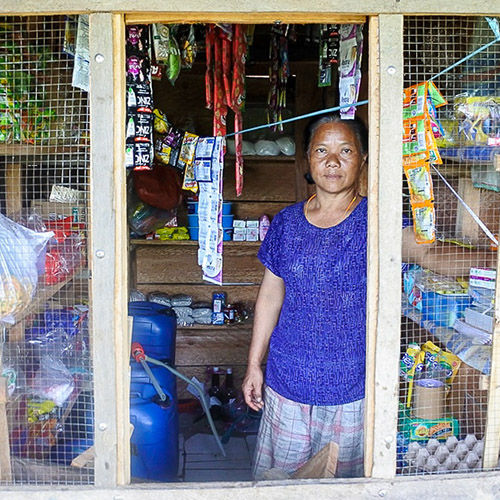
Suriati stands in the kiosk in her home, which she restocked with a loan from her savings and lending group.

An investment ripples out through a family

It’s a story you’ve probably heard from your friends and neighbors plenty of times: having a child in college can take a toll on a family’s finances. Sometimes making that investment in someone’s education means taking on extra work, and sometimes it means taking out loans when you wish you didn’t have to.

Suriati Roro and her husband have two sons in college. The family earns a living through farming rice, cocoa and coffee – it’s the typical livelihood of a family in this part of Indonesia. They also have a small food kiosk near the local junior high school where they sell noodles and cakes.

In the last few years, though, finances have been tight for the family. They had to close a larger kiosk that they operated out of their house because they couldn’t afford to restock it. Suriati went to the bank to try to get a loan to keep the kiosk open, but her application was rejected. Other people who had borrowed from the bank for similar reasons in the past hadn’t repaid their loans, so Suriati was considered too high risk. Without the bank loan, she turned to other lenders. “I once borrowed  money to restock my kiosk from a neighbor at seven percent monthly interest, which was quite high and burdening to me and my family,” she says.

Without that kiosk, the family began to struggle. “If we depended on our farm interest alone, we could not finance the children who are in college; the money just wouldn’t stretch that far,” Suriati says. “This is especially true for the last couple of years; our cocoa plants haven’t been producing as much as in the past, and our coffee harvest has also slowed down.” She’s describing a challenge that many families like hers are facing: gradual changes in the climate make it hard to rely on rain-fed agriculture, which is what they have done for generations.

Families like Suriati’s are working hard to make that challenges outside of their control – whether it’s climate change, economic uncertainty or a disaster – won’t destroy their income and livelihoods. One of the most effective ways to build this resilience is to have multiple income streams.

That brings us back to the kiosk at her house.

Through the CWS DREAM programs, people like you are investing in community groups in the area. Members of these savings and lending groups contribute a little bit each month. Group members can borrow from that pool of money to start or expand businesses – at a very reasonable interest rate (in this case, two percent).

Two months ago, Suriati took out her first loan from the Mawar Savings and Loan Group.

It was a loan for $35 to reopen her household kiosk. Suriati focused on goods the sell with a quick turnaround, like gasoline for motorbikes and popular vegetables, cakes and snacks. With the kiosk back in operation, her family is making about $2.50 each day in profit. They are saving some profit to pay back their loan, on time and in full with interest. But they’re also using those profits to pay their sons’ college expenses.

“I am very grateful for the Mawar Savings and Loan Group because it has given my family and me the ability to invest in our future. I plan to apply for a larger loan after I pay off my current one. I want to expand my kiosk business near the school to sell more school supplies, uniforms and shoes,” Suriati says.

People like you invested in Suriati and other hardworking entrepreneurs. She, in turn, invested in her business and in her sons’ education. It’s an investment that is rippling out to improve many lives.


Stories of Change


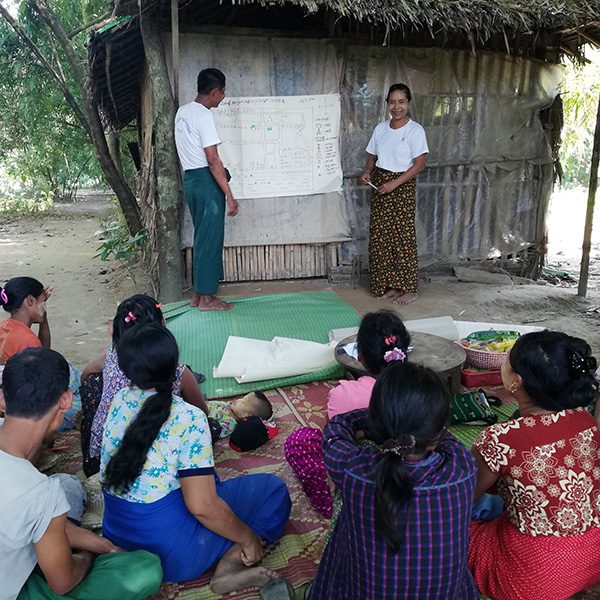
The Disaster Risk Reduction education session.

“Our community will be more resilient now!”

For many small villages in Myanmar, emergency services may be far away in the event of a disaster. That’s why it’s so important to make sure community members themselves have valuable skills and information to prepare for and respond in these situations.

We call this type of work Disaster Risk Reduction, and our program is reliant on community volunteers to help their neighbors and village leaders. Daw Than Than Aye and U San Maung are the pair of DRR volunteers from Ko Ein Tein West village. They attended one of our Training of Trainers workshops recently, where they learned about making maps of their village showing hazards and resources; creating historical timelines of past disasters and how they correlated to seasonal weather and activities; creating calendars for community action; and evacuation planning.

The volunteer duo worked hard to organize a series of meetings and training events for 20 of their neighbors, who were eager to learn how to better cope with natural disasters, especially the flooding that they face every year. For the first few meetings, our team coached and supported Daw Than Than Aye and U San Maung. Once they were more confident and experienced, they began to truly lead the gatherings. One thing that they found particularly helpful was to invite everyone to share their own personal experiences with disasters, including their own.

At the end of one meeting, the volunteers told our team that, “We really like sharing our new knowledge and information that we learned during the CWS-organized Training of Trainers.” A lot of their satisfaction seemed to come from the fact that they could help other community members understand how to prepare themselves for disaster – and especially to help save lives and assets when disasters strike. “Our community will be more resilient now!”, they said. And, with satisfaction for their own roles in helping Ko EinTein West village, and with plans for further follow-up and support, CWS staff are hopeful they are right.


Stories of Change


Village Development Committee members at the workshop.

Equipping Village Development Committees to lead effectively in Myanmar

For anyone in a leadership position, the ability to run a meeting effectively is an important skill. So are things like goal setting and making sure everyone’s voice and perspective can be heard. Many of us have attended workshops or seminars to build these skills. And now, the same opportunity is available to our neighbors in Myanmar who are part of newly-formed Village Development Committees.

CWS, in partnership with Lutheran World Federation, has helped about a dozen communities in Maubin Township, Myanmar, establish these VDCs. Groups like these, which are part of many of our programs worldwide, are the backbone of the sustainability of our work. Yes, we help communities make infrastructure changes like building clean water systems. And we lead information sessions for families to learn about topics like child nutrition or hygiene. But what happens when the water system is complete, or the information session ends?

VDCs are made of elected or volunteer community members who continue the impact of the work. In addition to having vital advisory roles on program activities, they also support families to continue putting into practice what they have learned, maintain new systems or convene regular meetings of program participants. And thanks to some recent Leadership and Management Training Workshops in the area, they can do this more effectively and efficiently.

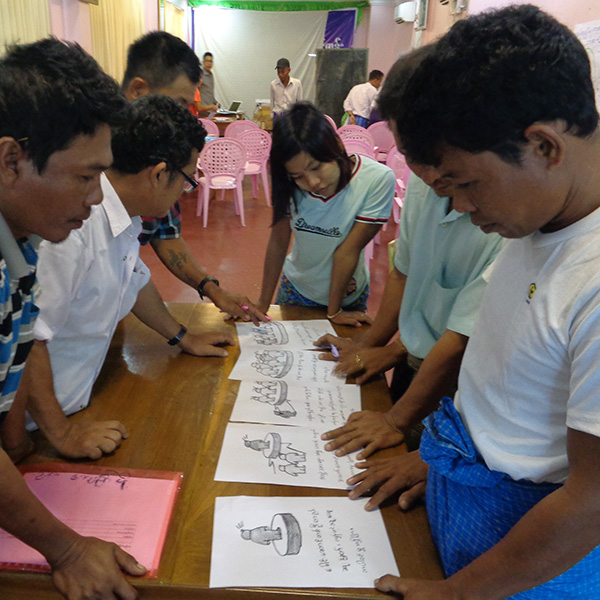
Between the two three-day workshops, 55 men and women came together to learn more about leading their groups. Participants included committee chairs, secretaries, bookkeepers and general members. Key topics were community development, community participation, good governance, leadership styles and management techniques. Practical sessions covered meeting facilitation, goal setting, work planning, activity leadership, monitoring and follow-up.

Since this was a first-time learning-sharing opportunity of this kind for most people, everyone joined enthusiastically in discussions and asked many questions, many of which were answered in conversation with other VDC members. Everyone also had a chance to practice facilitating a meeting and leading a discussion; and, one priority of the training team was to share ways and means to encourage women’s participation is all activities.

In reflecting on her time in one of the training workshops, Daw Wan Wan Lwin from Auk Htone village said, “It is really worth my time to join these sessions because this is the first time for me to learn things like this. [Though I knew the basics of what being a Committee member means], I now understand more of my role and responsibilities as a leader and I feel more confident as a woman leader.” (Despite the fact that more than a third of the workshop participants were women, it is still not typical for women in rural Myanmar to be community leaders – though this is changing with the CWS Integrated Resilience and Development project, and others like it across Myanmar.) Daw Wan Wan Lwin continued, saying, “Now I will use what I have learned, especially about facilitating meetings, to help Auk Htone organize to create a development plan. I am sure that my fellow Committee members do not think nor feel differently from me.”

A post-workshop survey showed that everyone was satisfied with what they learned and experienced, both in terms of the process and the content. Eleven VDCs are now well-equipped to hit the ground running on behalf of their families and neighbors. And, as Committee members reach out to their neighbors and other village leaders and duty bearers to ensure quality work to improve water, sanitation and hygiene; mothers’ nutrition awareness and knowledge; young children’s nutritional status; some families livelihoods and everyone’s preparedness for disasters, CWS staff will follow-up regularly with VDC members to help ensure continued self-confidence and results-oriented action to benefit all community members.


Stories of Change


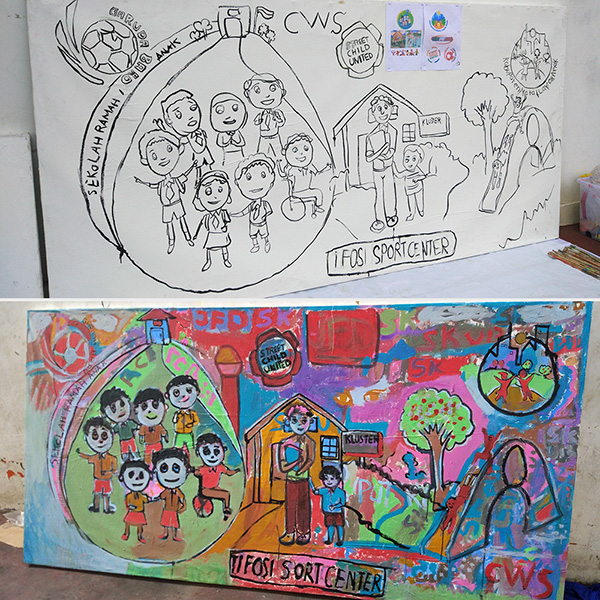
Top: the sketch that Taman and two other students did of the mural. Bottom: the finished mural.

A young refugee is “making up for lost time” in Jakarta

Taman was born to a poor family in Afghanistan, which didn’t have money to send her to school. So, she took matters into her own hands to be educated.

“I was always working odd jobs and learning and trying different things so I could earn extra money to pay for my education,” Taman told one of our CWS colleagues in Jakarta recently. At the age of 12, Taman was already a hairdresser and seamstress. She would make clothes and sell them to her neighbors.

This innovative and entrepreneurial attitude was successful, until a day that changed her life and ended her formal education at Grade 7.

That day she came home and found that her brother had sold her to a man in his 40s. Forced child marriage is common in Afghanistan, particularly in rural areas where desperately poor families sell their daughters for cash.

Once she was married, Taman continued sewing to keep her mind off the bad situation she was in. Still, she couldn’t handle the stress of her circumstances, so she boarded a bus to Kabul. She lived in a run-down hotel while she sorted out a plan to leave the country.

By a familiar smuggling route, Taman reached Jakarta, where she was met by someone in the smuggling network who took her to Bogor, a city nearly 40 miles south of Jakarta and left her in a market. She didn’t know where she was, but she managed to meet a couple of Iranian refugees and asked for their help. They took her to the UNHCR in Jakarta, where she registered and met several other Afghan refugees.

After a month of living in temporary housing, Taman was able to move to the girls’ group home that CWS supports with funding from the Australian Embassy in Jakarta. Once she settled in, Taman got busy. She joined all the classes and activities she could, including an informal school for refugees. “I wasted a lot of time in Afghanistan, and now I am making up for lost time. I want to learn everything! Thanks to CWS, I have an opportunity to take all these classes. Learning keeps me busy and is what I have always wanted: lots and lots of learning!”

It wasn’t long before a social worker noticed drawings Taman posted on the wall next to her bed. Taman clearly had artistic talent, so the social worker encouraged her to join an art class with CWS partner, Kampus Diakoneia Modern. “It started out easy at first, because I already spend a lot of time drawing: I usually draw every night before I go to bed. But then we started using color pencils and oil paint – which was all new to me! Using colors and learning new techniques added a new dimension to my drawing!” Taman explained.

Impressed by her progress, her teacher asked her and two other students to sketch a drawing on a 3-foot x 6-foot canvas for a yearly sports event for underprivileged children, where each child had a chance to fill in the drawing with color, and it is now displayed in KDM’s art class. Taman’s comment? “I had never drawn on a canvas before, let alone one this big. The drawing was fun, the children enjoyed it, and the result was wonderful.”


Stories of Change


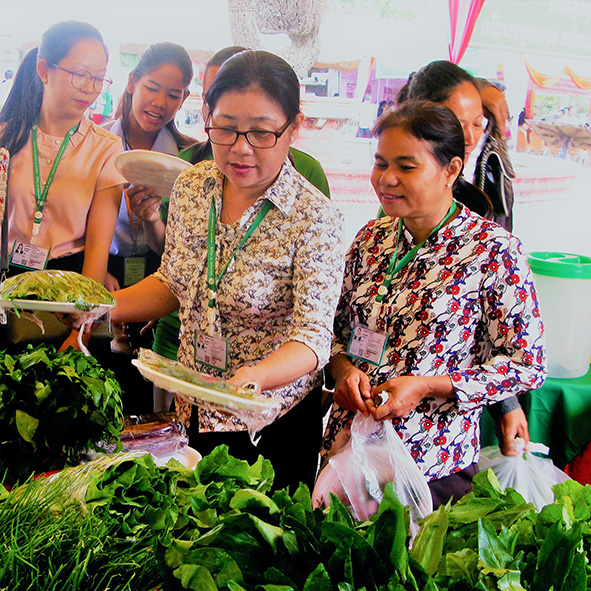
CWS-supported farmers at the vegetable exhibition.

Networking for prosperous, healthy futures in Cambodia

The government in Battambang Province, Cambodia, recently held a Safe Vegetable Exhibition. The event had two main purposes: 1) to raise awareness about safe agricultural practices for farmers in the region and 2) to create a demand for safe vegetables and, in particular, to link small producers and buyers.

Through our local partner Rural Development Association, CWS supports families in Battambang to produce safe vegetables. These families are just the type of small producer that the exhibition focused on, so five groups of families from our program took their produce to sell and share. They were able to sell the vegetables at good prices. Just as importantly, they had the opportunity to connect with new customers and markets for the future. And they had time to connect with one another – talking with and learning from other farmers.

The gathering was quite a success. It brought together farmers, organized cooperatives, brokers, agents, direct buyers and non-governmental organizations. Thuch Chantheng, the representative from one of the producer groups, reflected on her experience: “This is my first time joining an event like this, and I am very happy that we could sell our products at a good price and that buyers showed interest in buying more from us. This day was really an encouragement for me and the group. Now, we will work hard to increase our production, especially safe vegetables, which we can sell at higher prices and with no harm to people’s health. Thank you CWS and RDA for all the support for this opportunity, which really motivates us!”