Stories of Change


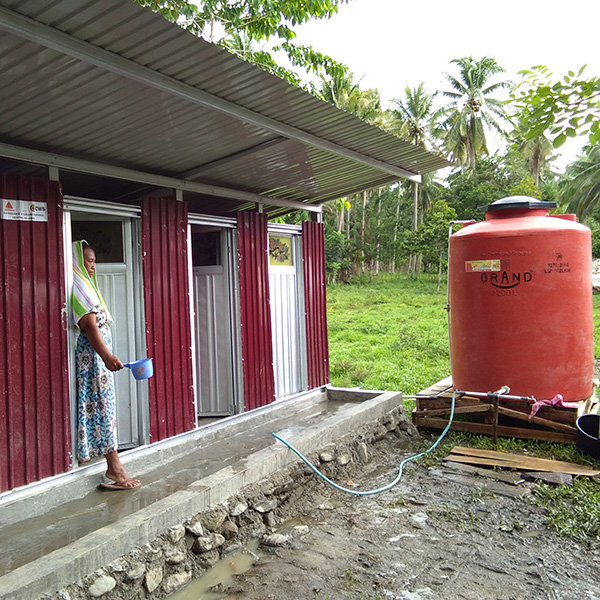
Sanuba exits one of the latrines constructed with CWS support.

Sanitary bathrooms and clean water for survivors in Central Sulawesi, Indonesia

“Before there were latrines in the camp, we defecated in the river, and often we [the women] had to wait because there were always men in the river and we felt insecure and uncomfortable.”

This statement comes from Sanuba, who moved to an evacuation camp in Donggala, Central Sulawesi, Indonesia, after the earthquake in September that devastated the region. It’s not just Sanuba, though – any one of hundreds of women in her situation could have said the same thing. Getting sanitary bathrooms into temporary camps after a disaster is a significant challenge.

The river Sanuba was talking about was about 300 meters (a little less than a quarter mile) from the camp. It’s far enough away that it can be hard for some people to reach, especially at night. “After it rains, the river usually floods. That makes it even more difficult to use,” Sanuba told us. “We were also scared of animals and snakes.”

One of the largest components of the CWS relief effort in Central Sulawesi is WASH, which stands for Water, Sanitation and Hygiene. CWS is working to organize skilled workers and buy high-quality materials to build safe, sanitary latrines and bathing facilities. Our team has constructed or is in the process of building more than 25 public bathroom facilities in camps in Donggala or nearby Sigi district. In December, as we were working with residents of one camp to build latrines and bathing areas, we heard, “I am grateful to CWS for providing basic materials, and a water tank, so we can build latrines and store clean water.”

Just as people were using filthy river water for bathing and relieving themselves, they were also using the water for other purposes. That’s why CWS has a fleet of trucks delivering clean water to about 13,000 people every day.

As relief and early recovery work continue for tens of thousands of people across Central Sulawesi, Sanuba and her family have been able to return to their land to plant corn, chili and a few other vegetables. They are farmers, and their camp isn’t far from their land. Since their house is gone, though, they continue to live in the camp and appreciate having safe, sanitary bathrooms to use.

The earthquake brought the region’s economy and countless families’ lives to an immediate standstill a few months ago. But now, several months later, people are overcoming their shock and dealing more each day with the devastation. Sanuba, and others like her, are moving slowly but sure to rebuild their lives and livelihoods, though it will take years, everyone knows, to return to the old normal. So, for now, Sanuba and others are creating a new normal and trying to get by – with a little help from their friends, like CWS, other ACT Alliance members and other government and non-government agencies.

Stories of Change


CWS staff member Tuan checks on Va's biogas system.

Biogas is a win-win for Va and his family

Ma Van Va and his family make a living from rice farming and raising cattle and pigs. They are a family from the Tay ethnic minority group in Vietnam.

When we met him, Va was struggling with an unfortunate side effect of making a living raising livestock: animal waste. He was letting the waste accumulate near his house, which led to an awful smell and lots of flies. His neighbors complained about the smell, too.

CWS was recently invited to Va’s village to help families implement some basic technologies that could help improve their daily lives. One of these technologies was biogas. Va was among those who were curious to know more about it, so he joined a CWS workshop that introduced the technology. He learned that biogas is made from managing animal waste safely and productively and that it can provide energy to power his home. When our team member explained the composite biogas model and the details of how to install and maintain it, Va realized right away that this was the solution he was looking for to address his animal waste problem.

This was the answer he was looking for, in more ways than one. It would produce gas for cooking, so the family wouldn’t have to use firewood as fuel. That would save his wife time and effort that she used to spend collecting and hauling the wood. It would also save trees that would have been cut down. Plus, using the waste as biogas would reduce the risk of feces-related communicable diseases and create a healthier household environment.

After the workshop, Va made the easy decision to invest some of his family’s resources to buy and install a biogas tank and to fix up his chicken coop and yard. The project has since been completed, and our team checked in with Va recently to see how things are going. When we visited, the smell was gone – as were most of the flies. That’s a huge change from our previous visit. Now, Va’s family always has gas for cooking without collecting firewood or buying commercial gas. “Biogas is quite a new thing for us,” Va said. “Thanks for introducing us to it. Knowing its many benefits, I strongly believe that my decision to invest in making biogas at home is completely right – for my family, and for our neighbors, too!”


Stories of Change


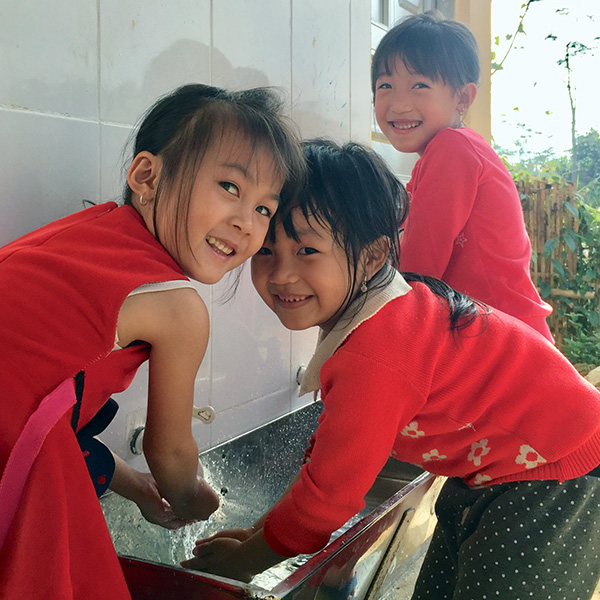
Hanh (right) and her friends wash their hands at school.

Clean water and clean latrines for Hanh and her mom

Our team met 5-year-old Mai Hanh during a recent visit to her preschool. Hanh and her mom live in a poor rural village about 135 miles northwest of Vietnam’s capital, Hanoi.

When we met Hanh, she had no idea what a toilet was. Where she lives, people still use fields, bushes and streams as their bathrooms. Many people Hanh has grown up around don’t wash their hands after using the bathroom or before eating, either.

This situation is all too common in many places in rural Vietnam, and across southeast Asia. That’s why CWS is teaming up with Hanh’s school, the Khuon Pong village kindergarten, to change this situation for young children.

When the school year started in September of 2018, something else started, too. CWS began supporting latrine and water supply improvements at the school. Since then, Hanh and her friends have had an exciting time experiencing modern latrines and clean water taps…and how these conveniences lead to better hygiene and, ultimately, better health.

Hanh’s mom, Tiep, was pleased to see these improvements going in at the school, in addition to a safe new school kitchen. Tiep was also grateful for the community information sessions and what she learned about proper sanitation and hygiene, including the importance of washing hands with clean water, for the sake of her daughter and her 100 schoolmates.

Since Tiep wanted to make the most of CWS help and learn as much as she could, she joined information sessions about biosand water filters and sanitary toilet models for homes. She has now signed up to build a latrine at her home and buy a biosand filter with help from CWS. Soon, Tiep and Hanh will have clean water to drink at home and a safe, clean place to relieve themselves. They are among the 170 families in Trung Ha Commune who are changing their lives for the better, thanks to CWS and our generous donors – and to their own determination and hard work!


Stories of Change


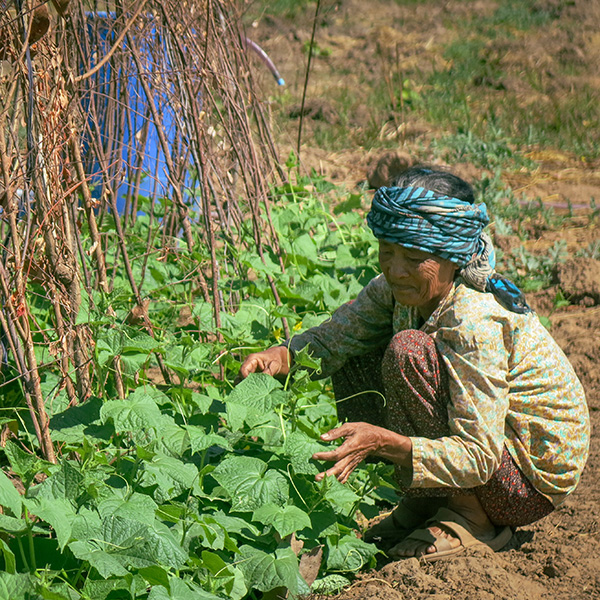
Sam Pho works in the family's garden.

Doing well while also doing good in Cambodia

A year ago, Sek Sok was elected to the Morokot Commune Council in northern Cambodia. Sok, 66, is a retired soldier who lives with his wife, Sam Pho, and their 16-year-old son.

Because Sok agreed to stay permanently in the area of his last army deployment, his family lives on a .75-acre, government-provided lot with a wooden house on it and a small yard. While they are certainly grateful to have the house and yard, the family doesn’t have enough land for significant commercial farming. Instead, they rely on Sok’s Commune Council monthly stipend of $120 as their only income. While this is more than many poor families in this part of Cambodia have, it was still tough for the family to afford to pay all of their expenses, especially school tuition and fees.

When he joined the Commune Council, Sok decided to take advantage of being involved in CWS community development activities. Among other program elements, CWS provides support to Commune Councils like the one Sok was elected to. We also partner with individual families who want to improve their lives as CWS household partners.

Sok started by observing CWS-hosted education workshops where, as a community leader, he improved his knowledge and expanded his experience in understanding micro-business management like mushroom growing, chicken raising and growing vegetables for profit. He also took the time to learn about community health promotion to help the people he represents, too.

After joining several workshops, Sok said, “When I learned about gardening adapted to changing climate conditions in our region, I was inspired by the facilitator to motivate the people [I represent on the Council] to set up vegetable gardens at home. This was mainly because I started to realize that home gardening is important, and a relatively easy way – with some support to start – to help families improve their diet and their income. As my thinking changed, so did my own practice, and I used what I heard and learned to set up a 100m2 (1,075 square feet) vegetable garden on my home plot. For me as a leader, my purpose was not only for my family to have more and different vegetable and additional income; but it was also to show to my people and encourage them to do the same. It was great that I could share practical knowledge and my own new experience with them.”

Sok’s hard work is starting to pay off for his family. “The first time I sold the extra produce from my garden, I earned $115,” he said. “I was happy, as I could use the money to buy chickens and ducks, and I could plan to expand my garden to increase my income even more so that I can save for my son to continue higher education.” He added, “I am so thankful for this partnership with CWS, which has been helping me better lead my community and improve my own life.”


Stories of Change


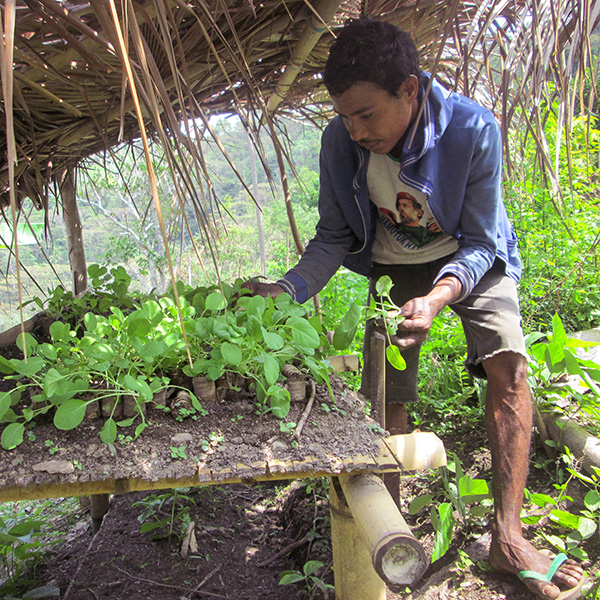
Leandro tends to his vegetables.

“This is the first time we have ever received support from an organization like CWS.”

Like most of their neighbors, Leandro Oliviera and his family depend on agriculture to make a living. Leandro and his wife, Angelita Vidigal, make about $5 each week by selling cassava and vegetables.

Unfortunately, the income source they depend on isn’t always reliable. The dry season in the part of Timor-Leste where Leandro and Angelita live runs from May to November each year. During these months, there is no water in their village. They walk nearly two miles to a neighboring village to bring back the precious water that has to meet all of the family’s needs, like cooking, bathing and drinking. They use the water first for meeting these basic needs, and then they use any run-off water from washing to water their vegetable garden. Despite their best efforts, these harvests were not good ones.

Leandro and Angelita have two children, who are just 2 and 4 years old. In an attempt to end their cycle of poverty and provide a better life for their children, the parents joined the CWS Timor Zero Hunger program in their area.

Their first step was to join information sessions with district agriculture office extension workers and CWS team members. Although Leandro, Angelita and their neighbors had a lot of agricultural wisdom and information already, there were some new practices and ideas that they could use to make their harvests even better. Leandro learned about raising chickens and horticulture, including how to make organic fertilizer and pest control, how to compost and how to better select different seeds for different seasons.

Then, Leandro and his family put into practice what he had learned. Like the other families participating in the program, Leandro and Angelita are now raising chickens. They are also growing more vegetables, some to eat and some to sell. “Our life has changed for the better since this project started,” Leandro says. “We now raise chickens and plant more vegetables, like morning glory, chili, tomatoes and eggplant. Already our chicken laid some eggs, which we ate, and then had four chicks, which we are raising.”

When our team was chatting with Leandro about how things are going for his family, he said, “This is the first time we have ever received support from an organization like CWS, so I would like to thank you for your presence and support.”


Stories of Change


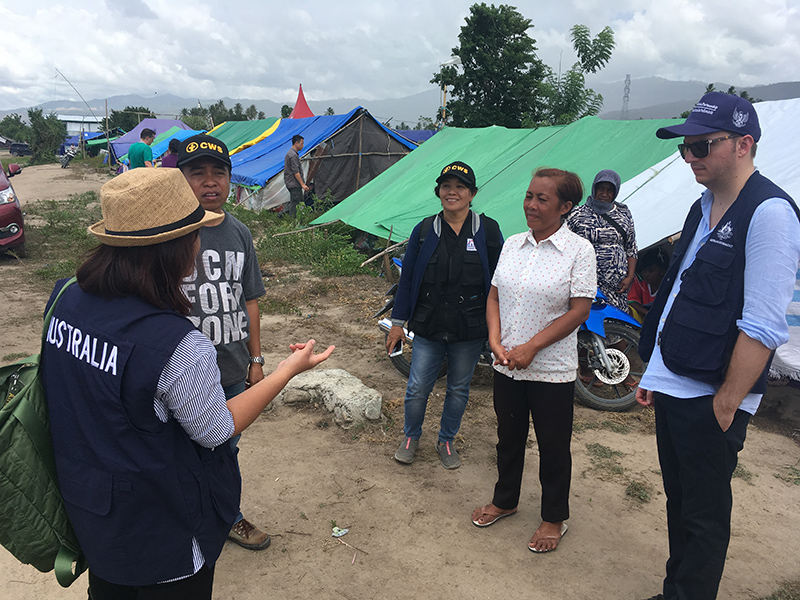
Henny (second from right) with Louis Henley, Second Secretary (Development Cooperation), Australian Embassy Jakarta, during a recent visit.

“The ground opened up and turned to liquid.”

“The mud flowed, destroyed our house and dragged it and other houses – or what was left of them – away.”

Henny Putong, 43, vividly recalls the moment on September 28 when her life, and those of her neighbors, turned upside down. It was the day Jono Oge, their village in Central Sulawesi, Indonesia, disappeared.

Henny and her family now live in a camp not far from where Jono Oge once was. There are more than 570 people from 187 families living in the camp. Henny is the coordinator here – one of few women who have that role. In fact, of the 431 camps in three districts in the area, fewer than one in five have women in camp management roles. Before the earthquake, Henny worked in the village administration office as the Head of Population Administration and Civil Registration. She was obviously well-suited to coordinate activities and services in the camp where she ended up living.

She is also a farmer and had a small food shop. “Now it’s all gone, but we are lucky to have survived,” she says.

CWS started supporting Henny and the others from Jono Oge a few days after the disaster. “CWS was the first organization to supply much-needed water, as there is no water source nearby and people walk a long way to a river to get water. Thanks to CWS, we now have a water tank that CWS refills daily with fresh water from a tanker truck.” Thanks to generous assistance from our ACT Alliance partners, the Australian and United States governments and others, CWS was able to provide hygiene supplies, large water storage buckets, jerry cans, tarps, sleeping mats, mosquito nets and emergency solar lamps to the families from Jono Oge and from dozens of other villages that were destroyed or severely affected by the earthquake and its aftermath. Now, three months after the earthquake hit, CWS is still working with other non-governmental organizations and the Indonesian government to continue relief work with a particular eye toward early recovery initiatives in 2019.

Note regarding the story title: When the earthquake struck Central Sulawesi, the land became something like quicksand. This is known as soil liquefaction. It occurs when soil that is saturated with water loses strength and stiffness in response to stress – like the earthquake. So, soil that is ordinarily solid turns liquid.


Stories of Change


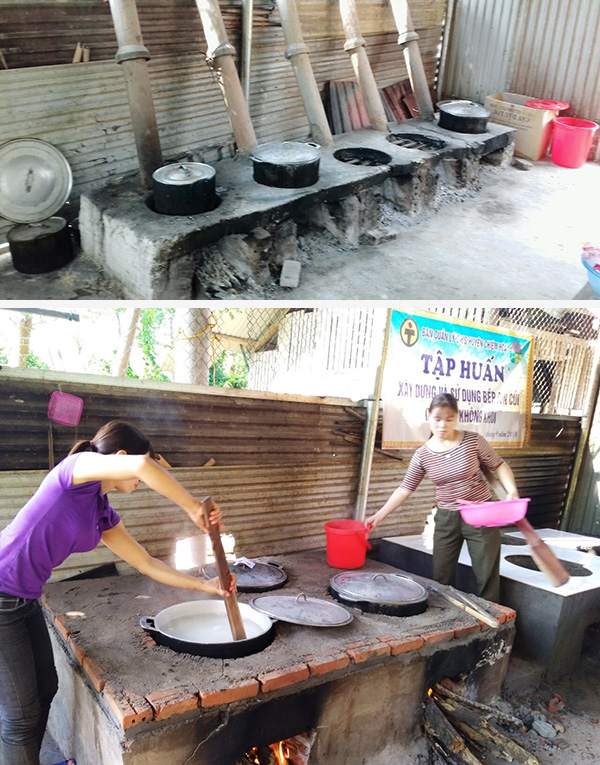
The old (top) and new (bottom) stoves at Hoa Trung school.

New stoves for a school in northern Vietnam

Hoang Thi Vien and Quan Thi Tham have a big job ahead of them every day: cooking two meals for more than 200 students!

The women work at the Hoa Trung primary school, which is a boarding school for ethnic minority children who travel to a central village for school. The students live in remote mountain villages, where only some parents see the value in making sure their children get an education.

“It’s not an easy job to cook for 210 students every day,” Vien says. “Our kitchen used to have five wood-burning stoves, and cooking the rice was the hardest work because we used three huge pots on three of the five stoves to cook about 30 pounds of rice in each pot for each meal.” The women started at 6:30 each morning to get the water boiling and cook the rice. It was a three-hour process – with so much rice in each pot, they scooped burning coals from the stove onto the pot lid to also cook the rice from the top. Not only was this difficult and a bit dangerous, but it also led to ash ending up inside the pot and spoiling some of the rice. Plus, it used a LOT of firewood.

As part of our program to support schools in this part of Vietnam, CWS helped build two new, larger stoves in the kitchen instead. Vien’s response? “It’s amazing! So convenient!”

“It’s now very easy and quick to light up a fire in the morning, because the stove is still a little warm from the last use. And now it takes only 20 minutes for the water to boil, and then only 90 minutes for all three rice pots to be cooked through the same,” she said. Tham added, “Now we do not have to put wood coals on the lid anymore, so our risk of burning ourselves is gone, and, even better, there is no ash in the rice – and no smoke at all in the kitchen. Most importantly, it saves a lot of wood. Before, we used four bundles of firewood, but now it’s only one and a half. We use less than half as much now!”

The time saved each day has a special benefit for Vien: “Now we don’t have to go to work so early, so I have time to take my son to his school before coming here.”


Stories of Change


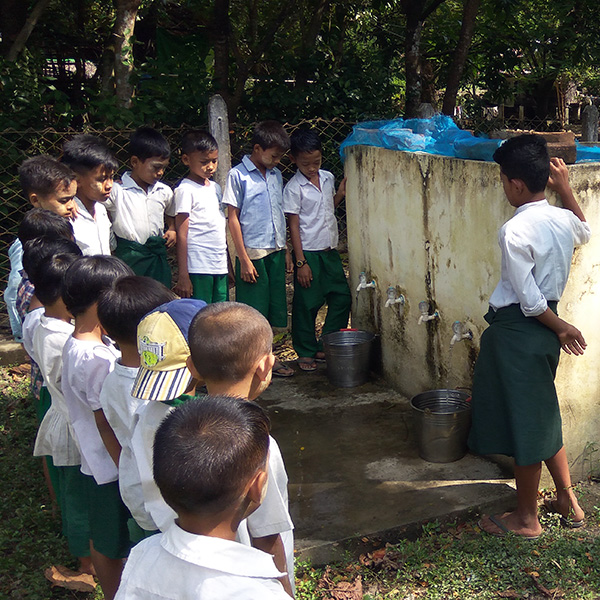
Elementary school students in Yae Li Gyi with their new water system.

It takes a village!

Our team in Myanmar first got to know the people of tiny Yae Le Gyi village in 2015 when we partnered with community leaders and others to respond to severe flooding in the Ayerwaddy River delta region. Since then, all 250 families have joined with CWS staff and each other to recover and rebuild … gradually.

To start,  in 2016, disaster risk reduction work began, so the inevitable next floods’ effects might be mitigated if not stopped altogether. Also, eight hand pumps were added to improve existing wells around the village, and not too long after those changes for the better, the volunteer WASH Committee members worked with our WASH engineer to plan for a new well with a high platform, hand-pump and water storage tank for the elementary school. Now about 70 early grades students, and their teachers, have nearby access to safe drinking water, and they don’t need to carry water from home each day.

A key part of Yae Le Gyi’s step by step success has been the engagement of community volunteers, especially the WASH Committee, whose members have taken the time to learn about improving their water, sanitation and hygiene infrastructure and, importantly, about getting community buy-in to invest in its long-term maintenance. Also “in the mix” for Yae Le Gyi’s mothers and young children: nutrition education and support for improved caring and feeding for under-fives with more diverse and healthy diets alongside good WASH practices.

As we look back at how far we’ve traveled with the 250 families of Yae Le Gyi, we are inspired by them as we look forward to the next stage of our shared journey toward more resilience against perennial floods and other integrated community development progress for all.


Stories of Change


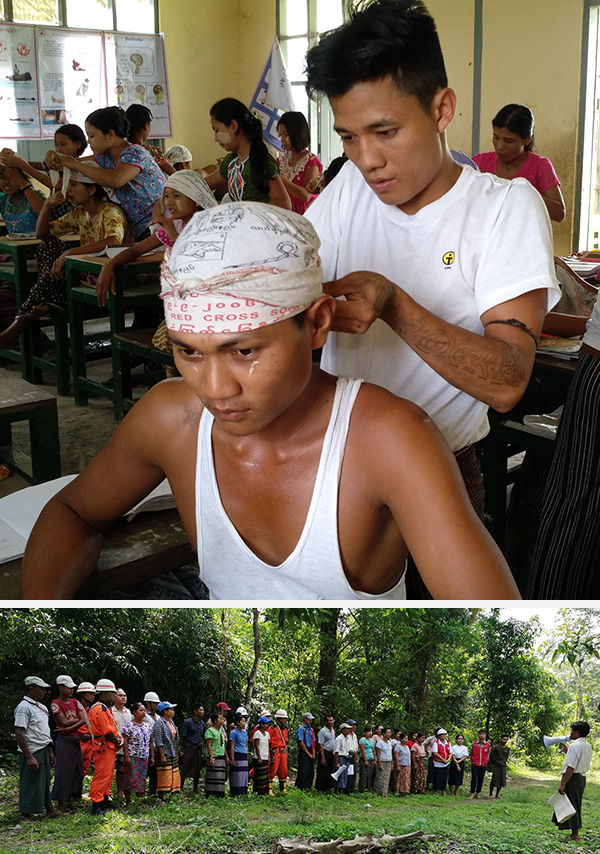
Volunteers participating in First Aid and Search and Rescue training.

Equipping communities to prepare for the worst in Myanmar

The massive Ayeywarwady River in southwest Myanmar is the defining aspect of life here. The river functions as a highway for people traveling among small riverside villages, goods traveling to market and information and news. Countless families rely on the river for their livelihoods, including fishing.

Every year, though, the monsoon rains come and the river floods. Suddenly, the river is a source of destruction rather than prosperity. And no one is helping communities here prepare for this annual disaster – except CWS.

After a successful pilot of Community-Based Disaster Risk Reduction programs in Maubin and another township, 15 communities near Maubin are organizing and preparing. Each village is led by two community-chosen volunteers, who join the CWS Myanmar team for an intensive Training-of-Trainers program. They learn the basics of modern-day disaster risk reduction, like making maps of each village with hazards and safe spaces and marking evacuation routes. They also receive training on First Aid, early warning signs of emergencies and search and rescue protocols.

Perhaps most importantly, and why it’s called a Training-of-Trainers workshop, is that these volunteers learn how to lead and organize their communities. They learn about group management and activity facilitation, and they form Disaster Risk Management Committees in their village. Each committee has smaller teams focused on First Aid, Early Warning or Search and Rescue. They identify men and women who are interested in learning more about and facing the challenges that affect their community.

This fall, volunteers joined local firefighters, Myanmar Red Cross Society staff and Department of Disaster Management staff for a series of training activities. Once their finished their training, they started to share what they learned with their neighbors and got started with disaster response simulations and working on maps.


Stories of Change


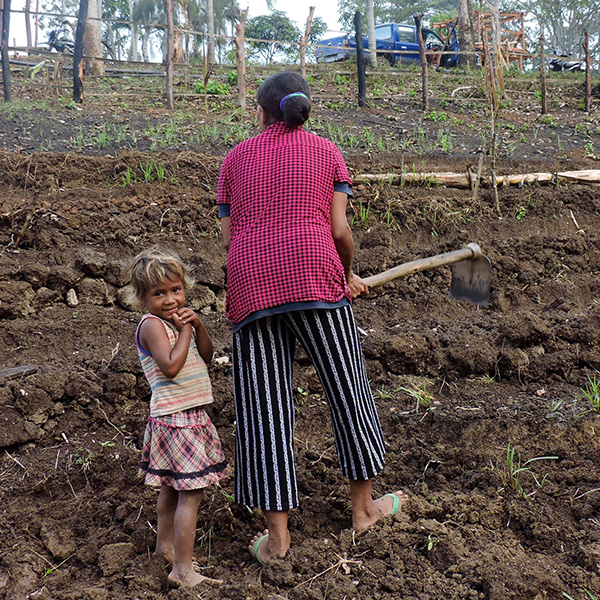
Beatrice is helping out while a neighbor works the garden along with Beatrice's mom Juliana (not pictured).

New information and farming practices take hold in Timor-Leste

A little over 20 miles from Dili, Timor-Leste, up a winding dirt road lined with banana trees, lives a uniquely blonde-haired 5-year-old girl named Beatrice.

Beatrice enjoys playing with her older siblings and cousins and following her mother around the house, “helping” with chores. Juliana da Silva Gonçalves, Beatrice’s mother, is a fairly typical Lebucaileti village mother and housewife, which means that she works really hard to help her husband earn a meager living and raise healthy children despite having very limited income-earning opportunities in a very poor place.

Because Juliana’s profile is a common one, CWS is expanding Timor Zero Hunger to rural Timor-Leste with a focus on activities that support modern farming practices – starting with ones that save water and use natural ingredients for composting and pest control. Not too surprisingly, what Timor Zero Hunger has to offer, all of which has been tried and tested in West Timor, Indonesia, over the past few years, is all new to the farm families with whom CWS works in remote Timor-Leste villages. Equally unsurprising is how proud the small CWS program team is to be able to be of help, and hope, to some of their country’s people.

For example, an activity that Juliana joined was building a demonstration garden plot with other members of her agriculture group. In the process, group members learned how to build terraces, make compost and plant new vegetable varieties which, if successful, will be introduced to others in the community. “In the past, our only vegetables were mustard greens, kale and corn, and my family planted corn only. If we wanted to eat mustard or other vegetables, we bought from our neighbors. Now, I am excited to be part in this program to raise different kinds of vegetables for my family so Beatrice and my other children can have better nutrition once the new vegetables grow.” If she grows extra vegetables beyond her family’s needs, Juliana plans on selling them to her neighbors. “The road is still too bad for me to take them to the market, so I will just sell them to my community,” she says.

Besides vegetable seeds, CWS gives families who are prioritized to join Timor Zero Hunger activities, several chickens to further improve families’ nutrition. Recently Juliana’s chicken hatched seven chicks; and, once the flock grows and the individual chicks mature, Juliana can sell both eggs and chickens to help purchase basic needs, like soap, rice and oil. She says she plans to teach her children to raise chicks, and to be responsible to take care of their own chicks in the future.