Stories of Change


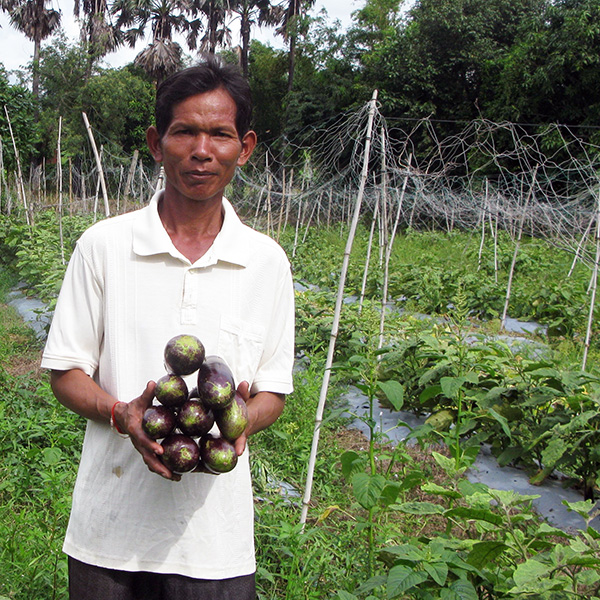
Bunthoeun holds some of the eggplants that he and Sarem grew.

There’s no place like home

Prom Bunthoeun and his wife, Yorn Sarem, raised their children in a village called Nikom Kandal. It’s in Cambodia’s Battambang province, near the border with Thailand. 

Years ago, Bunthoeun and Sarem grew vegetables on land they owned. But they never managed to make ends meet as farmers. They made the difficult decision to leave their three children at home with their grandparents and try to find work in Thailand. There, they could earn $15 a day laboring on construction projects. That may seem like plenty of money, but they had to spend most of it paying for food and rent in Thailand. There wasn’t much left over to send home to Nikom Kandal. 

Last year, Bunthoeun came back to visit his family. That’s when it became clear to neighbors that his family was really struggling. Among those who took notice was our partner Rural Development Association. Bunthoeun and his family were invited to join the CWS-supported Promoting Better Lives program to help improve their situation. Sarem came home, and we got to work.

Like all program participants, Bunthoeun and Sarem began with studying the basics of vegetable gardening best practices. They already had an advantage over many families because they already owned land–even though they stopped using it years ago. So step one was to reclaim their 1/5 acre (about 8,700 square feet) parcel. Then they started creating a sustainable government with supplies and guidance from CWS and RDA. The couple decided to grow eggplant because they knew that there was a demand for it locally and they would be able to sell it. By using what they had learned about soil preparation, natural fertilizers, pest control and water conservation, Bunthoeun and Sarem created a flourishing and profitable garden. 

During the three-month planting, tending and harvest cycle, the couple earned about $12.50 a day. With this much income, they had enough money to buy rice and nutritious foods. They are no longer facing food shortages like their children and parents did when they only had the small remittances from Thailand to live on.

But it isn’t just the food that they’ve been able to purchase. They had money left over to expand the garden to also grow cucumbers, another valuable crop. They teamed up with their eldest son, a 23-year-old electrician living in Phnom Penh, to send their middle child to university. Their youngest, a 17-year-old, is continuing high school. The family’s quick progress towards a life of dignified work and a bit of prosperity is an inspiration for our team, and reaffirms our believe that there is enough for all.


Stories of Change


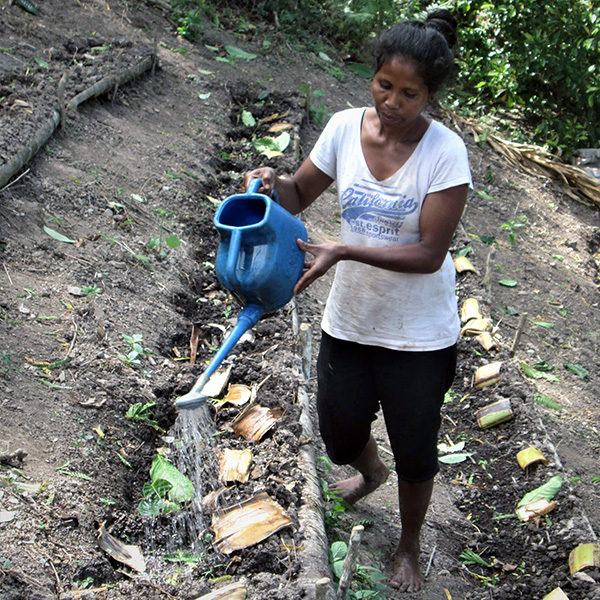
Brigita waters her terraced vegetable garden.

Better water access means vegetable gardens in Timor-Leste

Maumetalao is a coastal village near the Banda Sea on the north coast of Timor-Leste. Changing weather patterns have wreaked havoc on life here, bringing extended droughts to areas that were already facing poverty. 

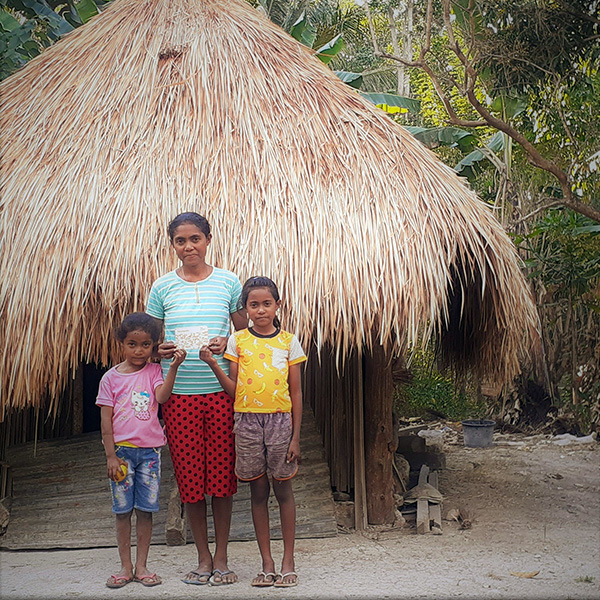
Brigita Maria Kefi and her family are among those who have struggled because of the droughts. She’s a 35-year-old mother of three girls, all of whom are under 10 years old. The family lives in a simple straw house in Maumetalao. Brigita and her husband planted a vegetable garden near their house years ago, which Brigita could tend to while keeping an eye on the girls. Because of the drought, though, they had to move their vegetables to an area closer to a spring–and farther from their house. Brigita could no longer tend the vegetables while watching her daughters, and having the vegetable garden farther away made it susceptible to theft, pests and animals. 

“Working so hard, and having little to no results was exhausting,” Brigita told CWS staff recently. Her family was losing money because their harvests were so small, and eventually they gave up on the vegetable garden. Like many of their neighbors, they reverted to planting only the local staples of corn, cassava and sweet potato. Their daughters’ nutrition deteriorated without the vegetables, and there was no extra cash from selling surplus vegetables. Without the cash, the family couldn’t buy vegetables or other items to meet basic needs.

We met Brigita through a freshwater spring protection project in Maumetalao. Our team works with communities to build water systems like this one to make sure water is stored in tanks instead of dripping on the ground and being wasted when someone isn’t actively filling a container. Now, spring water collects in a tank overnight. By morning, families can access about 4,200 gallons of water–enough for all their needs. There is plenty of water for drinking, bathing and housekeeping. And there’s enough to use to water vegetable gardens, even in the dry season. 

Now, once again, Brigita and her husband are growing vegetables near their home. Even better, they can garden year round, which means income from the surplus produce. Brigita estimates that she makes an extra $20 per month now, and this income has already been life-changing. “I was able to get some medical care I had put off,” she says. “I now feel healthier,” which will help her be even more productive. “Now I will start saving for some home improvements,” she says. 

The water system in Maumetalao has helped 400 people, including Brigita and her family, to have this opportunity. Our team is so excited to see all the ways that the families here will capitalize on their new wealth of water!


Stories of Change


U Htein Win prepares for another fishing trip.

A $45 loan nearly doubled a family’s income. Here’s how.

U Htein Win is a widower; his wife passed away four years ago. Four of the couple’s eight children still live at home; the rest are married and living independently. After his wife’s passing, U Htein became the family’s sole breadwinner. 

U Htein has his own boat and relies on fishing as a source of income and as a way to add protein to his family’s daily meals. He was making about 3,000 Kyat ($2) each day. He has long wanted to expand into shrimp fishing, but in order to do that he would need special traps. If he were to try to take out a loan to buy the traps, it would be at a 10-15% interest rate that he simply couldn’t afford.

His life changed, though, when CWS introduced the concept of a savings group to his village of Koe Ein Tan, which is about three hours west of Yangon. Any resident can join the village’s savings group by contributing at least 2,000 Kyat ($1.35) each month. Some savers contribute as much as 9,000 Kyat ($5.87) each month to help the group’s funds grow faster. Once the group has accumulated 70,000 Kyat ($45) in savings, they can approve a loan for up to that amount to a group member. The loans have a 5% interest rate and a three-month payback period. 

U Htein felt that he could contribute the needed amount, so he joined the savings group. He was one of the first of the 17 members to borrow from the group savings. He applied for the maximum loan amount–after doing the math and feeling confident that he could pay the loan back–and bought 20 shrimp traps. His daily income has jumped from $2 to at least $3.33 each day. Some days he makes twice as much as he did before the shrimp traps!

When our team recently chatted with U Htein, he said, ““I like this activity! I am already saving about 4,000 Kyat [$2.60] monthly from my extra shrimp income. I hope our saving group lasts a long time so I can get another loan for more traps. Thank you, CWS, for showing us how to set up the groups. Our family no longer worries about food, nor about borrowing money at high interest rates.”


Stories of Change


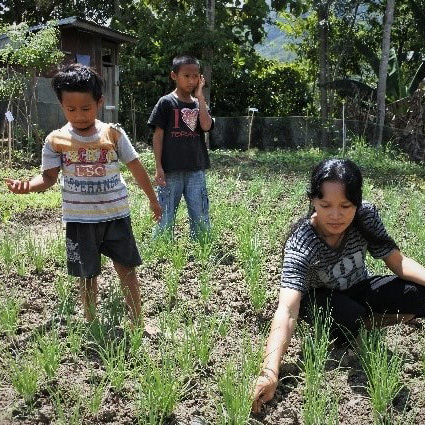
Elsi and her sons in the Laraswati group garden, where group members grow crops to feed their families and sell for extra income.

“I didn’t want to sit by and wait for the next disaster”

Landslides are a significant hazard in the Tana Toraja region of South Sulawesi, Indonesia. They are a particularly dangerous threat in the village of Rano, which is in a valley. Rano has hotter temperatures than neighboring communities. That means droughts are harsher here, when it doesn’t rain for long periods. When the rains come, they can trigger dangerous landslides. 

In late 2016, deadly landslides hit Rano and devastated the village. Elsi Bura Tasik’s family was harmed in those landslides. CWS responded immediately alongside a local partner to help families cope. 

“I didn’t want to sit by and wait for the next disaster [to devastate us again],” Elsi says. That’s why she’s now a community leader within the CWS DREAM program, which focuses on emergency preparedness and building long-term resilience. As soon as she could after the 2016 landslides, Elsi decided to learn more about what she could do to protect her family and neighbors. And in the years since, she has worked hard to help DREAM succeed in Rano.

Recently, Elsi has become a leader in the Larasati Savings and Loan group. Groups like this one, which CWS supports in the DREAM program and across our programs in Asia, enable neighbors to save together and take out loans (at a modest interest rate) to start businesses, grow existing businesses or get through periods of scarcity. Elsi has been a driving factor in the group’s amazing success; in just one year, the group’s capital has reached 3,000,000 Rupiah–about $200. That’s about four months of income for a family here. “All of the women in the group inspire and lift each up each other,” Elsi says. 

How does a savings group like this one lead to disaster resilience? They build economic stability and resilience, which are critical to coping with a disaster. Financially secure families can afford to repair or replace lost or damaged items after a disaster, and families with diversified income streams are more likely to continue to have livelihoods after disaster strikes. That’s why these groups focus on working with women to start or expand businesses to supplement their husbands’ farm labor income. 


From barren land to a flourishing garden


October 16, 2019

Welmince Kase and her husband had an extra plot of land in their community in West Timor, Indonesia that they weren’t sure what to do with. They donated it to a local church youth group, but the group didn’t end up doing anything with it. So after a year of watching her land remain barren, Welmince decided to try something …

Stories of Change

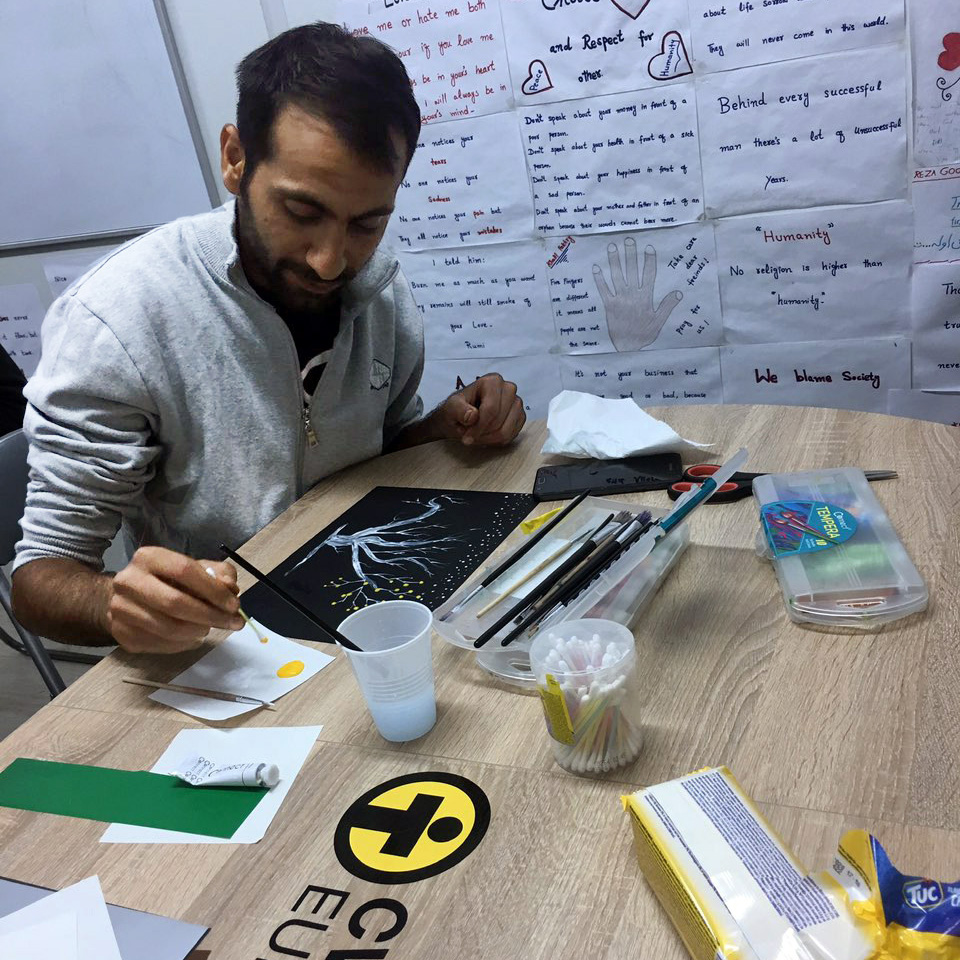
Mehrdad paints as part of a CWS program in Bosnia.

Finding an unexpected love of art

“Shiraz [Iran] is my city. I was born there, and I grew up there. When I would leave Shiraz, I always knew I would come back to my city. But today I’m not sure I will ever see Shiraz again,” says Mehrdad Azizi.

Mehrdad comes from a family of five children. “When I was 12 years old, my father left us,” he says. “My mother worked very hard to raise my two brothers, two sisters and me.” It wasn’t long, though, before Mehrdad realized that his mom needed help providing for the family. Despite being the second youngest child and merely a teenager, he got a job. “I became a welder. I would go to school and I would work…I became a head of our household.” He used his first paycheck to buy himself a mobile phone, and then he spent his earnings to cover household expenses for his family.

“I’ve always loved sports,” Mehrdad says. In his free time, he took up kickboxing. “That gave me an opportunity to travel and explore foreign countries. That’s how I traveled to Europe for the very first time. France. On that trip I fell in love with Europe. I returned home to Iran, but I was pretty sure that I would be back someday.”

The sense of responsibility that Mehrdad feels for his family runs deep. His older brother became a drug addict, and in a moment of crisis he set the family’s house on fire. “In the end, everybody gave up on him,”Mehrdad says. “But not me. I believed in him; I believed that he could be saved. Today is a happily married man, and he doesn’t use any kind of drugs.”

Mehrdad struggled with verbal and physical abuse from extended family members, and Europe remained a beacon of hope in his mind. In 2015, he and his cousin got visas to go to Europe. He made his first attempt in 2016, but as he was crossing into Serbia, one of his sisters called in tears and begged him to return home. Even though he had sunk significant time, effort and money into the journey, he returned to his family.

In 2018, he made his final decision. He wanted a life free of abuse where he would be treated as a human being, live normally and hopefully start a family one day. He had to get to Europe, and he wouldn’t be returning to Iran. “In Iran, I couldn’t have that life,” he says. He left with his cousin; his uncle was helping them pay for the trip. When they were crossing the border from Slovenia into Italy, his cousin got injured. “All the people from the group were telling me to go, to leave him behind,” Mehrdad says. “I was just a few kilometers away from Italy. But I couldn’t leave him. I stayed with him. Police caught us and deported us. Then another disaster struck: inflation in Iran. My uncle couldn’t help me with money. His son, my cousin, reached Europe, but I was stuck in Bosnia.”

“Now it’s been more than a year since I got to Bosnia. It was here that I discovered my love for art,” Mehrdad says. One day he came to the CWS program for migrants and refugees in Bosnia. In addition to the other program activities, Mehrdad stayed for a creative activity. “I took a paper and brush, and I started making moves with my hand. I forgot everything. In that moment, the only thing that existed in this world were that paper and brush. I was surprised by my talent. I never knew I had it. And the most important thing is that painting relaxed me. When I would start painting, I would forget all my problems and worries. So, I started coming to the CWS place regularly,” he says.

There were a couple of weeks when Mehrdad was having a really tough time. “While I was talking to the CWS team about it, they told me to come and visit them again after lunch,” Mehrdad says. When he came back, he found his paintings on display in front of the CWS program area. “They made an exhibition. I was really surprised. Everyone came to see it—staff and migrants and refugees. In that moment, I felt really happy and fulfilled. I will always be grateful to the CWS team that helped me discover my love and talent for art,” he says.

Mehrdad still plans to get to Europe. He says, “Now my goal is to reach England and to bring my mother there. I am planning to continue painting as a hobby. But maybe one day I will even become a professional artist and you will see my art in galleries. Who knows.”


Stories of Change


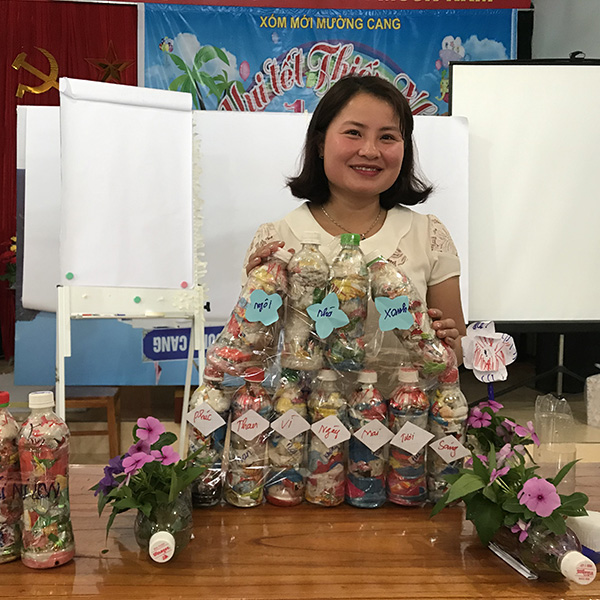
Bien with some of the completed eco-bricks.

A business owner helps reduce plastic bag use in her community in Vietnam

“Using plastic bags is so convenient!”

“Everyone uses plastic, so if I change, it’s nothing.”

“Why would I stop using plastic bags?”

These and many similar comments are ones that my colleague Dung and I usually receive when we ask people’s opinions about reducing their use of single use plastics, especially plastic bags.

The convenience of using plastics bags and other plastics is spreading from cities and towns to remote villages in Vietnam’s rural areas, where CWS works. Plastic bags are everywhere. And, once they are used – one time only – they are discarded on village roads and walking paths, in mountain streams and in farming fields. Or, worse, people burn them without knowing how dangerous burning plastic is for everyone’s health and the environment.

This is why CWS has started working with families and communities to learn better waste management, with particular focus on ending the use of one-time use plastics, especially bags. So far, our star pupil, so to say, is from Nam Sang village. Lo Thi Bien is a successful shop owner. Bien sells a lot of candy, bottled water and soft drinks that, unfortunately, generate a lot of plastic waste.

Until now, Bien has gathered up the waste her customers leave behind and burned it in her yard. And, until she joined our information-sharing session recently, she had no idea her fire created dioxin, which can cause respiratory disease and even cancer.

But she knows now, and she is changing her ways.

Immediately, Bien said she would stop burning plastic waste. And, from another thing she learned from the CWS team, she says, “I’m now very interested in making eco-bricks from plastic waste. It’s quite simple and easy. I will gather plastic bottles and bags, and candy and food wrappers, to make bricks at my home first. I will then teach and encourage others. When we have many bricks, we will use them to make benches and fences for our community culture house.” Bien also told us that she I will now use banana leaves to wrap foods for customers when she can – just as her grandparents did. And, in making her corner of the village safer for people’s health, she will save money in the bargain by not buying plastic bags!

This story was written by Nguyen Van Ty, CWS Vietnam Water, Sanitation and Hygiene Officer.


Stories of Change


Ety and two of her children in front of their kitchen.

More earning potential means more possibilities in Indonesia

Ety Pitáy is a single mom to four children who range in age from 6 to 15. She and her children live in a rural, mountainous community in West Timor, Indonesia. Before she started participating in the CWS Berdaya initiative, Mama Ety relied on processing dried corn kernels to provide for her family. She would grind about 40 pounds of corn each month to remove the hard outer shell. 

For all her hard work, Ety earned less than $9 each month. This hardly kept her children fed, and it wasn’t enough to afford to send them to school. Ety had no savings. 

The family’s future changed drastically when Mama Ety joined Berdaya, which is Indonesian for “empowerment.” The program focuses on supporting women, including to organize and lead their own savings and loans groups so that group members can start or expand businesses. Mama Ety is the secretary of one of these groups. Through Berdaya, Mama Ety also learned new skills that she can use to expand her business. “Before, I only knew how to process corn, but now, along with my corn processing, I can make sweet potato chips and marungga [a local tree with nutritionally valuable fruit and leaves] sticks to sell to snack vendors,” she says.

By adding these products to her business, Mama Ety has been able to double, and sometimes triple her income!

Thanks to the savings group, Mama Ety says, “I can improve my household business by taking out affordable loans to reinvest in myself. But not only that, I can save for my children’s education. I never thought education for my children was possible.” 


Stories of Change


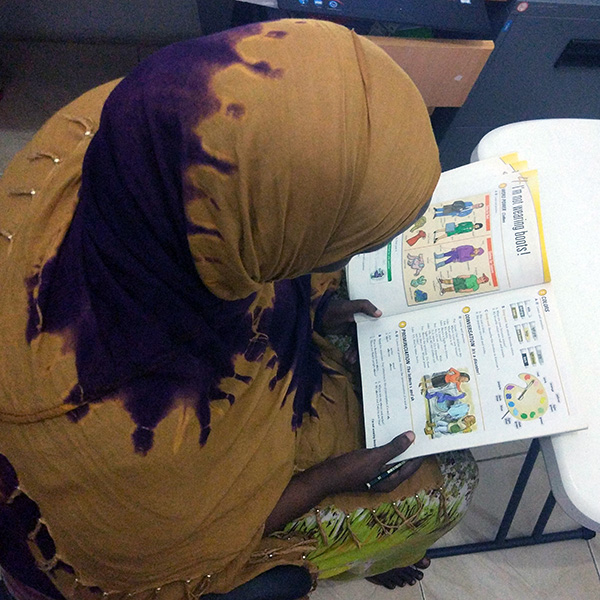
Khadra practices reading.

“Age should never prevent you from learning.”

Khadra* is a 45-year-old Somali refugee living in Jakarta, Indonesia. Her journey to Jakarta was a long and winding one across land, sea and air. Thanks to connections she had made before leaving Somalia, Khadra found other Somali refugees when she arrived. They helped her understand how to go to the United Nations High Commissioner for Refugees office to register as an asylum seeker. 

Khadra cannot read or write, so she was lucky to find someone to help her complete her registration documents. The UNHCR referred her to CWS, and we helped her settle into a CWS-hosted group home for refugee women and girls. 

That’s when she learned that for the first time in her life, education was available to her.

“Since I never attended school, I am a bit of a blind woman here,” Khadra says. She was born in an extremely remote village of just six families. The nearest town was a three-hour walk away. Even if she had been allowed or encouraged to go to a school that far away, her family had no money to pay for a uniform or supplies. So when a social worker in Jakarta told her about all of the classes and learning opportunities she had through the CWS program, she had her doubts. “At my age, I did not think I could join these activities,” she says. “But then I realized that age doesn’t matter. It all depends on your commitment.”

So, Khadra set out to learn how to read and write. Her commitment to learn was so great that these classes were not enough for her. She wanted to study more and more, so a CWS team member showed Khadra how to use a computer to study the alphabet on her own after classes ended each day. As her reading abilities grew, Khadra started reading and she practiced writing in paper exercise books. Now, Khadra can read basic sentences, and is certain that “age should never prevent you from learning. It is a lifelong process and an opportunity to not be missed. You just have to persevere.”

Education and skills development are an integral part of life for women, girls and boys in CWS-supported group homes. There are English, Indonesian, math, science and computer classes. And, life skills development opportunities help residents strengthen their readiness to live independently. Twenty-four women and girls are now living in a group home in Jakarta as are 45 unaccompanied asylum-seeking boys. All have a chance to develop new skills such as sewing, cosmetology, computer coding/programming, basic automotive mechanics and mobile phone repair. They also have a chance to study and practice arts and crafts, and to enjoy sports and yoga which, in their otherwise difficult and challenging lives, all the girls, boys and women do appreciate.

*Name changed to protect identity.


Stories of Change


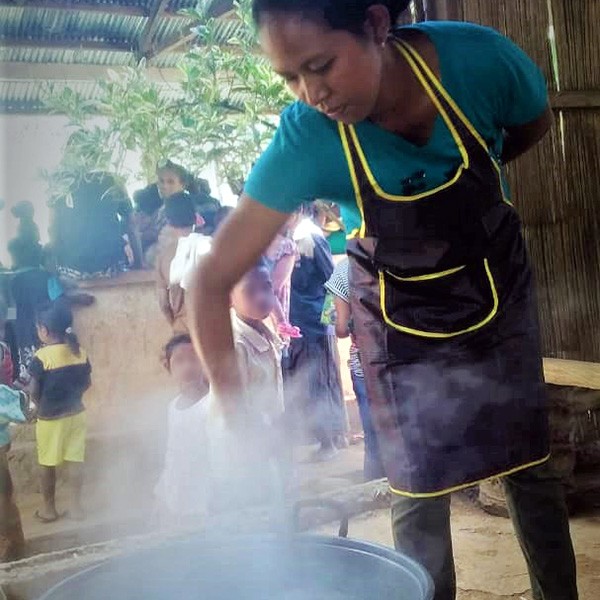
Odete makes a more nutritious version of the local favorite, rice porridge

Teaming up for better health in Timor-Leste

When our team first visited Gariana hamlet in Timor-Leste, we were surprised by how hard it was for families here to get basic health care. We heard that for two years, no one from Gariana had been able to access the government-guaranteed Integrated Community Health Services that are meant to bring doctors and other health care workers–and vital vaccinations–to rural families like those in Gariana. When we heard this, our team began partnering with Health Center staff to reinvigorate the integrated health services in Gariana.

One person who is excited about this development is Odete Martins Bruno. Odete is a mother of two who has been participating in our Timor Zero Hunger program activities. She’s excited about the return of government health outreach efforts so that her children can be vaccinated against preventable disease and her family will be able to get other health services. 

As the government’s program is being reintroduced to Gariana, our team is supplementing with additional information for families who are seeking care. Our focus is nutrition and using locally available foods. For example, we hosted a nutrition workshop on how to enhance the rice porridge that is the staple of their children’s diets with nutritious ingredients. During the workshop, Odete said, “I always assumed that my children didn’t like vegetables. But after we were encouraged to cut nutritious vegetables into small piece that blend well with the rice porridge, I was surprised to see my children eat plenty!”

This is a small but valuable lesson for Odete and other moms, too. In all, 67 mothers who have a combined 87 young children As part of the Timor Zero Hunger program, in one lesson alone in Gariana alone, CWS has a chance to support 67 mothers to properly prepare rice porridge for their 87 young children. Going forward, CWS plans to expand to more villages on both sides of the island in partnership with national health workers and community leaders for the benefit of vulnerable families and their young children’s health and nutrition.