Stories of Change


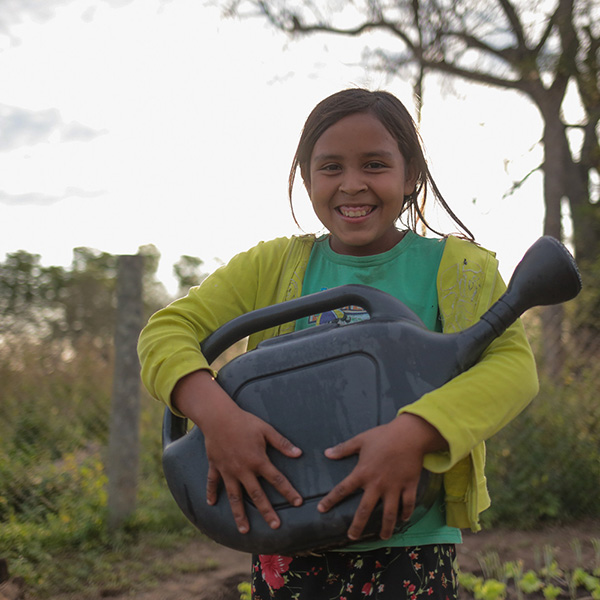
Mercedes Benitez, 10, stands in the community garden in her Sanapaná community in Paraguay. Photo: Sean Hawkey

A more hopeful new chapter in Paraguay

The average farm in the United States is about 443 acres. In rural Paraguay, a 2,500-acre farm is considered to be small to medium scale.

This vast area is known as the Gran Chaco. For most of its history, this land has been home to indigenous communities. The Sanapaná and other indigenous groups were nomadic, hunting, gathering and fishing in the largely untouched natural areas.

In recent years, however, these wide-open spaces have become home to giant commercial farms. Massive corporations have bought hundreds of millions of acres that they are using to farm genetically modified soya and corn, which is then exported. Many of those harvests end up as livestock feed in China, for example.

Meanwhile, the Sanapaná have had their movement severely restricted. As the area has increasingly been divided into parcels of private land, less and less is left for its original inhabitants. They end up living, quite literally, on the fringes of society. Some have tried to make a home on bits of land on the side of the road. Others have had their communities surrounded by private farms and end up cut off from the rest of the world.

And with their freedom of movement goes their ability to provide for themselves the way that they have for generations. They can no longer travel to their traditional hunting and fishing grounds. The precious natural environment is also suffering or being destroyed by the commercial giants.

Sanapaná families have struggled to adapt. Some have found occasional work as laborers on nearby farms. For the most part, though, they are still trying to survive by hunting and fishing, but nutrition and food security have suffered. Many families rely on traveling food salesmen to feed their families, but the food is overpriced, especially compared to their low incomes.

We recognize that the Sanapaná are in an unfair and difficult situation. So, alongside our partners, we joined these indigenous families in 2018 to help overcome food insecurity and the other challenges that come with isolation and marginalization. Now, we’re working with the Ministry of Health to make sure doctors can visit these communities. Also, a water consultant is helping indigenous communities create custom proposals so that they can advocate to the local or national government for more support for water and agriculture.

And then there are the gardens.

We’re connecting the Sanapaná people to agricultural experts and the tools they need to set up public gardens. These gardens provide a space for indigenous families to learn about and experiment with growing different types of vegetables in their local climate. Despite setbacks from flooding and droughts, families have enthusiastically taken to the gardens. They represent a new way for families to put food on the table despite having such relatively restricted land access.

The Sanapaná story is a sad one, filled with destruction, vulnerability and marginalization. By working together, however, we’re helping them turn the page into a new, more hopeful chapter.

Thanks to Growing Hope Globally for their support of the next few years of this program.

Stories of Change


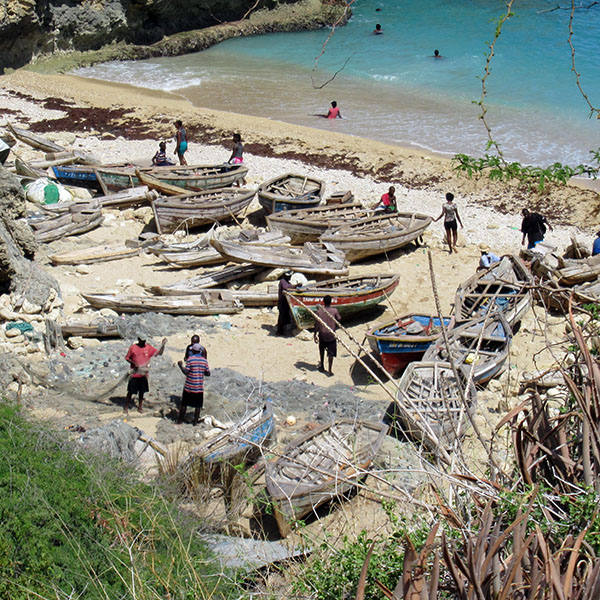
Members of APKF at the port of Rivière Côtes de Fer, returning from a morning of fishing before meeting with the CWS team.

Focusing on fishing families in Haiti

Despite being an island nation, Haiti has a neglected fishing sector.

The Ministry of Agriculture reports that more than 52,000 Haitian families rely on fishing to make a living. For the most part, though, these families are going at it alone in the face of mounting odds and stiff competition.

The Haitian government doesn’t regulate who can fish where, what size fish can be or how to protect coastal ecosystems. This entices fishers from the Dominican Republic, Jamaica and Cuba to fish in Haitian waters. These fishers usually have access to bigger boats than their Haitian counterparts, leading to a faster depletion of fish populations and heavier environmental tolls.

Because of the deep poverty in many parts of rural Haiti, fishing families usually only have canoes or small paddle boats. That means that they can only fish close to shore. With everyone fishing in the same stretch of ocean, coastal areas are overfished, and young fish do not have a chance to develop before being caught. Coastal resources are overexploited, but the open ocean is underused.

Some nonprofit organizations have attempted to help Haitian fishers in the past by providing boats or installing a system to attract fish. For the most part, though, the fishing sector isn’t one that most organizations have gotten involved in supporting, and no one seems to be focusing on community associations of fishing families.

We’re changing that through our new Fishing & Farming program in the Northwest Department, the region of Haiti with the highest rates of hunger and food security. 

Our team has a longstanding partner in the Northwest Department called GRADAID, or the Group of Research and Support for Agroecological, Innovative, Durable Development. We’ve worked with GRADAID for years to help support farmers and rebuild homes destroyed in Hurricane Matthew. Now, we’re teaming up with them again for the Fishing & Farming program.

We’ve identified an association of fishers in the town of Côtes de Fer. It has 58 members, who rely on fishing to provide for their families. The association is known as APKF.

The members of APKF already look out for each other. They start fishing before dawn each morning and wait for the last fisher to return at the end of the day before they leave the port. If someone doesn’t show up, they go to look for them before they go home. They also follow the news together and share information about weather advisories and warnings. Most importantly, they are excited to learn and improve their fishing practices together.

With support from CWS and Growing Hope Globally, GRADAID is going to provide materials and training to APKF and its members. A critical component of this program is the direct involvement of all members; too often in Haiti donated supplies end up in the hands of the local leadership and do not make it to the families who need it most. The idea and request for this support came from the community members themselves, and they already have the association in place to keep things organized and accountable. Training and information sessions will be open to all 58 families. And when supplies like boats, engines, freezers and fish aggregating devices are distributed, it will be in front of the whole association.

We’re also teaming up with APKF to improve their structure and capacity. We’ll be supporting training sessions for their members on administrative basics, and we’re helping them set up a couple of committees so that more members are directly engaged. One committee will oversee sales, and another will oversee storage, inventory and maintenance of materials. The first year of the program will focus on training and getting the committees and systems in place. Then we will begin providing materials and equipment.

Meanwhile, GRADAID will be launching advocacy efforts to encourage government officials to consider regulations that will protect both the Haitian people and their environment.

There’s a lot of work to be done alongside Haitian families who rely on fishing. We’re excited to be taking these first steps with your support.


Stories of Change


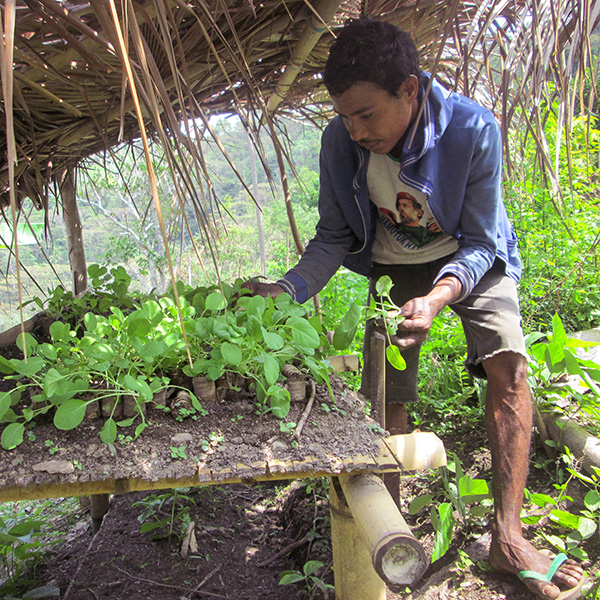
Leandro tends to his vegetables.

“This is the first time we have ever received support from an organization like CWS.”

Like most of their neighbors, Leandro Oliviera and his family depend on agriculture to make a living. Leandro and his wife, Angelita Vidigal, make about $5 each week by selling cassava and vegetables.

Unfortunately, the income source they depend on isn’t always reliable. The dry season in the part of Timor-Leste where Leandro and Angelita live runs from May to November each year. During these months, there is no water in their village. They walk nearly two miles to a neighboring village to bring back the precious water that has to meet all of the family’s needs, like cooking, bathing and drinking. They use the water first for meeting these basic needs, and then they use any run-off water from washing to water their vegetable garden. Despite their best efforts, these harvests were not good ones.

Leandro and Angelita have two children, who are just 2 and 4 years old. In an attempt to end their cycle of poverty and provide a better life for their children, the parents joined the CWS Timor Zero Hunger program in their area.

Their first step was to join information sessions with district agriculture office extension workers and CWS team members. Although Leandro, Angelita and their neighbors had a lot of agricultural wisdom and information already, there were some new practices and ideas that they could use to make their harvests even better. Leandro learned about raising chickens and horticulture, including how to make organic fertilizer and pest control, how to compost and how to better select different seeds for different seasons.

Then, Leandro and his family put into practice what he had learned. Like the other families participating in the program, Leandro and Angelita are now raising chickens. They are also growing more vegetables, some to eat and some to sell. “Our life has changed for the better since this project started,” Leandro says. “We now raise chickens and plant more vegetables, like morning glory, chili, tomatoes and eggplant. Already our chicken laid some eggs, which we ate, and then had four chicks, which we are raising.”

When our team was chatting with Leandro about how things are going for his family, he said, “This is the first time we have ever received support from an organization like CWS, so I would like to thank you for your presence and support.”