Stories of Change


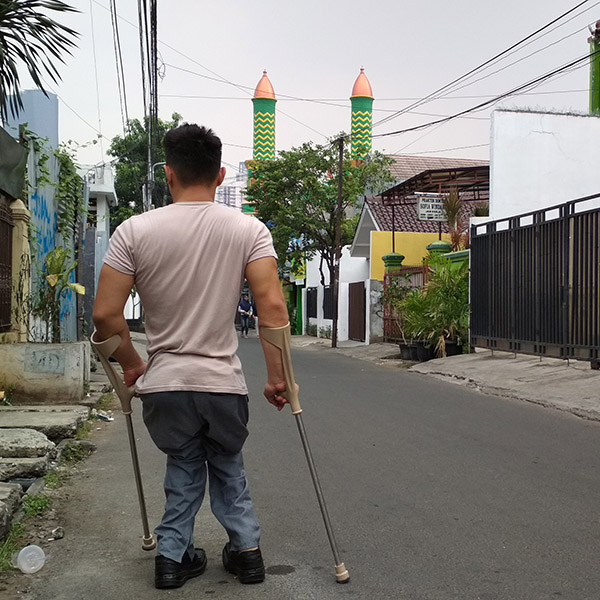
Despite the fact that he has to walk with crutches, Mohammad aspires to be a professional bodybuilder.


CWS supports 200 unaccompanied and separated refugee and asylum-seeking children in Jakarta.

Source: CWS Annual Report 2017

“I feel very safe here.”

Mohammad* is an avid sports enthusiast with a passion for weight training, and he works out regularly at a gym near his home in Jakarta. He lives with 39 other young men, all of whom are refugees and asylum seekers like Mohammad. He invited some of his housemates to join him at the gym, where he teaches them how to use the equipment properly and coaches them on their weight training.

Mohammad’s enthusiasm is infectious, and he seems to have boundless energy. He has a disability that requires him to walk with crutches, but that hasn’t slowed him down.

He is also a young man with a tragic past. He grew up in Afghanistan, but he fled the country alone at the age of 15 after his father was killed for converting to Christianity. His father’s killer threatened Mohammad’s life, too. He made his way to Jakarta through a difficult air and land journey that is familiar to hundreds of young asylum seekers. Staff from the United Nations High Commissioner for Refugees then referred him to the CWS-supported group home for unaccompanied and separated children, where he lives now. Many of the boys are Afghan, but Mohammad is the only resident with a disability.

The fact that Mohammad needs help walking never got him down, and our team didn’t let it get them down, either. They modified a bathroom so that it was easier for Mohammad to use. Social workers encouraged him to join activities in the home, and not just go to the gym alone. “It feels good to live with people I know,” says Mohammad, “They are friends and like family to me. I feel very safe here.”

While Mohammad enjoys all of the classes and daily activities that he and his housemates participate in, his favorite past time is still exercise. He aspires to be a professional bodybuilder. Whether or not he reaches that goal, he is still a role model for the other boys to be positive in the face of whatever adversity comes their way.

In Mohammad’s words, “I love sports and exercise; they make me feel healthy and happy. I’m also glad to see my friends doing positive activities. And I’m grateful that CWS supports us all for this.”

*Name changed to protect identity

Stories of Change


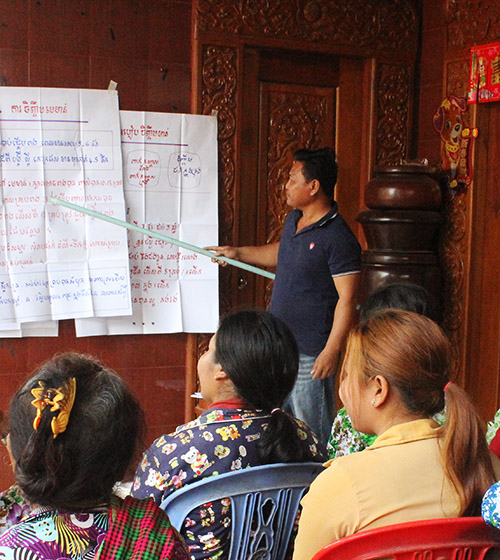
Ven is sharing what he has learned with his neighbors so that other people can be successful, too.


CWS programs in Cambodia reached more than 21,000 people in 83 communities last year.

Source: CWS Annual Report 2017

When chickens mean enough to eat, education and even home renovations in Cambodia

If you had met Bun Ven in 2007, you would have met a man who was struggling. He and his wife, Heng Samoeut, were extremely poor. Most days, they didn’t have enough to eat. They couldn’t afford the fees and uniform costs to send their daughter to school. There just wasn’t enough.

What Ven had plenty of, though, was initiative. He had the drive and energy to improve his life. His goal was to earn enough money to live a decent, if simple, life. He just needed a hand to make it happen. Then he heard about CWS.

Ven decided to learn more about raising chickens and joined a CWS program. He received a gift of a few chickens from CWS, and thus his business was born. He put his natural initiative to work, continually learning from his and others’ experience to improve his chicken-raising business.

Now, his business is thriving. He says, “From knowing nothing about chickens, I am now running a successful business so my family has enough food all year round, my daughter goes to school and we even saved some money to renovate our house. I now earn around $1,500 each season from my rice harvest and from chicken-raising.”

Ven is always on hand to answer questions and coach his neighbors. In fact, he works as a livelihoods educator-trainer, sharing his practical knowledge and skills with others in his community. His expertise about raising healthy chickens includes cage preparation, proper feeding and disease prevention, especially through vaccination.

When he thinks back to 2007, Ven says, “I am so thankful for past support, and now for helping me use my knowledge and skills, which I learned because of CWS, to confidently share my knowledge with other community members.”


Stories of Change


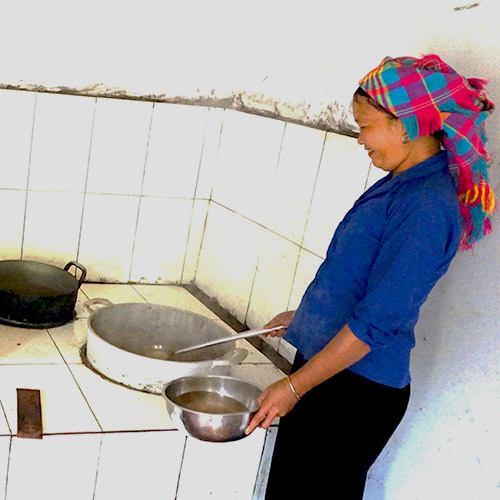
Cooking on the new stove in the new kitchen at the preschool in Lun village.


CWS efforts in Vietnam positively impacted 40,036 people in 69 communities this year.

Source: Annual Report 2017

“Smoke No Longer Gets in My Eyes”

Like many other schools in rural mountainous areas in Vietnam, the very remote Ta Mung kindergarten has an even more remote satellite school in Lun village. Amazingly, nearly 100 preschool-age children between ages three and six come to learn and play for the whole day for five days each week.

The school staff cook lunch for all the children every day. This used to be a challenge because the stove was just several iron bars atop some stones in the bamboo hut that served as a kitchen. That’s a lot of mouths to feed with such a limiting tool! Can you imagine the danger – not just from a possible fire but from the smoke that also made the food taste bad? To make matters worse, the ash and smoke reached the young pupils and their teachers in nearby classrooms.

In the scope of ongoing work with government and donor partners to support rural ethnic minority communities in improving their daily lives is as many ways as possible, the CWS Vietnam team was happy to work with the Ta Mung and Lun village kindergarten teachers to change this situation. In addition to helping make the kitchen safe with bricks, a metal roof and tile floor, CWS team members also introduced and helped build an improved stove. It still uses firewood, but it has a closed oven with a brick chimney. Now, cooking is more efficient and the stove doesn’t send polluting smoke and ash toward the classrooms.

Once these small but important changes that the village could not have made on their own were completed, Ms. Lo Thi Phen, the school caretaker, said, “The new stove is so good! It is very clean, helps us cook faster and it saves us a lot of firewood, too. I am very happy, especially because the smoke does not hurt our eyes like it used to.”

While visiting the kindergarten recently, Mr. Ha Van Dinh, who has lived in Lun village his whole life, was also surprised. “This is the first time I have seen such a good stove that requires less firewood and has no smoke. I want to make one for my family, too.” The CWS team was happy to hear this, and will work with anyone in Lun village, and beyond, to help them improve their lives while saving trees, too!


Stories of Change


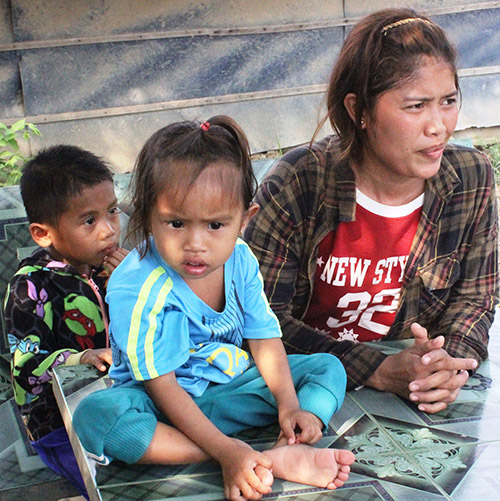
Ratha and her children.


Last year, CWS programs in Cambodia reached 21,373 people in 83 communities.

Source: Annual Report 2017

Healthy children mean a more hopeful life

Bun Ratha and her husband, Horm Chanthorn, are the parents of two little ones, a four-year-old son and a two-year-old daughter. They are farmers living on Ratha’s mom’s land in Rung Chrey village in western Cambodia. They raise ducks for a living, but they don’t make enough to get by and are trying to pay off a high-interest loan that they took out to buy the ducks.

Their financial struggles, combined with the fact that the children were constantly ill, were taking a toll on the family. Their community connected them to the CWS Promoting Better Lives program, which is implemented by trusted local partner Rural Development Association.

The first thing Ratha told us when we visited with her is that she knows that both of her children are underweight and likely malnourished, which is why they are always sick. When we spoke, she said that when given the chance, “I joined some information sessions that CWS supports; and I have learned a lot about nutrition.”

Being reminded, along with other mothers, that good nutrition helps keep children healthy was a first step forward for Ratha. In talking about the information session, Ratha noted, “Since my daughter was severely underweight, the CWS program supported me to take her to the local government health center for immediate treatment, which helped her a lot.”

Now Ratha brings both her children to CWS-sponsored supplemental feeding groups where young children eat nutrition- rich, multi-ingredient porridge that mothers learn to make from local ingredients. So, change is not expensive and can be made at home. Happily, Ratha also told us, “Both children, but especially my daughter, have gained weight and are growing healthier. They rarely get sick like they did before.” And, she continued, “I am happy that we don’t need to spend money for drugs and other treatments, or time worrying and caring for sick children. Now I have more time to focus on work and helping Chanthorn raise our ducks so we can pay off our loan and make a better life. I am so grateful for the support.”

Knowing that it is likely Ratha and Chanthorn may need more support to get their lives and livelihoods on a more positive path, CWS is ready, alongside trusted local partners, to welcome the couple to other activities that can help them live lives of dignity and worth. When we met them, they were quite hopeless and a bit stuck in a bad situation; now, with a little help, they are more hopeful, and CWS is proud to be there to accompany them further on their journey if they want.


Stories of Change


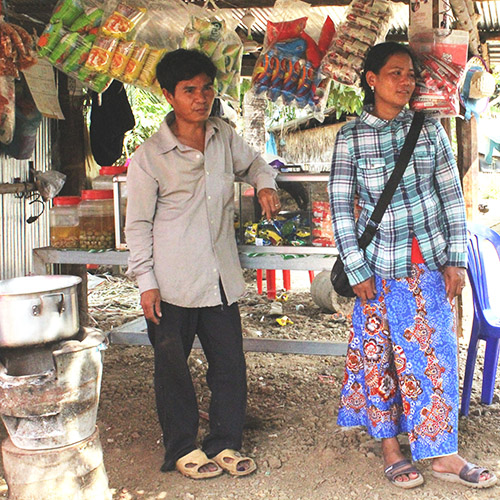
Oeun and Pich.


At the end of last year, 71% of the families that CWS partnered with through our Promoting Better Lives program were considered food secure. That is up from 39% at the beginning of the year.

Source: Annual Report 2017

From hunger to saving for a house

Touch Oeun and Kun Pich sowed and harvested vegetables twice a year. They were better off than some of their neighbors in their village in western Cambodia because they had a garden to plant, but they still often didn’t have enough to eat.

Oeun was eager to provide a better life for his family, but he didn’t have the resources or training to do it. That’s where CWS and our local partner, Rural Development Association, came into play a couple of years ago. Our Promoting Better Lives program in this part of Cambodia works largely on a referral system. When we learn about a family like Oeun’s that is particularly vulnerable, we reach out with training and supplies to help them achieve their goals.

Oeun already had the commitment to create a better life for his family. We worked with him on techniques to better irrigate his garden, and helped him expand his vegetable varieties through new seeds. He also learned how to compost and how to properly use natural fertilizer.

When our team talked visited Oeun in June of last year, he told us, “By using the information and knowledge I gained to grow a variety of vegetables using a natural fertilizer and natural pesticide, too, I reduced my production costs!”

Oeun is saving lots of money because he is no longer buying chemical pesticides and fertilizers. He has managed to double his income to 1,000,000 Cambodian Riel ($250) per harvest! His family used to struggle to get by each day. Now, Oeun has enough to support his family, and to have some savings, too.

In order to ensure that they could continue the momentum, Oeun and Pich decided to join a savings group with their neighbors. When our team saw them in February, they told us, “Seeing the market demand in the village, we decided to borrow 300,000 Riel ($75) from the group to start a small grocery shop and to sell grilled chicken when there is ceremony in the village. In less than a year, the expanded garden and new business activities are running well and netting about 30,000 Riel ($7.50) most days. In the last four months, after our expenses, we saved $300! We have just used $150 from savings to expand the shop and add more profitable items for sale such as beverages and pre-paid phone cards.”

The couple proudly added, “Now our family not only has enough to eat, but we can stockpile so we do not have to worry about a future food shortage. And we can afford for socialize with other villagers at
weddings and other ceremonies, where we make connections. We continue saving with the neighborhood savings group and we have our own separate savings, too. We dream to have a proper house to live in, and now we are planning to start! We will build a 5m x 6m (320 square feet) home later this year or early next, and we are so thankful for the changes that CWS and Rural Development Association have helped us make!”


Stories of Change


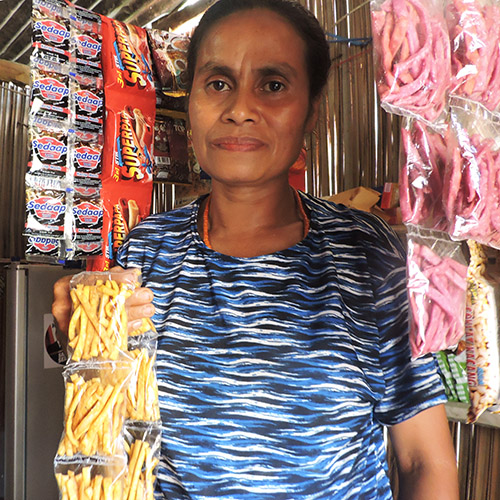
Mama Jeni in her kiosk.


CWS efforts in Indonesia positively impacted more than 17,000 people in 16 communities last year.

Source: Annual Report 2017

Saving for an even brighter future

Jeni Liunokas, who goes by Mama Jeni with her friends and neighbors, is a mother of three and an active member of the Fetomone women’s savings group in Enonabuasa village in West Timor, Indonesia. Mama Jeni and her neighbors started the group through the CWS Timor Zero Hunger program. Specifically, it’s part of the Berdaya initiative, which is funded by the Disciples of Christ – Week of Compassion.

One aim of Timor Zero Hunger is for families to have more and more nutritious food, especially a variety of vegetables and protein-rich eggs and chicken meat. Another aim to help women find opportunities through Berdaya, which means empowerment in Indonesian, to improve their lives in other ways.

Since starting their group in Enonabuasa, members have developed three business units: 1)savings by and loans to group members, 2) farming and 3) weaving. With CWS support, they have also organized several workshops to help them increase and better manage their income.

Before joining the savings group, Mama Jeni only had modest income from occasionally selling her handwoven textiles and selling celery from her garden in a local market twice a month. Her husband raises pigs and cultivates mung beans and is a village health volunteer. The family is doing okay financially, and they are able to send their younger children to school. They were even able to save enough money for the oldest child to manage the $13/month tuition at a teacher training college in the nearby town, Soe.

Despite the family’s relative financial security, daily life is still difficult. And, like most moms, Mama Jeni wants a better life for her whole family. She wants to be more secure in case of an emergency – like longer or more severe drought, which Enonabuasa and all villages in this part of the world are increasingly experiencing.

So, like women the world over, Mama Jeni was ready and waiting to change her situation for the better. With her micro loan from Fetomone and some technical support from CWS, she opened a small kiosk next to her house, where she now sells homemade snacks. “I learned to make snacks from pumpkins, sweet potatoes and bananas,” explains Mama Jeni. “I’ve earned almost four-times as much money (gross) as the 50,000 Rupiah I borrowed from Fetomone and, after I bought a food processor so my snack-making is more efficient, I repaid my loan in full, including interest. My routine income is higher now, and I am saving money especially so my younger children can have more education, like their older sister, if they want.”


Stories of Change


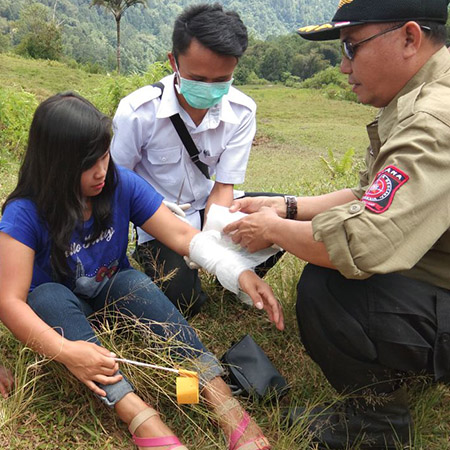
First aid practice as part of the SOLIDARITAS program.


The SOLIDARITAS program reached 7,000 people last year.

Source: Annual Report 2017

It takes a village to prepare for an emergency

Mudslides and localized flooding from heavy rains are a problem for the North Toraja district in Indonesia. Father Yos has concluded that it takes a village – literally – to be prepared to respond. He knows how important it is to maintain coordination, not just among individuals taking action but among groups that are responsible for people’s survival and safety when a disaster strikes, like local government and the Indonesian Red Cross.

Rev. Yosmart Tolede, known as Father Yos, is the coordinator of the emergency responders within North Toraja’s Social Welfare Office. As someone who is active in his community as well as in his church, he longs to help the most vulnerable people who are affected by disaster. According to Father Yos, a disaster is a shared burden, and response is a shared responsibility. Most of that responsibility, in fact, falls to the strong and well-prepared, not those most likely to suffer most from the disaster. “The Bible says, ‘Love thy neighbor as you love yourself’ and so, for me, as a pastor, I feel that it is not enough to pray for the people most affected by disasters; I long to help them immediately, directly and materially, too,” he says.

Fortunately for Father Yos, CWS and the SOLIDARITAS program are there to help him achieve his aims.

Before SOLIDARITAS, no villages in North Toraja were prepared for disasters, and staff from the newly-formed District Disaster Management Agency were unsure about their role. Agency staff lacked guidance and guidelines about how to lead and manage an effective emergency response if one were needed. There was no practical coordination of all the people and agencies involved in disaster  preparedness and response management. Therefore, a key purpose of the SOLIDARITAS program, which CWS implements with funding from the Australian government, is to improve communication and coordination among communities – especially their leaders, like Pastor Yos – and the government departments and teams from the District Disaster Management Agency and District Social
Welfare Office, among others. As part of our commitment to local partnership in our programs, local North Toraja organization INANTA Foundation is also involved in activity design to bring a grassroots perspective and understanding that can foster the needed coordination among everyone involved in disaster preparedness to respond as well as the actual response when needed.

The thing Father Yos likes most about SOLIDARITAS is that it is not only helping leaders and managers strengthen coordination; it is also helping villagers increase their knowledge about disaster causes and ways to mitigate their impact, plus awareness and skills to act effectively when a disaster does happen. He says that activities like a recent disaster simulation held in Likulambe villag are a perfect way to test everyone’s ability and motivation to take on their roles and responsibilities – and to protect others, especially the most vulnerable, just as we would want them to protect us if we are not able to protect ourselves.


Stories of Change


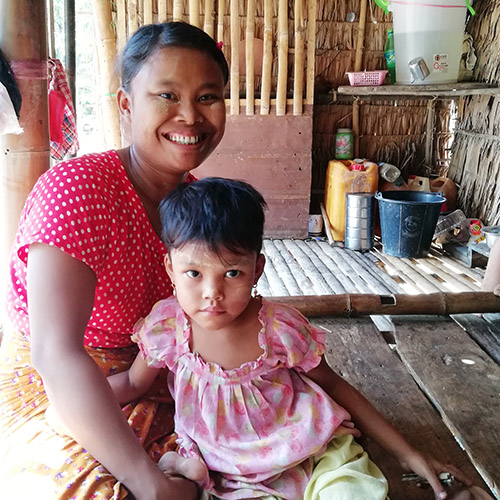
Ma Aye and her youngest daughter.


Through nutrition education, DRR and water, sanitation and hygiene programs in 20 villages in two Ayeyarwady region townships, CWS helped 2,431 families – nearly 12,000 people –take steps towards improved wellbeing last year.

Source: Annual Report 2017

A healthy foundation for finances and nutrition

The far-flung Ayeyarwady River – and its hundreds of powerful tributaries – dominates the landscape in Myanmar’s Ayeyarwady region. Here, the river is a source of livelihoods as well as unique challenges.

Ko Myo Kyi and Ma Khin New Aye live in Taung Tar Yar village in the region. Ko Kyi and Ma Aye have three children: 12-year-old Okka Maung, 10-year-old Moe Pyae Thazin and a toddler named Chit Phue Hnone.

In the dry season, the couple earns 300,000 Kyat ($250) growing chilies and corn on the half-acre of land they own. In the rainy season from June through November, their land is underwater and thus they can’t plant.

Ko Kyi is not a fisherman, and they have had no other ways to earn a living during the rainy season. Out of desperation, they have taken out high-interest loans from commercial lenders for years just to buy food and pay basic expenses.

Because of this difficult situation and the fact that they have a young child who needs a better diet, their community nominated this family to participate in a CWS nutrition education program funded by Japanese company Ajinimoto. Grateful for the help, Ma Aye readily joined in all the education sessions about nutrition, hygiene, sanitation, chicken-raising and home gardening – all of which combine, of course, to help families have healthier children starting from their earliest years.

Ma Aye received three hens and a rooster when she finished the nutrition course. Since then, she has used her new knowledge to start a home garden and raise the chickens, which are already laying eggs to help her improve her children’s diet. She has five baby chicks to expand the brood. Ma Aye’s garden has watercress, long beans, okra, spinach and pumpkin, some of which she cooks regularly to further improve her family’s diet. When we spoke to Ma Aye recently, she smiled and said, “Now I have more information and know how to prepare well-balanced meals with vegetables and eggs for protein to help my children grow healthy. And, though I honestly never thought about it before, I also wash my baby’s hands before meals and I make sure the older children do to.”

From the conversation, our team is confident that Ma Aye knows how to prepare nutritious food properly and to monitor her youngest child’s growth to make sure she grows strong. So far, the family has used their vegetables and eggs only for themselves; but if she’s like her friends and neighbors who have participated in this program, before long Ma Aye will be selling her extra eggs and chickens for much-needed cash, and adding chicken meat to the family’s diet. Slowly but surely, she and the CWS team are confident, she and Ko Kyi will be creating a better life for themselves and their children. They plan to work their way out of their old debts, too; and then – who knows what more good can come? For now, because of their partnership with CWS, they are hopeful and on their way.


Stories of Change


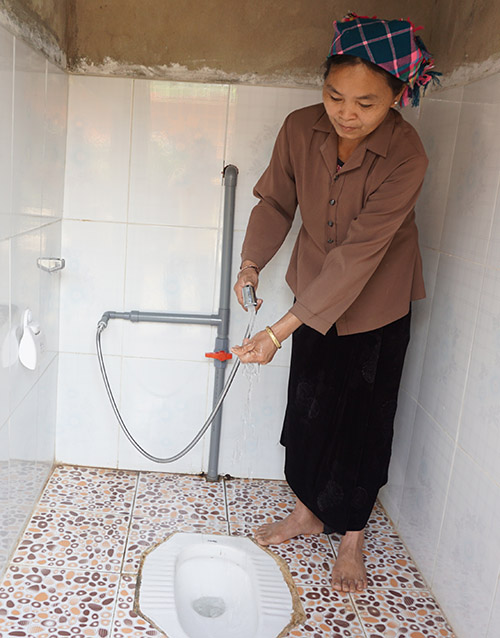
Lo Thi Cay cleans her new latrine.


Last year, our team in Vietnam helped 21 communities get certified as Open Defecation Free.

Source: Annual Report 2017

For almost 20 years, we didn’t know this basic information.

Lo Thi Cay isn’t among the poorest people in her remote village in northern Vietnam’s Than Uyen district. Her family has some land for rice farming, a few pigs to raise for eventual sale and a small fish pond that adds income when fish grow large enough to catch and sell. They own a clean, well-kept brick house, which was built in line with age-old customs and lifestyles among the Thai people who have lived in the area for more than 20 years.

Based on those customs, though, Cay’s family home doesn’t have a bathroom and toilet. Every day, she, her husband and their daughter go to a nearby stream nearby for bathing and toileting. Imagine doing both those things in the same water! But, to Cay and her neighbors this is just a normal part of daily life.

CWS, in partnership with the Vietnamese government and the Evangelical Lutheran Church in America, identified Cay’s village as one that needed extra support on hygiene and sanitation practices. Our team held an information session on hygiene and sanitation at the community house. Cay and other participants saw graphic, real life examples of ways that bathing and toileting in the same place are bad for their families’ health.

Suddenly, Cay understood the situation much better. She told us, “After attending the CWS-hosted gathering at the community house, I felt so disgusted about the unsanitary situation I was part of, I was determined to build a toilet for my family.” Along with the other households in the village, Cay’s family installed a toilet in January. Cay’s family went one step further and used some of their resources to build a bathing room next to their toilet.

“For nearly 20 years, my daughter, husband and I have gone to the stream for open bathing and toileting. I didn’t like this as I knew, somehow, that it was not safe. But, we did it because we had no bathroom to use – not even information about a better way! But now, after CWS friends visited, my husband understood how to live in a healthier way, and he agreed to build the bathroom and toilet. I am so excited to have these,” Cay said.

The CWS program here that partners with ethnic minority communities is called NEW IDEA, which stands for New Integrated Development and Essential Action. This CWS-ELCA program came to Cay’s village, Na Dan #1, in September as part of our Community-Led Total Sanitation model. Within four months, all 68 households had new hygienic latrines and the village is recognized as an Open Defecation Free community. This designation is a very important one in rural Vietnam, and it’s a point of pride for the community members. Clearly, hundreds of people have better protected health now because of the teamwork the project has engendered to contribute positively in changing knowledge, awareness and behavior in rural Vietnam.


Stories of Change


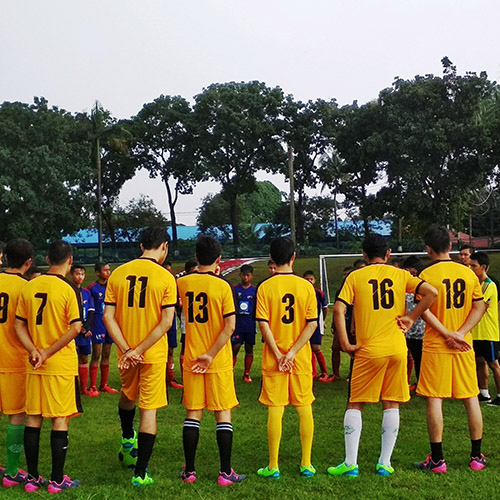
Refugee youth (in CWS yellow) prepare to play.


200 unaccompanied refugee youth live in CWS-supported shelters in Jakarta.

Source: Annual Report 2017

Why we’re here in the first place

Soccer holds a special place in the hearts of millions of adults and children around the world. It’s a time for teamwork, for exercise and for joy.

For refugee children in Jakarta, soccer has an additional meaning: freedom. In particular, many boys who have arrived in Indonesia seeking safety and asylum from war-torn countries – without their parents – find a moment of freedom when they play. It’s a time to put worry and fear about the future aside, and just play.

Most or all children who are smuggled into Indonesia by circuitous routes – most of whom are teenage boys – think they are in transit to a third country for a new life. Nearly all end up stranded in Indonesia with little hope of onward asylum.

While they are in CWS care and protection, each receives a small weekly allowance. Most of the money gets pooled to buy food that they cook communally. By living in a CWS-hosted group home, they get a roof over their head and a safe place to sleep. Unfortunately, these services are only for unaccompanied children, so the youth age out of our program when they turn 18.

Imagine, in such circumstances, how much three hours a week to play soccer must mean to these children. It is an active time in an open outdoor space where they can run, laugh … and even let off some steam, which surely builds up in living with 39 other children day in and day out. Some children excel and feel pride; others do less well, but keep trying and, no matter how they do at the sport, they love being active and outdoors.

Knowing that CWS organizes soccer outings for children in our protection, Indonesia Garuda Baru, a team of Indonesian homeless children participating in Street Child World Cup 2018 , invited CWS to have a friendly match to help them prepare their World Cup debut.

CWS staff readily accepted the invitation. Not only was it a great chance for the kids in our program to have one more hour for their play time, but they would also get to know some Indonesian children,  which they seldom have a chance to do. And, besides giving them more time on the field, another bonus is that their practice matches may help Indonesia win a very special World Cup!

Now, boys from a combined-shelter team are readying for the “friendly” challenge with excitement. As they practice with their new coach to play in their very first match as a united team, these boys represent hope and resilience.

Nowhere is this exemplified better than by 16-year-old Aman,* who was very happy when he was chosen for the team and received his TEAM CWS jersey … and new soccer shoes.

Nearly a year ago, Aman was referred to CWS for care because he was ill from rough living on the streets after a long journey from Afghanistan. With CWS support, Aman got to a hospital, where he was diagnosed with Pulmonary Tuberculosis with Pneumothorax. Just two months ago he had a special, complicated medical procedure to get the water from his lungs – which worked!

For Aman to be able to play soccer once again as he did back in Afghanistan is a miracle for him. For our team, watching him being healthy and active reminds us of the reason we are here in the first place – to offer essential protection and care to some of the world’s most vulnerable children. Seeing Aman score a goal during the “friendly” match was just a bonus!

*Name changed to protect anonymity.