Stories of Change


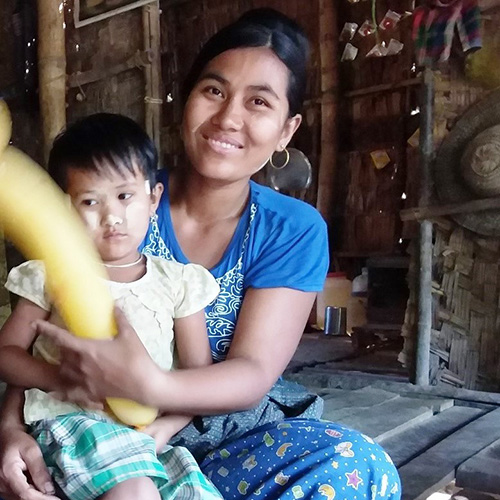
Ma Khaing with her daughter, May Phu Khaing.


Last year, nearly 19,000 people benefited from CWS and partner initiatives in Myanmar.

Source: CWS Annual Report 2017

Chickens, vegetables and dedicated parents mean a healthier child in Myanmar

Put yourself in Thin Thin Khaing’s shoes for a minute. Imagine being a 27-year-old who lives in rural Myanmar with your husband and four-year-old daughter. Your family has about an acre of land, which you can use to grow chilies during the dry season. You earn about $29 each month selling chilies for the six months of the year when your land isn’t flooded.

But that’s it.

For the other six months of the year, you can’t grow anything on your land. You and your husband try to earn something as wage laborers, but finding that work is difficult and unreliable.

Even with a small income, you thought you were doing a good job of keeping your daughter healthy. You thought you were feeding her well. Then there’s a nutrition survey of the children in your village, and you learn that she’s technically malnourished.

How would you feel? As a parent, what tools and knowledge would you want?

When Ma Khaing found herself in this situation not too long ago, it hurt. She learned that her daughter, May Phu Khaing was malnourished. “I thought I had taken good care of her, so I did not feel good about her condition and I wanted to learn more about nutrition and hygiene to help her grow up healthy,” she says.

CWS offered nutrition education activities in her community, and Ma Khaing went to all of them. “I joined all the education sessions offered by CWS, and I did not feel shy or ashamed to ask questions. Also, I practiced cooking new foods and in new ways at home. I also shared what I learned with my neighbors, and with May Phu Khaing’s grandmothers and other relatives,” she explained.

Once Ma Khaing had completed the nutrition and hygiene education work – and because they were prioritized by the community to receive support based on their limited income –  her family received a rooster, three hens and plastic netting to create a caged area for them. They also received seeds to plant water cress, spinach, long bean and pumpkins along with gardening tools. This combination of chickens and vegetable seeds helped her parents jumpstart improving May Phu Khaing’s health and the family’s overall well being.

A few months later, the family had 10 new chicks and lots of eggs. Ma Khaing cooks a variety of dishes with her home-grown veggies, fresh eggs and chicken meat and makes sure May Phu Khaing eats protein at least two days each week.

When she talked to our team, Ma Khaing told us with a proud smile, “I am happy to see my daughter enjoy eating every day. She has not had a cold or diarrhea in many months, and her weight and height have increased a lot.” She added, “My daughter’s progress has motivated me even more to take good care of her with healthy meals and better hygiene, especially hand-washing before meals and after using the bathroom. We are grateful to CWS and their supporters not only for material aid but also the chance to gain knowledge, which has helped me change my awareness, attitudes and action for my child’s development. I will continue to pass on my knowledge and experiences to others because I want every child to grow up healthy like my daughter is now.”
Stories of Change


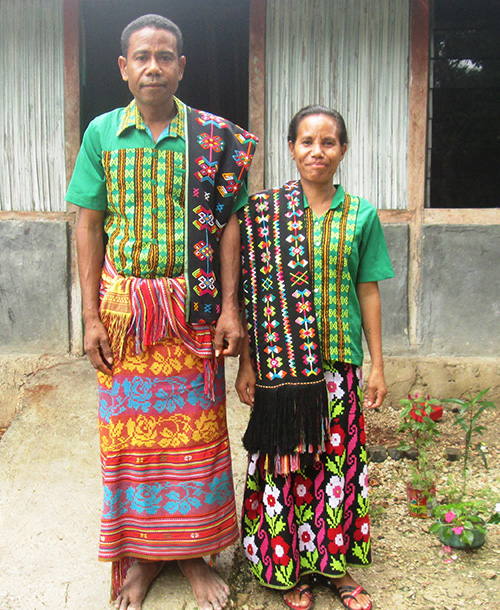
Mama Yance and her husband Samuel wearing traditional ikat textiles.


CWS efforts in Indonesia positively impacted more than 17,000 people in 16 communities last year.

Source: CWS Annual Report 2017

Group savings, expanded businesses in Indonesia

Yance Tefa is better known by Mama Yance in her community in remote southern West Timor. She lives with her husband and four kids, who range from four to 16 and are all students.

Like most of her neighbors, Mama Yance is a household farmer. She raises pigs for her primary income, while many of her neighbors raise corn or other crops. In addition to her pigs, Mama Yance and her daughter also earn income by weaving traditional ikat fabric for ceremonial shawls – which are worn in weddings and funerals – and blankets. She can sell these items for a nice profit.

Mama Yance is doing better now than she was even a few years ago. She has recently expanded her weaving business, and she has also increased her farming activities. She now has a vegetable garden, which has helped improve her family’s diet while providing yet another income stream.

These improvements happened because Mama Yance is both ambitious and diligent, and CWS was able to support her accordingly. CWS has been supporting the women of this community through our Berdaya (“Empowerment”) Initiative for the past year. The program, which is funded by long-time partner Week of Compassion, focuses on helping women and girls. It has been enthusiastically received here, particularly among mothers.

One of the main advances that Berdaya helped the community make was to start a savings group. We didn’t need to provide funding. Instead, our team provided some technical assistance, advice and a lot of encouragement. “A year before CWS came to this village, I and some other mothers were working with textile buyers from nearby Soe town to sell our ikat in Kupang. Kupang is our biggest city and a place where we could potentially have more customers. However, the problem we faced was the lack of enough capital to buy thread and other materials in large quantities, so the number of ikat scarves we could weave was small. The profits we had from selling our pigs or vegetables was quite small, with not much left after we paid our bills each month,” Mama Yance explains.

Forming the savings group enabled the women to get that capital that they needed. “When CWS approached us about Berdaya a year ago, we figured we could learn a lot and benefit ourselves through the education and training being offered. And, we were right, especially in creating our savings group! We started with $23 of our own money; after just four months we had $61, which we used, in small loans to individual members, to buy yarn and other weaving supplies and tools.”

Thanks to CWS, the group also learned about basic bookkeeping, business opportunity assessment and planning, market assessments and marketing ideas. With these principles in mind, Mama Yance was able to move from one $15 loan – which she repaid quickly after selling two shawls for a nice profit – to another, and then another. Each time, she increased her inputs (thread) and outputs (shawls and blankets) to grow her profits. During four months she wove six shawls and two blankets. She sold four shawls and both blankets for $69 in profit!

“With this assistance from CWS, I would like to encourage all members of Berdaya-inspired savings group to try new business opportunities since we all have the benefit securing start-up loans. For those of us weaving ikat textiles, I hope that our collaboration with the buyers from Soe will continue to go well so that our handiwork can be regularly and increasingly sold in Kupang for more and more profit,” Mama Yance says. In addition to profit, Mama Yance and dozens of other women in West Timor are increasing their pride alongside their profits by bringing their talents to bear for their families in improved livelihoods and well being.


Stories of Change


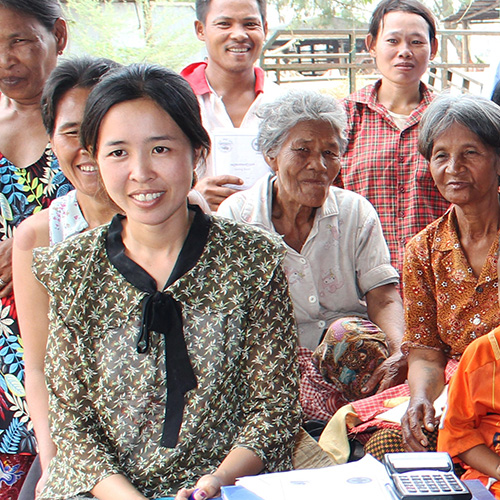
Rany (front) with members from her community savings group.


CWS programs in Cambodia reached more than 21,000 people in 83 communities last year.

Source: CWS Annual Report 2017

Sanitation and savings: Rany’s impact in Cambodia

At 29 years old, Noun Rany is a champion for health and hygiene in her Cambodian village of Tumpung Cheung.

Rany joined a CWS program in late 2016 to learn about the importance of clean water, good sanitation, proper hygiene and basic information. In a village where most people can’t read, Rany has a higher literacy level. Between that and her commitment to raising the standard of living for her family and neighbors, she was a great choice to be the WASH Focal Person for the community as well as a Self-Help Group committee member.

WASH, which refers to water, sanitation and hygiene, is the foundation for good health in a village like Rany’s. In her role as Focal Person, Rany is helping her neighbors learn about safe water, diseases and the importance of sanitary latrines and good hygiene. “I want to see all villagers have better living conditions; I especially want all the women to have a better understanding of good health and hygiene,” she says. And her work is paying off. She says, “I notice that people now have a better understanding than before and they protect their health by drinking filtered water, washing their hands properly and using a sanitary latrine.”

The Self-Help Group, which is a community savings organization, is a key to fighting the poverty that is so entrenched here. Nearly all families in Tumpung Cheung rely on daily wage labor for income. That means that they are relying on an income stream that is inherently unreliable, and even when work is available, the income it yields is not high. With such limited capital, families can’t effectively cope with any shock to their daily lives, like health challenges or natural disaster.

Rany saw too many of her neighbors going to moneylenders when they were in need, and they ended up saddled with high interest rates that they couldn’t afford. Some couldn’t even get a loan at all because they don’t have an asset that can be used for collateral. So, Rany took action. She started a savings group with 14 women and seven men. Each member contributes a small amount monthly, and members can borrow from the group at a reasonable rate. Rany serves as group facilitator and record keeper. She says, “I am so happy and am enjoying my work, which gives me an opportunity to help my community!”

Community champions like Rany are hard at work all over the world, using their skills and knowledge to help the people around them. And we’re glad to be able to help them as they do it.


Stories of Change


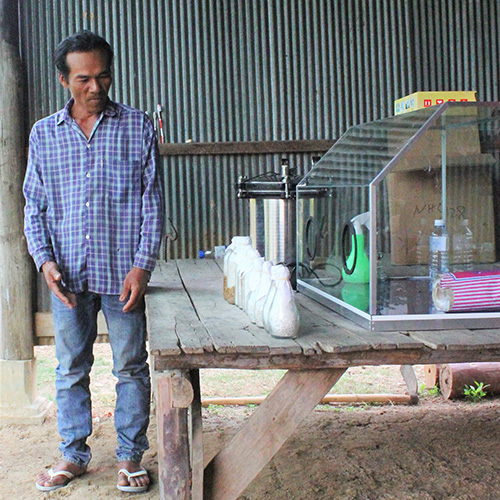
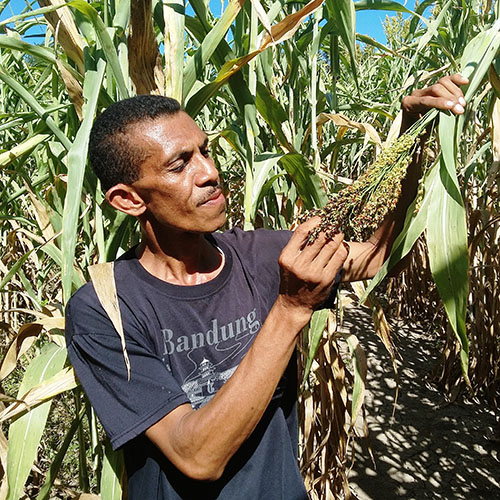
Maxi inspects his sorghum.


CWS efforts in Indonesia positively impacted more than 17,000 people in 16 communities last year.

Source: CWS Annual Report 2017

Crop diversification for better family diets in Indonesia

Maxi Taneseb and Fince Yane Baifeto live in a small village in West Timor with their three children. Because of their poverty and ambition to live better, the family joined CWS in Timor Zero Hunger activities in January 2017. With CWS support, they started to improve the way they grew vegetables and raised chickens, and they also started working towards better access to clean water and a family toilet – something they did alongside others in Noemuke village who also wanted to improve their economic status for better food security and their children’s health and nutrition.

When we spoke to Maxi recently to see how the family is doing, he said, “One of the biggest problems we face is not having enough food – almost every year,” So, with CWS support his family and their neighbors joined a pilot project to learn about growing sorghum to diversify their staple crops. We planted sorghum in the past,” Maxi recalled, “but I haven’t seen anybody planting it for more than 20 years, and I don’t know why. In the past we planted it together with corn; but the yield from sorghum was quite low compared to corn and people also did not know its nutritional value”.

Since Timor Zero Hunger focuses on helping families consider alternative crops and ways of growing them, the idea of returning to sorghum was raised and Maxi planted 10 acres of the crop when, he noted, “We learned from the CWS team that sorghum grows best when it’s not planted together with other crops.” With this, he continued, “I harvested about 200 kilograms (441 pounds) of sorghum. That’s pretty good [since we have had so little rain]. If there is more rain, 10 acres should yield 300 to 350kg (660 to 770 pounds). But, if rainfall is lower, which is happening a lot now, the yield will be only about 100 kilos. “[For now] I’m happy because my family has food other than corn that I now know is really nutritious. So, I’m proud that my family and I have been able to set an example for our neighbors. Sorghum is ideal for our dry climate as it does not require a lot of water” – something that many Indonesian farming families must now consider given their climate’s shift toward less and less rain.


Stories of Change


Three of our new volunteer teachers who work with unaccompanied refugee children in group homes that CWS supports in Jakarta.


200 unaccompanied refugee youth live in CWS-supported shelters in Jakarta.

Source: CWS Annual Report 2017

Role models in Jakarta

About 100 unaccompanied and separated refugee children in Jakarta just started new classes. These kids live in  CWS-supported group homes. They had just had a two-week break and were excited to get back to learning. It was also an exciting time for their 13 teachers, all of whom refugees themselves. On that first day of classes, five of the teachers were new.

Three of these teachers were new to teaching, but not to the group home. In fact, they had been living in these homes themselves until a few months ago! Now they had reached 18 and are no longer considered children by international standards. Like other new adults before them, they left the homes to face the challenges of living independently outside the protection of a strongly-supported group home.

We needed to find more teachers, and this was an opportunity to help these young men ease their transition away from the homes. CWS recruited the volunteer teachers, who will now receive a small stipend and still be in contact with social workers as well as all their friends in their homes.

After the first full week of teaching, the three new teachers shared news of their experience. “I think some of the students are very keen to learn,” said one teacher, while another noted that his students are very polite as he gets to know them better – but from a different perspective.

“My students are very enthusiastic,” says the third teacher, “and they are very happy to have one of their friends teaching them and sharing their knowledge with them.” Having lived in group homes themselves has definitely helped these young men in their new roles. Says the one who teaches English, “I was a mentor for a year, and five times each week I would mentor other children in our home as part of the mentor-mentee program. That experience helped me get a lot of practice and it built my confidence as I became familiar with teaching. But honestly, all of the experiences I had in my group-living days helped to prepare me for my new role as teacher. I have always thought about becoming a teacher; to me, it is a great way to give back.”

Echoing his friend, the young man who now teaches computer classes says he feels fortunate to have been a part of the group home as it is helping him teach. “Going back to the group home after a few months reminded me of how grateful I am to have had the chance of learning a lot of valuable skills. A year ago, I could not have imagined that I would be a computer teacher one day. But, thanks to the group home setup, I had access to computers and was helped by my teacher, too.”

Our team is proud that these three new volunteer teacher are making the best of what is a very difficult situation for them. Becoming a volunteer teacher in Jakarta is not what they dreamed of for themselves when they left their homelands for safety, security and a better future. Nevertheless, they realize that teaching is the start for them to reshape their futures. They are proof that with a little support, trust and motivation young refugees will strive to succeed.

These young men inspire us to always do better to help young refugees – the hope, and the teachers, of the future.


Stories of Change


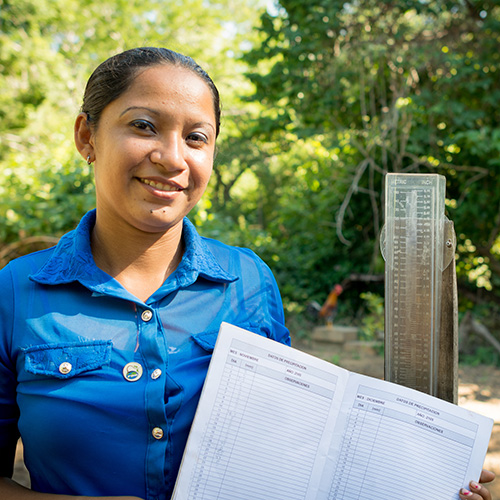
Lissett stands in front of the rain gauge, holding records. Photo: Alex Morse / FRB


CWS programs, implemented in partnership with Foods Resource Bank, aim to provide rural communities – especially women and youth – with access to technical assistance, training and economic opportunities.

Source: CWS Annual Report 2017

Diversification: drought insurance in Nicaragua

Lissett says her diversified vegetable garden makes her feel stronger and more able to cope with crises. “We had a drought two years ago that affected all of us a lot. It made us poorer, but it also made us more intentional about growing more foods besides corn and beans, and finding other ways to make money.”

Her family had had financial challenges when she was growing up, so she was glad to join the program and improve her agricultural skills as a way to generate additional income. She’s been putting into practice the soil conservation techniques she’s learned from CWS local partner CIEETS, and has built a water reservoir for irrigating her plants. “The training we receive helps us understand better how plants, soil and water all work together as part of one system.”

The drought made her get serious about planting a wider variety of fruits and vegetables to reduce the likelihood that she would lose everything if it happens again. She is now growing various citrus and other fruits, quiquisque (a starchy corm similar to taro root), banana, guava, yuca (cassava), sweet pepper and papaya. She’s also raising chickens. As she puts it, “My diversified plot ensures that I’ll have food to feed my family, and even have some surplus to sell at the market.”

In addition to diversifying her crops, Lissett also manages a rain gauge to inform her and her community when there is sufficient moisture to plant crops.

“My community and I thank all the people who collaborate with us to improve our situation. Rest assured that we are taking advantage of these resources that come to us through CIEETS,” says Lissett.

This story was originally published by Foods Resource Bank here. CWS and Foods Resource Bank partner to support established local organizations like CIEETS across Latin America and the Caribbean as they help communities achieve food security.


Stories of Change


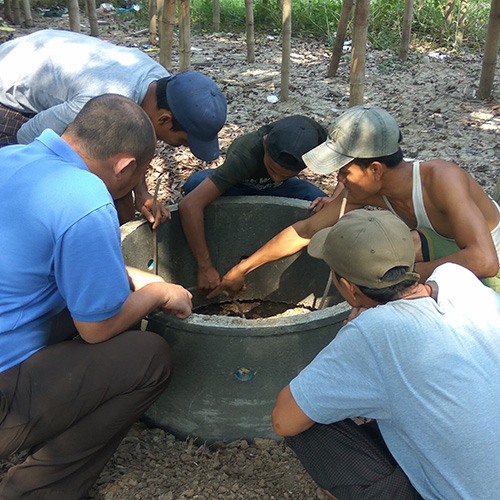
Participants work on constructing a sample latrine.

Masonry training so communities can build sanitary latrines in Myanmar

Our team in Myanmar has been partnering with villages in Maubin township in southwest Myanmar for years. Many communities here are flood-prone and face deep poverty, so our team has helped them prepare for and mitigate flooding, improve child nutrition and improve sanitation in schools and at home.

To further this work, we once again turned to our partner, the Centre for Affordable Water and Sanitation Technology to further strengthen sanitation here. In mid-May a visiting CAWST Global WASH Advisor, Parviz Pulotov, co-led a basic masonry workshop with CWS Engineer, Ko Soe. Thirteen men from five villages joined the session, which focused on building two types of pit latrines. The men gained new knowledge and had a chance to practice new skills so they can help their families and neighbors expand affordable and acceptable latrine availability and use.

Coming together with little knowledge and no masonry skills, the men started by learning about the key points of latrine construction: basic latrine parts, site selection, hole digging, lining components and superstructure options as well as different types of pits, which range in complexity – and cost. All sessions were presented in English and translated as needed with illustrated materials to support Q&A, small group learning and after-class study.

After two days of theory, the group moved to practice by building two latrines of different designs for flood-prone and high-water table areas: one used only concrete rings to line the pit and the other used concrete and bamboo. Eager to learn new techniques as well as basic skills, the trainees strictly followed Parvis and Ko Soe’s instruction, step by step, and they were rewarded for their efforts with two successfully completed sanitary pits.

At the end of four intense days of learning, asking questions, practicing and testing, trainees said they were happy to have learned how to build latrines by doing the work, asking questions and solving problems together with guidance and coaching from CAWST and CWS staff. Most importantly, an experienced local mason joined the workshop and can be an information source and coach, along with Ko Soe, in the future.

At the workshop’s end, after receiving his certificate, one trainee said, “I know now how to build a pit latrine from start to finish, and I really like the [active and interactive] teaching methods used by the trainers; they were different from my past experience. Thanks to the trainers and CWS [for organizing it]”. And another trainee added, “I thought the training would be easy. In reality, while there were things we already knew, [there were other] things we have never come across or known about; so, we learned a lot.”


Stories of Change


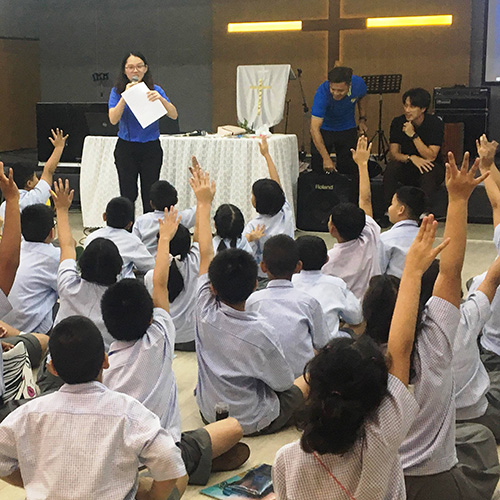
Children raise their hands during a Bullying Awareness information session.


Last year, 466 adults and 1,000 children joined educational workshops in Thailand about child protection.

Source: CWS Annual Report 2017

Protecting children – and fighting bullying – in Thailand

In Thailand the CWS child safeguarding team is working to support The Church of Christ in Thailand as it mobilizes its communities – schools, orphanages, churches and hospitals – to understand and embrace its 2016 Child Safeguarding Code of Conduct. Recently, the team surveyed young students about their feelings about safety and, more broadly, their happiness (satisfaction) with their school and home lives.

Three schools – Sri Thammarat Suksa School in Nakhon Si Thammarat Province, Sajja Pittaya School in Bangkok and Dara Academy in Chiang Mai Province – were included in the most recent surveys, where more than 650 students completed surveys to share their feelings and ideas about feeling safe and protected, or not. Once the survey results are compiled and analyzed, results will be shared with key leaders and duty bearers, and some student leaders, during a Child Safeguarding School Network Conference.

In addition to their important learning about Thai children’s safety concerns in formal surveys and follow-up, the team also led “Bullying Awareness” sessions in the three school so the Church can raise awareness about this issue among students. Office of Child Protection colleagues were interested to support the awareness-raising because national Department of Mental Health information shows that Thailand ranks second in the world for high prevalence of school bullying. During the session students learned about many kinds of bullying and how to respond if they are bullied or see another child bullied. Most important, the team tried to emphasize that violence is never the right response to any kind of bullying: verbal or physical.


Stories of Change


Koemsat explains the process of growing mushrooms.


CWS programs in Cambodia reached more than 21,000 people in 83 communities last year.

Source: CWS Annual Report 2017

Education and enough to eat, from an expanding mushroom business!

It wasn’t too long ago that Loy Koemsat was struggling to find work. During planting and harvesting seasons, he could sometimes find work as a laborer for $5 or so a day. He also collected and sold crickets and grasshoppers in the market. Because neither job was consistent, Koemsat, his wife Yong Chem and their two daughters didn’t have enough to eat for at least half the year. Their situation was bleak.

In March of last year, our partner in this part of northwest Cambodia, Rural Development Association, heard about Koemsat and his family. Through the CWS-supported Promoting Better Lives program, they supported Koemsat as he began to change his family’s situation.

Koemsat considered the options that he could pursue through the program and settled on growing mushrooms. He already had some knowledge and experience in the sector, having had limited success in mushroom cultivation on his own in the past. After successfully completing education and training sessions, which he took to with enthusiasm and focus, Koemsat received materials for producing mushroom spores. He promptly got to work growing a brighter future for his family.

“After joining CWS-hosted sessions, I used my new knowledge and skills to produce mushroom spores; and though I was not successful at first, unlike the past I didn’t give up. I kept trying to learn from my mistakes and consult with the trainer to improve. Now, finally, I can produce mushrooms to sell.” Once he was able to successfully produce mushrooms to sell, it didn’t take long to earn a substantial income. “Within six months I could rely on earning about $900 to support my family to have enough to eat,” he added.

Nine hundred dollars. In the past, when he was relying on subsistence earning activities, Koemsat would have had work seven days a week for six months to earn this much. Given how unreliable work had been, though, this certainly wasn’t an option. Now he as a more secure income (he has now perfected the mushroom growing process), and he’s even planning to expand his operations. He can stop working as a day laborer and can focus on building his business.

Koemsat proudly added, “Our mushroom business has not only helped my family to have enough to eat, but we can also send our girls to school. We are thankful for the support to help us change our life – completely.”


Stories of Change


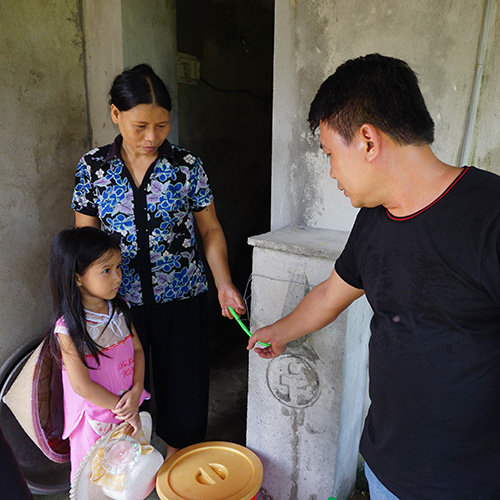
Ty, right, explains to a family how to properly use their new biosand filter.


In a single month, our team can help about 150 people begin to use biosand filters. That is how many people we partnered with in May 2018!

The look and taste of bottled water, nearly for free!

Ty recently had the chance to visit Truong Quoc Hoan and his family in northern Vietnam. They live in Nha May village in Quan Chu commune. In rural Vietnam, you often see extended families living together – Hoan, his wife and their two children live with his parents. The family earns their income from planting tea and from a rice paddy. Hoan also does some carpentry work for his neighborhood from time to time.

Like many other families in the village, Hoan’s family uses water from a drilled well – even though the water has strange smell and usually leaves a thin layer of opalescent dregs at the bottom and on the sides of cooking pots after each use. To cope with this, Hoan or his wife used to have to clean their pots quite often. But that’s in the past, thanks to a change Hoan made after joining a CWS info-sharing workshop about biosand water filtering. Biosand filters helps to not only clean dirt and stone residue but also remove bacteria and parasites. After talking to the village leader and the head of Women’s Union after the presentation, Hoan signed up to make a biosand water filter for his family with technical support from CWS.

Now, after simple filtration, the water has no smell and tastes the same as expensive bottled water from the store. The family is happy in using the filtered water for drinking and cooking, and they think that every family can make one because it is low-cost and easy to use – requiring no electricity and almost no operation cost.

There’s one thing that Hoan may not know, though – how much his family and the others we work with inspire both of us. His family story is so encouraging to us that it re-energizes and motivates us and increases our belief in working to help bring improved community health through each and every biosand water filter we help families make and learn to use.

This story was written by Ngo Quoc Dung, CWS Vietnam Country Representative, and Nguyen Van Ty, an engineer with our Vietnam team.