”I was on my way to the market and met Vui, who is the head of the hen raising group in my village. She told me some visitors were waiting for me at home. I rushed back home and wondered who the guests were.” Cam Thi Thao is a Thai woman living in Phuc Than commune in Vietnam. Thao and …
Stories of Change
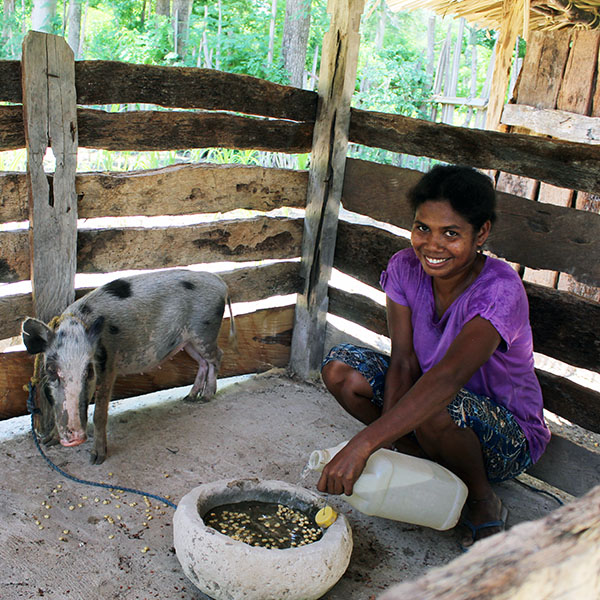
Mispa with her new piglet.
Replacing worry with confidence in rural Indonesia
Mispa’s life used to be defined by worry. As a single mom to her now 17-year-old son, it was up to her to support her family. She worried about paying for her son’s education. She worried about putting food on the table. She worried that she wasn’t making enough money as a weaver. Then she worried when she ran out of money, couldn’t afford thread and went into debt.
Even after she first met CWS, Mispa still had a lot of reasons to worry. She joined a CWS program called Berdaya (which means “empowerment”) in her community in rural Indonesia. Alongside other women, Mispa received supplies and lessons to improve their weaving and naturally dye thread, which makes their weaving more desirable. She learned about the basics of financial management and business planning. She got out of debt, but she was still only making about $1.50 per day. The worry was never far away.
Things got tougher when the COVID-19 pandemic affected markets in 2020. There was less demand for products like hers, putting her weaving income in jeopardy. Income shrank, and worry grew.
In the face of the pandemic, CWS scaled up the support we offer to Mispa and her neighbors. Before 2020, Mispa was one of millions of “unbanked” Indonesians who don’t have bank accounts. CWS and a local government-owned bank helped nearly 1,000 people, including Mispa, to open their first bank accounts. We deposited cash that Mispa withdrew to use for her latest CWS-supported business venture: raising chickens and pigs. (In the future, she will use the bank account for her textile and livestock businesses.)
As always, our work in this part of West Timor, Indonesia, is focused on nutrition. This latest chapter has been made possible with support from Latter-day Saint Charities. Mispa used the cash from her bank account to purchase two hens, a rooster and a three-month-old pig from a local shop that CWS had vetted for quality. It helped support a local business, and started a new business at the same time! She also had enough to build a chicken coop and pig sty. Our team worked with her and her neighbors to learn about how to care for their livestock to keep their businesses flourishing. Mispa had been worried that her chickens may die from local diseases. She was relieved to learn that the CWS team had ensured that all the animals were healthy and fully vaccinated. Having healthy animals from the start, and her new knowledge and skills about raising them, have helped her overcome her worry with confidence. “I’ll take care of these chickens and the piglet with all my heart,” Mispa says, “because I know that these chickens and pigs can provide for my son and me and support his education as well.”
While Mispa was in the process of getting her chicken business set up, CWS provided eggs for her family. They usually eat boiled corn and vegetables, so eggs are a nutritious supplement that they could start eating immediately. Mispa will continue to have eggs to eat from her new chickens, and she plans to sell the pig in a year and a half to buy more piglets.
“I would like to thank CWS for all the help and everything I have learned,” Mispa says. “I joined a weaving group at first and now I have eggs, chickens and a piglet. May God give CWS lots of His blessings.”
Stories of Change
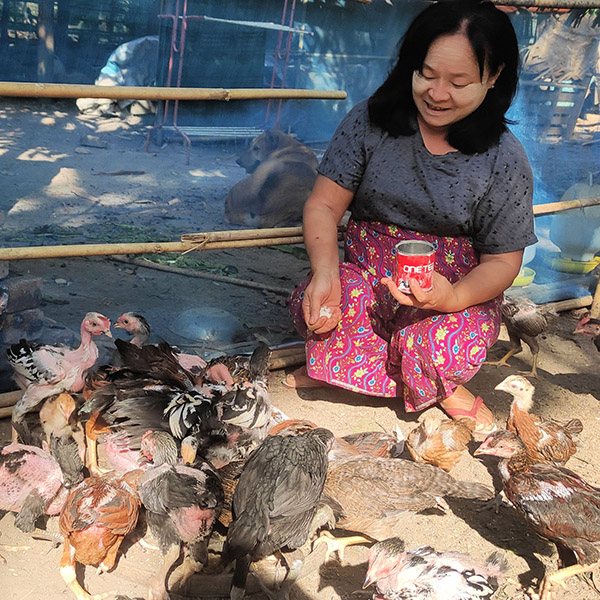
Daw Aye May and her chickens.
Hope for a new chicken farmer in Myanmar
Daw Aye May, a 56-year-old widow, used to make a living selling herbs in an open-air market. That was before COVID-19 public health restrictions curtailed public gatherings at large markets and travel beyond township borders. In the village of Sar Phyu Su, 40 miles north of Yangon, Myanmar, salaried job opportunities are limited. And when she lost her husband in 2019, Daw Aye May thought her future was gone too. Then along came the pandemic which disrupted an already limited economy by reducing the ability for farmers to sell products in more distant and larger markets.
Although Daw Aye May lives alone, she has emotional and limited financial support from a son and daughter, both married and in their thirties. When selling herbs was no longer a possibility, she started to consider how else she could earn money. Then in July, she heard that CWS was sharing chickens with families in greatest need. She learned that funding had come from vending machines set up by the Latter-day Saint Charities. She had never heard of CWS, nor of the Church of Latter-day Saints. Moreover, she had only seen vending machines in American movies, and those machines contained drinks and snacks.
Within weeks of picking up two hens and a rooster from a hatchery delivery truck, she had eggs. “I didn’t have any idea about how to raise chickens, but just wanted to try. I just fed the chickens and let all the eggs hatch,” she said. In fact, she let the first 12 eggs hatch into young chicks. Shortly afterwards, she collected another 13 eggs from the first two hens and sold 10 eggs in the village to earn $1.81. That’s more than half the official daily minimum wage of $3.53. “I was so happy as this was my first time to make money from chicken raising business,” she said proudly.
CWS sourced a local breed of hens and roosters for villagers because they are easier to raise free-range style. Daw Aye May now has 30 hens and five roosters in less than five months, and with no prior experience in raising poultry. “I learned that chicken meat from the local breed earns more money. For example, 3.5 pounds of my chicken sells for $5.06. Meat from foreign species sells for $2.89 for the same weight.”
She spends just 37 cents per day to feed the flock as they forage around a fenced yard area for scraps and insects. Daw May Aye expects to gather 30 eggs per day starting next month, earning up to $5.42/day in sales within a cluster of walkable villages.
The newly inspired chicken farmer gushed, “I thank CWS for sparking the light of a more hopeful future for me. Honestly, I wasn’t initially interested in chicken raising. Now, I want to be a poultry businesswoman. With a flock of 35 hens and roosters already, I will expand the flock further. My plan is to collect and sell more eggs in neighboring villages where I am allowed to travel. Also, I will use chicken manure in my home-gardening as organic fertilizer. Lastly, I say ‘Thank You’ to CWS and LDS, as these simple words express my sincerest gratitude.”
Stories of Change
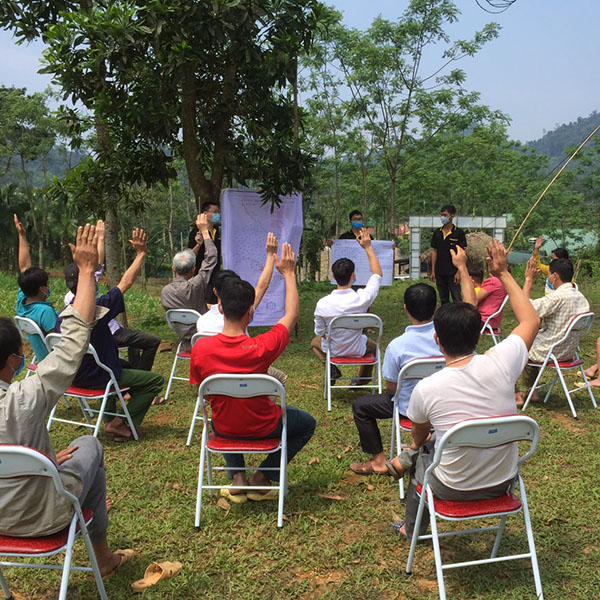
A meeting in Cao Binh to discuss the new water system.
Fair water access promotes peace in Cao Binh, Vietnam
Most of the people who live in Cao Binh village are from the Tay ethnic group, Vietnam’s largest ethnic minority. The name of their village comes from its location in the mountains of northwest Vietnam: “Cao” means “high” and “Binh” means “flat.” So, it’s the flat area on a high mountain.
Cao Binh’s residents use a small stream about a mile from the village center as their drinking water. The stream’s flow changes seasonally, so families often face water shortages. This is especially true in the dry season from December to March.
Not surprisingly, facing so many water shortages means that people don’t care much about water quality. They are only able to focus on quantity.
As a result, there was often tension and conflict among neighbors over water, especially during shortages. And, since families haven’t traditionally shared water among themselves, things could get pretty bad. Better-off households had money to build simple pipelines to tap upstream water, which left poorer families with little or no water downstream.
With the financial support of the CWS family, CWS staff joined community leaders early this year to find a way to address the problem. Together, we conducted what’s called a “community needs assessment” and surveyed households about their water needs and usage. With findings in hand, Cao Binh’s official leader Mr. Thang met with Women’s Union members, school leaders, other villagers and People’s Committee leaders. And, with our team, they brainstormed, discussed and planned a solution to their water crisis.
In two community meetings, everyone had a chance to share ideas. Then, a consensus emerged: a gravity-fed pipe system was the best way forward. A total of 43 families registered to join a new Water Users’ Group. Importantly, they also agreed to contribute their labor to dig trenches and transport materials. Additionally, each family agreed to pay 300,000 Vietnamese dong ($13) to buy a water meter and small pipe to connect the main pipe to their house.
An operation and maintenance team was also formed. Everyone agreed on a three-person team. Then, water use fees were agreed for operations and maintenance costs. Each family agreed to pay 1,000 dong (about 4 cents) per cubic meter of water used for the first 20 cubic meters, and 2,000 dong if they used more water. After these agreements, CWS helped the team create a water use and fee collection record system to ensure transparency.
Recently, Mr. Thang told our team, “People are now satisfied with the water supply system. It is well designed and, as planned, easy to use and maintain. With meters, people are more responsible in using water. Also, homes at the end of the pipeline now have enough water. And village solidarity is improved and conflicts over water no longer happen.”
Stories of Change
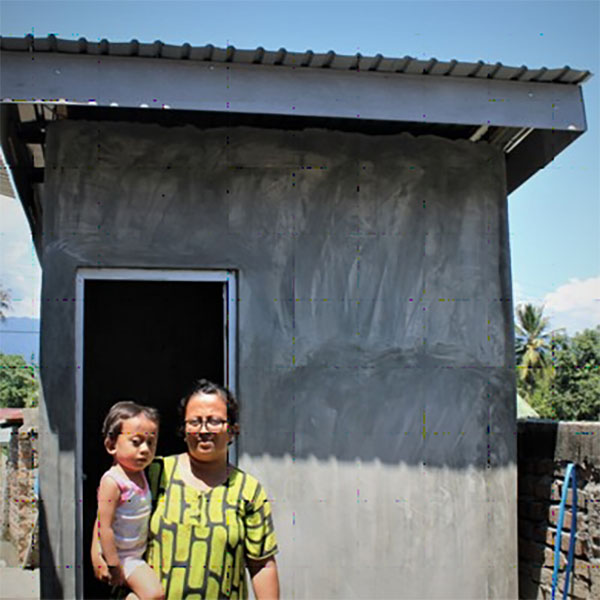
Azizah in front of her family's new bathroom.
Household latrines help families in Indonesia stay healthy during COVID-19
Disaster struck the village of Balongga in Indonesia in September 2018. A massive earthquake–and the resulting tsunamis and land liquefaction–destroyed or badly damaged most houses here.
Today, many families in Balongga still live in “temporary” shelters that organizations including CWS helped them build. They are meant to be an intermediate solution and have a couple of sturdy rooms in each one. But there’s a key problem: those rooms don’t include a bathroom.
Recognizing this shortcoming, CWS and our partners set out to help families build bathrooms near their shelters. So far we’ve reached 273 families in 14 villages, including Balongga. We also team up with community members called Community Health Promoters to lead hygiene and sanitation workshops.
Azizah, Dwi and their family are participating in this program. During a chat with CWS staff, Azizah said, “I feel grateful because we now have our own toilet. And I now know more about hygiene. The Promotors reminded us about behaviors that help us create and keep a clean, healthy home environment. For example, we heard about the basics of community-based total sanitation: stop open defecation, wash hands with soap, protect safe drinking water and manage household waste properly.”
This year, Promoters have also shared information about COVID-19 and how to prevent its spread. Dwi said, “Now that we have our own toilet, I don’t have to worry about the physical distancing rules [for shared public spaces]. Since we no longer use the communal latrines, which is good, [we are safer].” Azizah chimed in, “I agree! And, since we’ve had our own sanitary toilet, my children no longer have diarrhea.”
Stories of Change
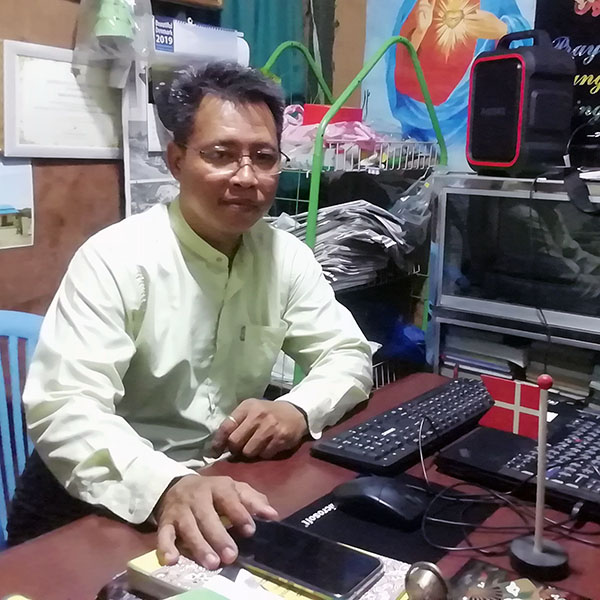
Secretary General Saw Kyaw in his office at the YMCA.
How do you share 30,000 chickens with families? By working together.
Vending machines are uncommon in Myanmar. And vending machines filled with practical items for vulnerable families are unique, even in the United States. But last Christmas, the Church of Latter-day Saints stocked vending machines in a few U.S. cities with gifts for families around the world instead of snacks. Among the gifts were two hens and a rooster per family.
Fast forward 9 months later and across the oceans to Myanmar. By the end of 2020, as a result of those vending machines, more than 10,000 rural families west of Yangon will raise chickens for eggs and meat. What an unexpected windfall for families facing food insecurity!
It takes disciplined and trusted partners to execute complex projects. The YMCA of Maubin is one such partner for CWS. In 2005, the YMCA opened its office in Maubin Township, sixty miles southwest of Yangon. Secretary General Saw Kyaw leads YMCA staff and volunteers in community development efforts. A biblical quote serves as inspiration for the office: “That they all may be one.” (John 17:21). Under the direction of the Secretary General, the YMCA offers vocational training like motorcycle repair, hair styling, sewing and basic computer training.
In 2015, YMCA partnered with CWS to assist people flooded out of their homes in Maubin Township. Then in early 2020, YMCA facilitated 45 days of sewing classes for 20 women from the villages that CWS works closely with. When the opportunity to share chickens with families arose, the YMCA jumped at the chance. They found families in 27 villages interested in raising a local species of chickens. Secretary General Saw Kyaw explains: “We provided 10,317 chicken to 3,439 families in 27 villages. Each family now has three Chittagong chickens which they like because they are easy to raise.”
Families hailed from among the poor and vulnerable who could not afford to pay the usual $5.42 per chicken. Parents lined up for chickens in anticipation of making egg dishes rich in protein for their children. Hens start laying one egg per day beginning at age 5 months old. Older children describe the chickens as “cute” and help their parents collect eggs.
Not only is chicken raising valuable for families, but it also helps CWS and YMCA staff hone work skills. For example, the YMCA identified vulnerable families and managed logistics delivery. After arrival from hatcheries, Village Leaders coordinated orderly pick-up and enforced social distancing. CWS Field Coordinators managed communications with hatcheries, drivers and Village Leaders. The Field Coordinators collected signatures and snapped pictures of delighted families beside delivery trucks.
Secretary General Saw Kyaw praises the collective effort. “Our team learned new procedures and documentation processes while working with CWS. We appreciate the support and collaboration which helps our confidence after each project. We always welcome CWS as our good partner,” he remarked. CWS intends to fulfill the intentions of donors by sharing over 30,000 chickens in Myanmar. Collaboration with partners, YMCA included, paves the road to better food security.