Stories of Change


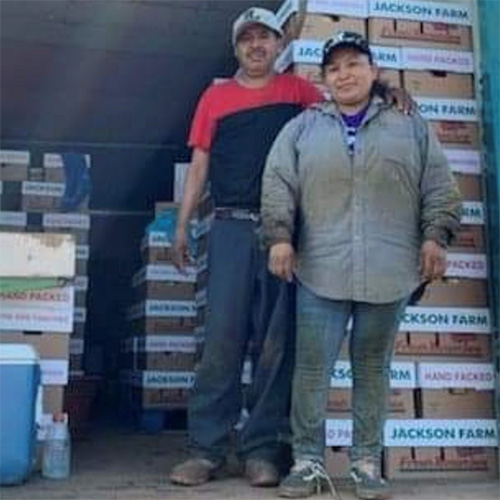
Meliton and Margarita Cruz have been migrant farmworkers for 25 years. In 2018 they returned to their small trailer home only to find it ruined by Hurricane Michael. With help from CWS partner Panhandle Area Education Consortium they were able to cope with the long-term recovery needs!

Long-term Recovery from Hurricane Michael in 2018

Yes – it has been almost 2½ years since Hurricane Michael, but we continue to see the long-term effects, especially on our most vulnerable populations.

The following is one such account:

The last 25 years have been met head-on with hard work, providing for family and determination to overcome the daily obstacles encountered by the very people who provide the food on our tables. This family is La Familia Cruz.

Meliton and Margarita made their way from Mexico, saving every penny they could and finally becoming legal permanent residents – a dream come true for them and their three children. Since then, they travel yearly from their home in Quincy, Florida to Immokalee, Collier County, Florida, to Tennessee, back to Immokalee and finally returning to Quincy – and all along the way picking the beautiful tomatoes we look forward to in our burgers, salads, sauces and much more! This has been their yearly routine for years.

This is not an easy life, and Hurricane Michael proved disheartening to them when it eventually affected the only home they have ever owned in Quincy, FL. They call it their “trailita” (“little trailer”), and they are very proud of this place they call home.

During their many journeys, they have experienced many other disheartening situations such as: being robbed at gunpoint of all their money and immigration papers just a block from the U.S. border, simply because they wanted to see their parents in Mexico; losing work due to crops devastated by weather, and now, facing the uncertainties and restrictions of COVID. Regardless, they have never given up and continue to work every day as much as they can.

Margarita said, “Every time we felt we were making it and getting ahead, something new happened.”

When Hurricane Michael hit their trailita, it was a water pipe that was one of the many needed repairs from this disaster that hit the Florida Panhandle area in 2018. Unfortunately when repairs were being assessed, the water pipe damage was missed and when they received a water bill for a little over $300 they were unable to pay due to an extremely limited income, even working every day of the week. They did not have the money, and Margarita came to share about her family’s dilemma with CWS local partner Panhandle Area Educational Consortium, which includes a Migrant Education Program among many of it’s outreach services in the north Florida area.

Thanks to the funds provided by CWS, PAEC was able to help the Cruz family pay their water bill and resume their access to this basic need: water! Running water, a critical factor in our daily lives.

Through the PAEC/CWS partnership and generosity, the Cruz family was given a “hand-up” towards improving their quality of life. The one thing I can assure you is that their faith continues to fuel their energy. Without a doubt they are grateful for your support!

There are ongoing long-term recovery needs among families affected by Hurricane Michael. Sadly, among immigrants like the Cruz family, the needs very often go unnoticed or unaddressed due to barriers to access services normally available to other Michael survivors. [With help from CWS,] organizations like PAEC help to bring their unmet needs to the table. 

This story was written by Dr. Maria Pouncey, Administrator for Instructional Services with the Panhandle Area Education Consortium.
Stories of Change


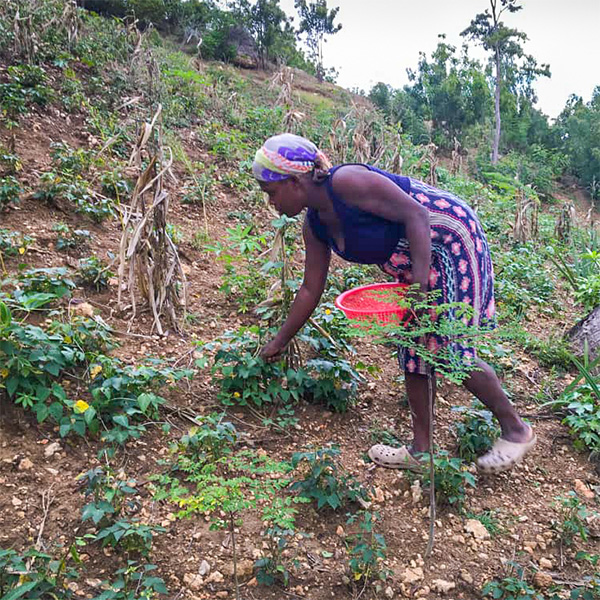
Ruthelaine Destin. Photo courtesy AGEHPMDNG

Small Investments Lead to Big Joy

Throughout 2020, the COVID-19 pandemic took a catastrophic toll. Haiti’s Northwest department was no exception. Unemployment soared, and people lost their livelihoods. This meant that many people spent what little savings they had.

When planting season arrived in November, farmers had fields that they had prepared to plant. But many couldn’t afford to buy the seeds that would go in those fields. CWS and our partners knew that a small boost now would lead to a huge impact for families when harvest season rolled around. So we provided seeds to 100 farmers. These seeds were short-cycle, which means that they would be able to harvest sooner. Of the 100 farmers, 70 were women. The seeds they received to plant included corn, peanuts, black beans, white beans and lima beans. 

Now, five months later, farmers are reimbursing us with part of their harvests. These repayments will ensure that seeds are available for future planting seasons if farmers need the boost again. Each farmer pays back 1.5 times the number of cans of seeds they received. 

Gedeon Sidernier received peanuts and corn to plant.  When he came to reimburse corn, Gideon said: “With one can of corn received, I was able to harvest a yield of 80 cans.” 

Ruthelaine Destin is a single mother of three. When she came to our partner AGEHPMDNG to reimburse her seeds, she said:

“In November I received corn, black and white beans, and lima beans. It was a good moment for me to receive this, because my land was prepared, but I had no money to buy seeds. [AGEHPMDNG and CWS] gave us seeds to plant. I had nice crops, good crops. I have already harvested black and white beans and lima beans. Even though the harvest of black and white beans could have been better, it was still good.

They gave me one can of beans, with which I made a yield of 6 cans, without counting what I have eaten and donated to others. As for lima beans, I made 14 cans out of 1 can. I shared with others, I sold a part, I paid for school for my children, and I used part for our own consumption. On top of that, I have 14 cans saved.

They gave me one can and now I have come to reimburse 1.5 can, while the rest is mine to keep, so that I can take care of my family and our daily needs. That makes me really happy, because this season, even though I had finished preparing my land, it looked like I was not going to be able to plant.

With these seeds, I am doing well. Right now, I am harvesting the corn. If you go to my house now, you will see the bags of corn. Once I am done harvesting the corn, I will reimburse three cans, because they gave me two cans. This is my joy and this will help me advance, because I am progressing thanks to this group that gave us these seeds. My lima beans are already giving a second harvest. If you look at them, it seems they are beans that have just been planted, giving such a good yield, while I already harvested them once.”

With a small investment, a huge harvest of joy is underway right now. Thank you, CWS family, for making these stories possible!


Stories of Change


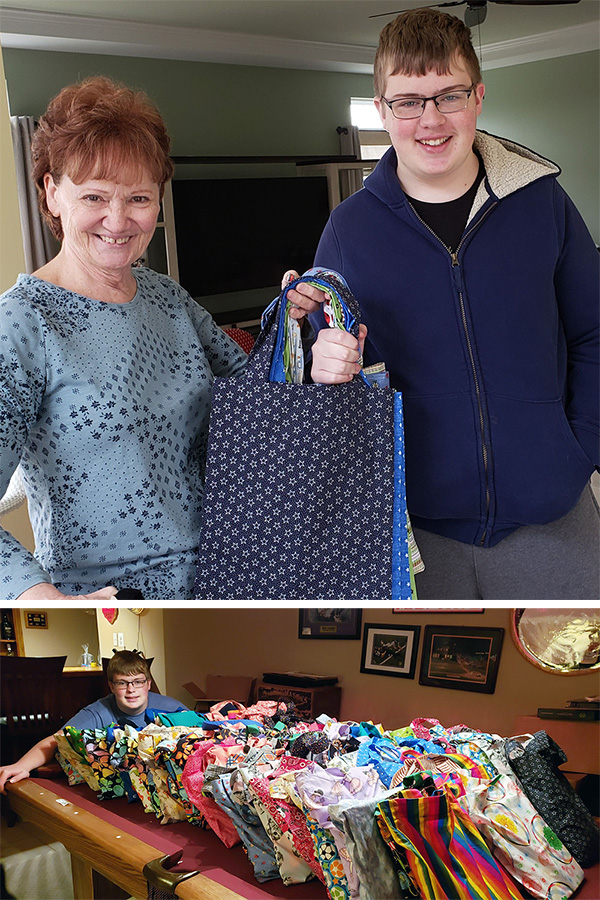
Top: Luke and his grandmother, Pat Edelmann. Bottom: Luke with the finished CWS School Kits.

Boy Scout Assembles CWS School Kits with his Grandmothers

“Luke’s goal was to prepare 20 school kits, and this week he delivered 69 to CWS,” says Amy Edelmann. Her 14-year-old son, Luke, decided to assemble CWS School Kits as a way to earn one of his Boy Scout merit badges. Luke is part of Boy Scout Troop 777 in Maryland.

“He planned to sew two bags himself to help fulfill the 8-hour BSA Citizenship in the Community merit badge requirement,” Amy says of Luke. “He enlisted both of his very talented grandmothers to sew the other bags. He prepared email and print communication adding a personal note with the CWS kit requirements. He went door to door to our neighbors and emailed friends, family and church leaders. Our pastor extended the invitation to participate to the entire Fork United Methodist Church congregation.”

And participate, they did.

“Response from Bel Air, MD neighbors, family, and church members in the form of supplies and monetary donations was overwhelming,” Amy says. “Luke gave his contact information so was busy for a couple of weeks answering calls, texts and emails fielding questions and coordinating pick-ups. We shopped for supplies three different times as money kept coming in and his Grandma and Mom-mom kept churning out bags with fun prints for kids. I am so proud of his commitment. He got to see community in action and appreciate how that effort works. This week Luke packed up and delivered 69 kits to the Brethren Services Center in New Windsor, MD. Thanks to his effort and the response from his community, his goal was far surpassed and he was able to make a meaningful contribution to a fantastic program.”

Luke planned to work on the kits for three weeks. But support just kept coming, and the project extended to six weeks. He ultimately racked up 16 hours of community service.

“I like that it benefits children who don’t have supplies or whose families don’t have money to buy supplies for school,” Luke adds. “The community helps you and you help the community.”

We couldn’t have said it better ourselves, Luke. Thank you for your compassion, your generosity, and for being an outstanding citizen in our global community. We hope you wear that merit badge with pride!


Stories of Change


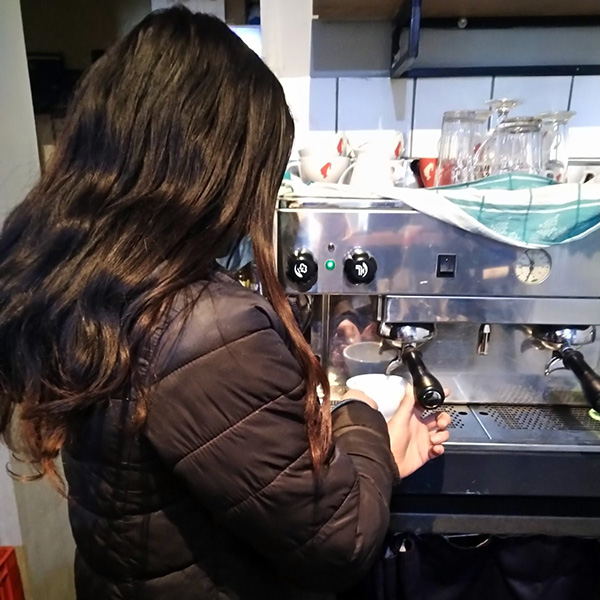
D in Café Bar 16.

Serving Up A Brighter Future in Belgrade

D* lives with her four siblings and their grandmother in one of Belgrade’s informal settlements. She had a turbulent childhood that was characterized by constant moving and instability. Six years ago, D’s parents separated. Her mother took all five children from Serbia to Germany. They lived in poor conditions and didn’t go to school, so German social services got involved. The authorities contacted D’s father in Serbia, who brought the children back to Belgrade.

After she returned to Serbia, D started visiting the CWS-supported drop-in shelter for children who are or who are at risk of living and working on the street. The children who visit the shelter live in informal settlements like the one where D lives: their houses are made from boards and supplies that have been cobbled together, and water and bathrooms are scarce. The drop-in space is a place for children to hang out, study, eat a meal and take a shower. The shelter staff also help parents connect their families to important services like schools and healthcare. D began to make friends and readjust to life in Belgrade.

After a while, D’s father left his children with their grandmother and moved on. This was a pivotal moment in young D’s life, when she was forced to grow up almost overnight and care for her younger siblings.

Then the COVID-19 pandemic hit, and things got worse. Conditions in settlements like D’s got even more appalling. People were confined to the small sheds where they live and earned even less money than usual due to restricted movement. D’s family was facing a bleak outlook.

The drop-in shelter staff offered a lifeline: an employment program at Café Bar 16, the social enterprise connected to the shelter. It’s a coffee shop in Belgrade where teenagers can learn how to become servers and baristas in preparation to work in one of Belgrade’s many cafes. D, who is now 16, liked the idea and knew it could be her chance to support her family during the pandemic.

D regularly attended the training course, passed her final exam and earned her certificate. She had a great work ethnic and was extremely motivated. She even had a job interview with a potential employer, although she decided to continue the training course instead. D has also decided to enroll in high school, saying that she has realized that education will be a solid foundation for independence and progress in her life. While she goes to high school, she will look for a part-time job.

D says that when she thinks about the future, she sees an educated young woman who provides for her siblings and grandmother.

*We are only using the first letter of her name in order to protect the identity of a minor.


Stories of Change


Rosemarie. Photo courtesy TCPPAH.

Relief for Rosemarie, and an Education for her Grandson

The pandemic has caused widespread unemployment all over the world. As a result, countless families are facing tough economic situations.

Rosemarie Grandville, 65, takes care of her grandson in Haiti’s capital city, Port-au-Prince. “For 10 years, I have sold bread. It is thanks to this activity that I meet my grandson’s needs and mine. His mother, my daughter, went to look for work in the Dominican Republic. But since COVID-19, she hasn’t been able to support me because she lost her job,” Rosemarie says.

Her daughter’s unemployment left Rosemarie in a tough situation. “This is very hard on me. Before I received the support [from CWS], I even had to take my grandson out of school because I could not make ends meet.”

In August 2020, CWS and our partners did a study about the pandemic’s impact on older adults in Haiti. Our partner Table de Concertation sur la Problématique des Personnes Âgées en Haïti, or TCPPAH, interviewed 60 older people in Port-au-Prince. Everyone reported challenges stemming from the pandemic and its economic fallout.

Of the 60 people, 33 of them were in especially difficult situations. CWS and TCPPAH knew we needed to help. So in February of 2021, we offered those 33 older adults business grants. Each grant was 10,000 gourdes, which is about $137. People used the funds to buy and sell all kinds of food and supplies from gasoline to coffee, bananas, cosmetics or even cement. Eight people used the money to start new businesses, and 25 expanded existing ones. Rosemarie was among the 25.

“I will never stop thanking God for this support that I received,” she says. “Today, I have not only been able to buy a bigger stock of bread, but I also sell fresh vegetables. Thanks to this, my grandson can continue to go to school.”

“I know that you will never be able to understand all the good that you have done for me, but I will continue to pray that God will return it to you a hundredfold,” Rosemarie says.


Stories of Change


Nelson Valdez

Leadership During Hard Times in the Dominican Republic

“My name is Nelson Valdez. I am the president of the youth group Jóvenes Unidos por el desarrollo de El Batey [youth united for the development of the community of El Batey in the Dominican Republic].

My family is my mother, my father, my grandmother and three sisters. One of the worst things I saw during COVID-19 was mass unemployment that left people and families totally unprotected. I saw sick people and also know of people who had to move from their community looking for jobs elsewhere. Fortunately, I did not lose any relatives to COVID, but it was a tough time for my family.

COVID-19 made me stop my education. When COVID-19 began, I was pursuing studies in mathematics at the university and attending a finance and accounting course at INFOTEP, the government´s vocational and professional education agency. The university closed down due to COVID, which also affected my finances because my monthly scholarship for excellent grades of $104 was suspended. This affected not only me personally, but also my family.

One of the main lessons I learned in the [CWS-supported] entrepreneurship training was that, if I do it right, I can begin a new business despite how big difficulties seem to be. Even though the pandemic has hit many people so badly, there are people that innovated and move forward. I learned that while many people want to do businesses in good times–we called these times “tiempo dulce”–a true entrepreneur shows leadership during hard times.

I learned from participants who in the middle of the pandemic began to produce and sell masks and gloves. After the training, I spoke to one of my cousins about an idea I had after I saw the tree nursery the community is building [through the CWS-supported program]: I want to plant fruit trees in a vacant lot of land in the community.

The tree nursery project is very important for the community and especially for youth because it will create jobs. The only job opportunities around here is to go the town of La Loma or to move to the capital city of Santo Domingo, where you can find jobs and education. If young people can make a decent living here, then at least we have the option to stay if we want.

I am part of the tree nursery project, and one of the aspects of the project I like is that we will travel to other communities to sell our plants and we will learn things from them. In the community of Juan de Herrera (pop.12,000), for instance, we can meet new people, share ideas and learn from them. So it won’t be just about selling our production and make a profit but new learning and making new friends. Of course, the tree nursery will help members to expand their income as well.”

Nelson participates in a CWS food security and livelihood program that engages rural communities in the Dominican Republic. Our local partner is Servicio Social De Iglesias Dominicanas, and Growing Hope Globally supports this work. 


Stories of Change


A new cistern at the home of Predalus Gilbert, one of the program participants in Haiti.

Water Makes a World of Difference in Haiti

Tulsaint Sermilien knows what it’s like to always be worried about water. “I used to walk over 60 minutes to get water in Digé or at the source at the river Cadet,” he says of his daily walk in his community in Haiti.

It was a dangerous trip, too. Animals had been known to fall on the slippery, rocky road. Children had an especially hard time with the daily journey for water; some in the community have broken teeth falling on the journey. Other times, their container would crack or break during a fall, and they had to watch the water they worked so hard to get seep into the ground.

To make matters worse, carrying water is heavy work. No one could carry enough water back to their house to meet all their needs. It’s just not feasible to carry enough for washing, cooking, watering gardens and sharing with livestock.

“Now God our Father has used CWS through the local association AGEHPMDNG to allow me to have a cistern with a capacity of 3,500 gallons,” Tulsaint says. “This is the biggest grace I could have enjoyed on this earth. Even if I were to work for five years, I would not be able to build such a cistern, seeing the quantity of materials included in the cistern.”

Our local partner, AGEHPMDNG, teamed up with 36 families in the area to meet their water needs. They are in the process of building 12 cisterns–about 15 people will use each one. The concrete tanks are filled by rainwater that is being caught on the roof of a nearby house. PVC pipes connect the roof to the tank.

Each cistern costs about $4,500 to build. That’s an average of $300 per person to take this huge weight off their shoulders permanently. It means having water just a few feet from their door. It means not having to make that treacherous trip every day, and getting more rest because they don’t have to wake up extra early for the trek. It means enough water for laundry, preparing food and cleaning–and having plenty left over for flourishing gardens. In a community where vegetables are expensive and difficult crops to buy, this means more nutritious diets and healthier families. It’s a world of difference.

Here’s what a few other of the people participating in this program had to say:

– “My biggest challenge was water, but today this challenge has been removed thanks to this cistern. It will allow not just my own family to find water close by, but also two neighboring families thanks to funding from CWS to AGEHPMDNG. Now I will be able to produce vegetables at my house, which I like a lot. It is the first time I have seen such importance being given to the construction of cisterns. I participated in a training before the construction started. We have never before seen such things being done in our community. The materials are good in quantity and quality, as the engineer explained to us during the training. I have seen everything being done as was promised during the training.” – Elizanne Supervil

– “I am 62 years old. My husband has been ill for 26 years. I have been the head of the household since then. I have seven children. My biggest grace is that today God sent CWS, an organization that knows the needs of people. I received materials including 120 bags of cement, 140 bars of rebar ½ and many more rebar 3/8, five truckloads of sand and many more materials that I cannot count. Construction workers are working without me paying them. The engineer oversaw site staking without me paying. This shows me the love AGEHPMDNG and CWS have for me and the other families. I am rejoicing because my husband has mental problems and wastes a lot of water–and we used to carry water from far away. Now I have been saved. With this cistern I will start a kitchen garden, my animals will have water, and my family and two other families will use the cistern, meaning that 17 people will find water at my home. I hope that God will bless the team of CWS and AGEHPMDNG for this work that the community is benefitting from.” – Saint-Anie Cimeus

– “I am a masonry worker and an iron worker. I have more than 10 years experience in this profession…As a masonry worker, this is the first time I have seen this quality work being done on construction of cisterns. I give God thanks for sending CWS to the community to accompany us to increase our knowledge.” – Merijil Demetreus


Stories of Change


Nurmita (on the right) is back to selling her cakes. With her profits she pays her 6- and 7-year-olds’ school fees. She also saves some money every month, which will help when another disaster or family emergency hits.

Back in Business: CWS Cash Transfer Initiative Helps Nurmita Return to Work

Nurmita lives in a Central Sulawesi village where, before a devastating earthquake in 2018, she sold traditional cakes to earn a nice income.

In the disaster Nurmita lost her baking equipment and supplies … and her livelihood. Her situation was not uncommon, unfortunately. And it has taken quite some time for people to recover and regroup.

Now, finally, with help from CWS and our local partner organization, INANTA, things are changing.

Some months ago, Nurmita and 89 others in Lende Tovea village each received a small grant to restart a lost business. With her 2.8M Rupiah ($200) Nurmita bought a mixer, a small oven, a cylinder of propane gas and other supplies to start baking again. Now she is back to selling her cakes, which are as famous as ever in the whole village.

In fact, on days she does not make the rounds in Lende Tovea, people come to her house to buy the local favorites. Her top sellers are biapong, a steamed bun filled with peanut paste and konto-konto, a fried bun filled with brown sugar. Each day Nurmita sells just over 100 cakes for about 1,100 Rupiah (7-8 cents) each. “Already my average monthly profit is more than 500,000 Rupiah ($35). I use the money to pay for my children’s education and other household necessities.”

Because her husband is a day laborer who sometimes has work, and sometimes does not, Nurmita has let us know how “very grateful” she is for CWS and INANTA support. With our help, and that of our donors, Nurmita helps her whole family. And, she proudly adds, “I am even able to save about 50,000 Rupiah ($3.50) every month!”


Stories of Change


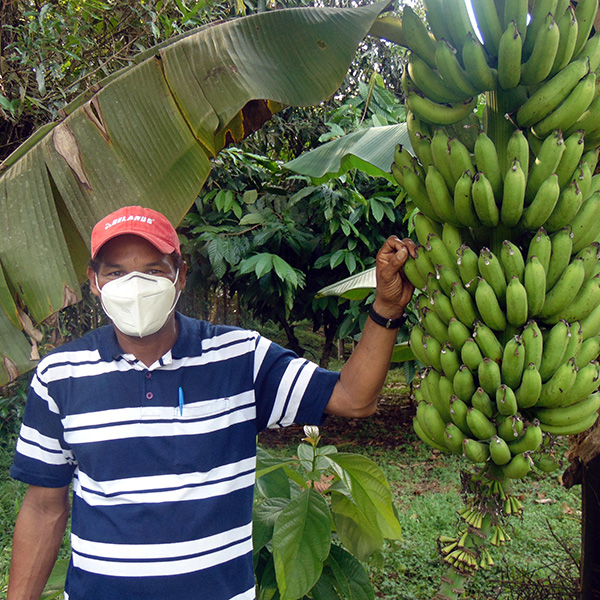
Donaldo in one of his fields.

New information means a new outlook in Nicaragua

Note: This story was written in the fall of 2020, before Hurricanes Eta and Iota slammed into Nicaragua’s Atlantic coast. Communities participating in this program were severely impacted, as you can see here. With CWS support, Accion Medica Cristiana responded immediately. We are now working together to plan longer-term recovery support, but we do know that the information and practices families like Donaldo’s have put into place through our ongoing program are making them more resilient. Donate to this relief effort here.

Donaldo Justiniano Nicho is a father of six. His family lives in Kuiwitingny, the same community on Nicaragua’s Atlantic coast where he was born and raised.

Kuiwitingny is one of 13 communities in the area where CWS and our partner Accion Medica Cristiana work. Our program focuses on nutrition, especially for young children. We’ve teamed up with farmers here for years through our training center model. Community volunteers called agricultural promoters gather at training centers, where they share ideas and learn new ways to improve their harvests. When they return home, promoters share what they’ve learned with neighbors. 

“I am very grateful and cheerful because I am preparing as a community agricultural promoter, with the support of Accion Medica Cristiana’s program in my community,” Donaldo says. “For me, the training I am receiving is very important and valuable, and I am realizing the great opportunities that I missed in the past when I only focused on other tasks for my survival.”

Reflecting on the impact of the program, Donaldo says:

Everything I learned I’m putting into practice. Before I didn’t know how to set up my farm. I planted the crops in a messy way and on small plots, just to produce something so I could feed myself. But now I know the importance of having good food through crop diversification.

That is why I have established my production farm for this year, and I have already managed to obtain the first harvest of basic grains: 40 quintals of rice, 10 quintals of maize, and a large amount of cassava. I also have established 300 banana plants, 50 cane plants, 100 malanga and 100 quequisque that they gave me through the project. I am also starting to cultivate several species of fruit plants such as pejibaye, mango, soursop, orange, lemon, guava, coconut, avocado, pear, and cashew .

My main idea is to establish a diversified production, and at the same time raise hens and pigs.

I thank AMC and those who help with financial funds to make these efforts possible for families in need.


Stories of Change


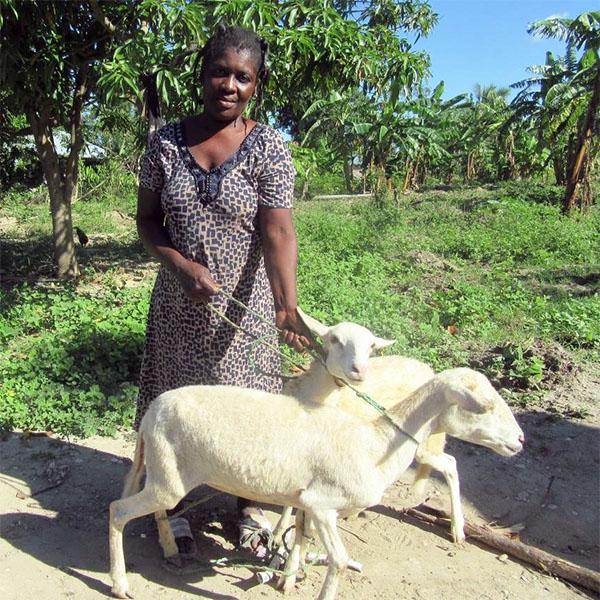
Rosalie François with her two new sheep.

“Thank you very much for this beautiful program.”

Many families in Haiti earn a living by raising livestock. People breed animals such as sheep, goats or pigs and then sell the offspring. In recent years, though, disasters have struck the nation and claimed the lives of many families’ animals. Families may also have to sell their livestock as a last resort to meet urgent needs, ending this sustainable income stream. 

In 2020, CWS distributed sheep to many Haitian families to help them start or restart raising livestock. Here’s what a few program participants had to say:

Rosalie François:

“My name is Rosalie François. I am married to Iliado and am a mother of three daughters and three sons. Two nephews and my father are also living with me. My father is blind. I am a merchant, a farmer and I do animal breeding. I used to have a cow, two sheep and three goats, which were very helpful for me, but due to circumstances I had to sell them so that I could solve some problems, purchase food and send my children to school.

During the [CWS-supported] training…I learned to build a shelter for the sheep, to regularly clean the shelter, and to collect excrements and leftover food to produce compost. That is what I do now and then I will use it for my crops. I know that I should not build the shelter on a steep hill, so that the animals are comfortable in the shelter. I apply what I learned at the training. My shelter was built well and water cannot cause the animals any problems.

I will respect the contract I signed and reimburse the firstborn lambs to the leaders so that they can distribute them to other people who haven’t received any yet. Thank you very much for this beautiful program.”

Pelita Decelouis:

“I am 43 years old and married to Junel. We have four daughters and one son. I am a farmer, I have a small business and also some animals. I used to have four goats, two donkeys and four sheep, but right now I do not have any animals at all. This animal breeding program of MOSODEL and CWS has a major importance in the community. Many people who had no sheep, now received two ewes. If they take good care of them, they will have lambs, they will reimburse some and the rest will be theirs to keep.

I already took my sheep for mating and now it is pregnant. Before I received the sheep, I gathered materials and built a shelter for the sheep, because I learned during the training that a shelter is a protection for animals. It protects them against wind, sun, rain, and other animals that can attack them.

When my sheep will have lambs, I will reimburse the firstborn lamb to the leaders of MOSODEL, so that they can pass them on to people who have not yet received any sheep. I give many thanks for these sheep that I received.”

Watnie Atilus:

“Watnie Atilus is my name. I am 26 years old, I have two daughters and I am married to Louis Jean Baptiste. I am a merchant and practice animal breeding. This program and AGEHPMDNG have a lot of importance for me. If I was not a part of this group, I would not receive any sheep.

I already received two female sheep and I benefited from many advices during a training that I attended for two days. At that training I learned to keep an eye on the sheep so that I can take them to mate when the time is right. I also know that I should not let the sheep roam around freely, because then they can get lost, thieves can catch them, or they can die. I tie them with a rope at a place where they can find fodder to eat. In the afternoon, I put them in a shelter that I built for them before I received the sheep.

I feel proud when I look at my sheep, I am very happy. I hope that everyone keeps their promise to reimburse the firstborn lambs so that the program can continue to advance. I give thanks to all those who have contributed to this program in one way or another.”

Alène Desir: 
“My name is Alène Desir. I am 51 years old and have one daughter. I am not married. I live with my mother and take care of her. I am a merchant, a farmer and I do animal breeding. I have three goats, one pig and 21 chickens.

During the training I learned there are three ways people look after animals in Haiti. There are people who choose free roaming of animals, others tie them with a rope, and others put them in a shelter. I learned about the importance each method has and also the disadvantages. Now, I have chosen to apply the rope method, because during the day I tie my animals close to grasses and in the afternoon I go get them to put them in a shelter and feed them again for the night.

Often it is a problem to find fodder for animals in the community because of drought. I learned at the training that when it rains a lot of grasses grow and I can cut them to dry them in the sun and tie them together to make hay. Then when I feed the hay to the animals, I can water it with some water with salt. I have already started to produce hay to give to the animals when the next dry season arrives.

I built the shelter before I received the sheep. I feel comfortable when I look after the sheep and I also believe that the sheep themselves are comfortable when they can be in the shelter without any problems. That makes me happy.

This program helps me a lot, especially when the sheep will start tot have lambs. They reproduce quickly so I can sell them to solve any problems I have, for example with my house or to feed the children. I hope that the program will continue so that people who haven’t received any animals can also have them, while I will give my own contribution when I reimburse the firstborn lambs. Thank you very much.”

Ifanie Daté:
“These sheep that I received are my future.”

Thanks to Latter-day Saint Charities for their support of this program.