
CWS’s recent gender analysis in arid and semi-arid lands in Kenya shows that climate pressures are deepening existing gender inequalities, while also revealing that women’s leadership is central to building resilient households and communities. Women and girls in arid and semi-arid lands in Kenya are experiencing some of the harshest effects of climate change. As drought deepens and rainfall becomes unpredictable, families face growing threats to food security and …
A True Leader
October 10, 2024
“I remember that day, as if it was a dream… like a drama…” Margaret Kitheka states, as we begin a conversation about her unexpected ascension to the leadership position of her self-help group, where she now sits as the group secretary. The following text is Margaret’s retelling of her experience becoming a leader in this program: With the CWS project …
Stories of Change
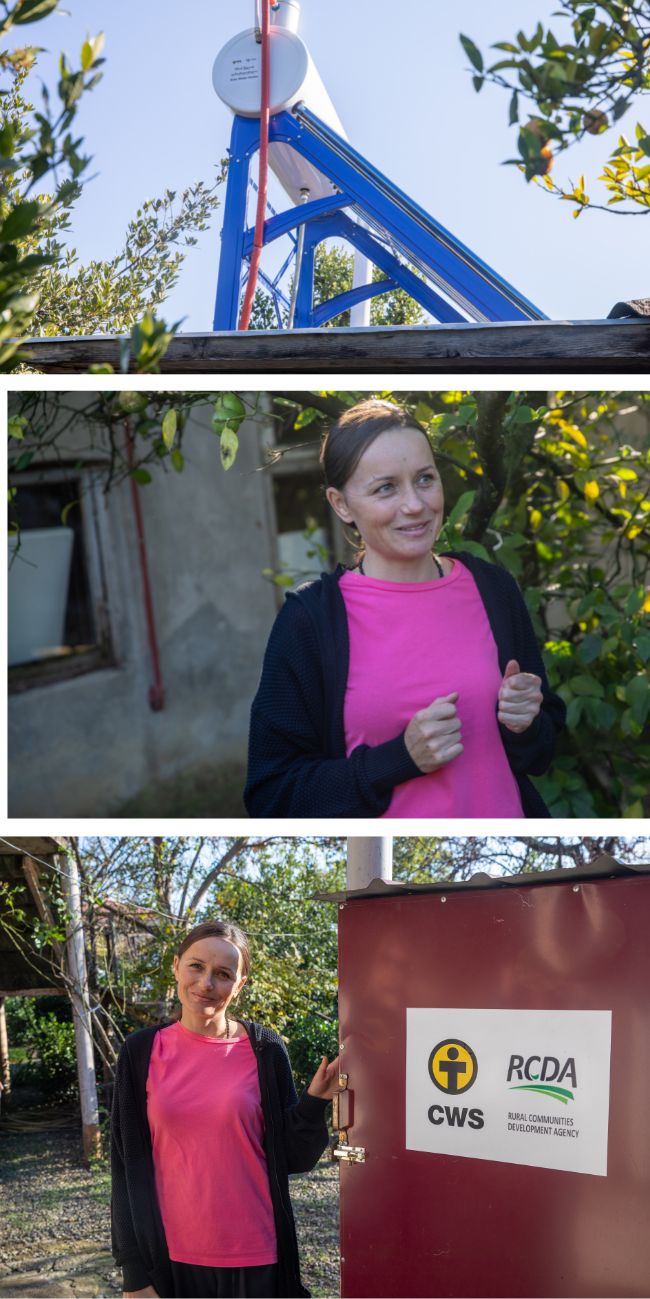
Top: Lilia’s solar heater, Middle: Lilia excitedly talks about her projects, Bottom: Lilia and her solar dryer
Lilia’s Fruitful Opportunities
The wonderful thing about giving is that if you give one thing to one person, oftentimes they will multiply that one thing into much more. This is exactly what Lilia, a Ukrainian woman in the country of Georgia, has managed to do in her small village.
Lilia and her husband are participants in CWS programs that focus on renewable energy as well as livestock, which are implemented by our talented local partner, Rural Communities Development Agency. Through these programs, Lilia and her family have received a solar heater, solar dryer, beehives and chickens.
On the day we met Lilia, the sun was shining brightly. It was a powerful reminder of what’s possible through renewable energy technologies. Lilia told us that during the summertime, her family is able to rely entirely on their solar heater to generate energy, which allows them to save 25-30% of the money they would normally use on things like firewood and electricity. With the money that they save, Lilia and her husband have been caring for their home, which is around 60 years old. This is especially important to them because Lilia’s husband’s family has been in this village for nearly 400 years! In fact, the name of the district that they live in translates to “here live the Kirias” (Kiria is Lilia’s husband’s last name).
Lilia explained to us that not only are they saving more money, but they are also saving time, which they have invested into new business opportunities. Lilia told us, “The chickens are helpful for us because of the meat and the eggs and because we can also sell the eggs.” Lilia shared with us that it was always her dream to have beehives but that the cost was too high. Through the livestock program, they were gifted the hives and taught how to care for the bees. Lilia’s husband now dedicates his time to developing a special ointment made out of honey and medicinal plants which he dries using the solar dryer. The ointment has been so successful that they are in the process of selling it to pharmacies throughout Georgia.
Lilia and her husband have also learned how to use honey and the fruits and plants dried with the solar dryer to create a medicinal syrup. They have generously distributed this syrup to their friends, family and neighbors for free. Lilia also told us that during the pandemic, they sent the syrup to relatives in Ukraine who had COVID-19 to help relieve their symptoms.
In addition to these gifts, Lilia was also invited to join a women’s savings group. In the group, the members pitch in a small amount of money to create a larger sum that they can pull from to develop their own small businesses. Lilia told us that the group helps her not only financially, but socially and emotionally as well. She said, “Women who live in villages usually stay at home, but through these groups, we are meeting with the other women at restaurants, cafes and other’s homes.” When we asked her more about this group, a big smile appeared on Lilia’s and she showed us a selfie the group took during their last meeting. “It makes me feel great! Everyone liked it,” she said.
With some simple gifts, Lilia and her family are generating a greater income, developing businesses, creating a legacy for their son and changing the lives of women in the village. We can’t wait to see what more they will do in the years to come.
Stories of Change
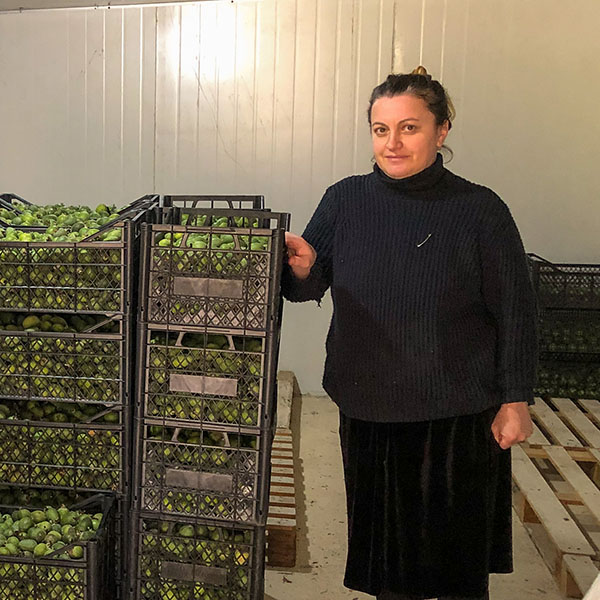
Tamar stands next to some of her cooperative's produce in their cool storage area.
Catching Up With an Old Friend in Georgia
“I live in the village of Kheta in the western part of Georgia,” says Tamar Chumburidze. “I am a mother of three and have two grandchildren. We all live together and our main source of income is a small plot of land where we grow [bay] laurel trees, vegetables and fruit for sale. The income we make is hardly enough to make ends meet and cover basic needs.”
Tamar’s story is all too common in her remote, rural community. Many of her neighbors, especially women, struggle to find jobs or earn a living. There’s also another challenge for families here that compounds everything else: a lack of energy sources. Every day, women and children in particular have to try to find firewood or other biomass that they can burn to heat their homes and cook meals. It’s simply too expensive to try to use gas or electricity to meet even these basic needs.
“The main problem for our family is trying to get fuel to heat the house and cook meals, to sell the fruits and vegetables, to get some inputs to sustain our livelihood. It is very hard to haul heavy firewood every day and travel long distances with such a load. I often get a pain in my knees and my back. In addition, expenses for gas and electricity comprises some 30% of our scarce incomes,” Tamar explained when we were getting to know her.
Several years ago, CWS and our partner Rural Community Development Association teamed up with Tamar and her neighbors to overcome these challenges. Tamar explained, “Thanks to the [CWS]-supported project, we became well aware that if we need to change our lives, we need to do it ourselves. With the support of the program, and together with my neighbors, we initiated a women’s cooperative in our community and organized a drying and cool storage facility for fruits and vegetables that we cultivate on our small plots of land.” Tamar is the head of the women’s cooperative. She and her team use renewable energy (industrial-scale solar dryers) to dry the fruits and vegetables, which they can sell to earn a living.
In 2019, the cooperative was able to add a cool storage facility that the women could use to store their fruits and vegetables to dry later. By waiting until the off season, when demand for dried fruits and vegetables are higher, they could earn more income from their sales.
When we talked to Tamar last year, she told us that every member of the cooperative earned about $210 through the project in 2020. She called it “substantial money during the economic hardship period caused by the COVID-19 pandemic.” She said at the time, “My neighbors and I know that Christmas and the new year will be happy for us and our families, as we’ll have enough fuel for heating and cooking, but also we’ll be able to afford presents for our children and family.”
A year later, in late 2021, we checked in with Tamar again. She proudly told us that the cooperative is still going strong. There are nine women employed at the moment, each of whom earns about $1,420 per year of additional income for their families. “Thanks to the involvement with the cooperative, I have so much more motivation for everything,” Tamar said. “I strive to work better and provide for my family. It also helped me to recover after my husband passed away last year. I managed to become active in social life again thanks to the support I got from colleagues.”
Thank you, CWS family, for walking alongside women like Tamar. Your support has been a lifeline during dark times and a source of joy and hope in the brighter ones.
Stories of Change
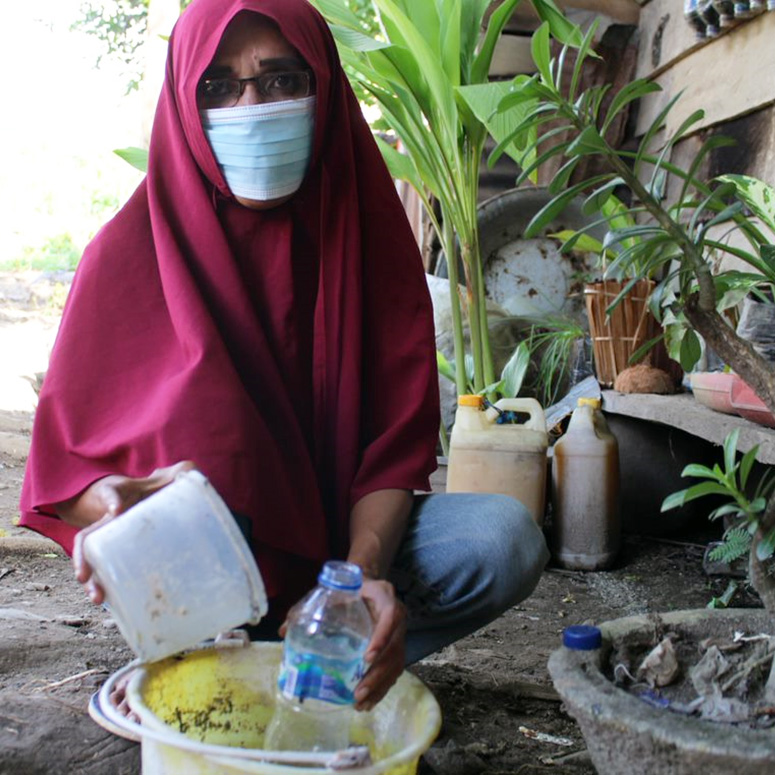
Juharni also grows some vegetables at her home for her family to eat.
Working together to mitigate the toll of climate change in Indonesia
Most families in North Pakuli village in Indonesia make a living through agriculture. They primarily grow rice, but important secondary crops include corn, cocoa and coconut. There are two main rice harvests each year, and the other crops are harvested based on their respective growing seasons.
This way of life has been under threat since September 2018. A massive earthquake and tsunami struck Central Sulawesi, which is where North Pakuli is located. These disasters buried a lot of the community’s land under sand, rendering it unusable for farming. On top of that, there have been a series of floods since the earthquake. These floods damage even more agricultural land. Crop yields were down again in the last rice harvest of 2020. As farming families struggle to cope with these acute challenges, they are also facing the looming threat of climate change. Weather conditions have become erratic, and the rainy and dry seasons are unpredictable. Pests and diseases are thriving and attacking rice crops.
In the last three years, many families have lost their way of life. Now they are looking for other ways to earn an income.
Juharni and her husband Kasman are among them. As recently as five years ago, Juharni’s income from farming was enough to provide for her family. Today, this isn’t true. That’s why Juharni jumped at the chance to join a CWS program in her community that focuses on building resilient livelihoods as a way to adapt to climate change. She decided to join two groups in the program: a women’s savings group and a farmers group.
“I am interested in joining the women’s saving group because there are many benefits for me,” Juharni explained. Each member of the new group contributes a little bit each month into a shared fund. Then they can take out loans from the group at a reasonable interest rate to build businesses or get through emergencies. If they have a bad harvest, for example, they can use a loan from the group to buy seeds for their next harvest or to put food on the table in the meantime. “I can share knowledge with other members, and motivate them. The result in the form of money may not exist yet, but this is one of the efforts to overcome the economic problems of farmers who are often uncertain about their harvests,” she said.
Juharni also joined CWS-hosted workshops on organic fertilize and organic pesticides. She says she was happy to participate. “I can get the ingredients easily, and making my own organic fertilizers and pesticides helps me cut costs,” she explained.
As our world grapples with the ever-increasing cost of climate change, it is more important than ever that farmers like Juharni have the skills and resources they need to adapt. We’re proud to team up with her and her neighbors as they build resilience!
Ecumenical Advocacy Days Recap | Women and Climate Change
April 27, 2021
At an Ecumenical Advocacy Days workshop last week in observance of the 2021 Earth Day theme “Earth Restored,” two speakers passionately called for increased investments in women led programs as part of the global strategy to address climate change. Mary Obiero, the director of the Relief, Development and Protection team with CWS Africa, described how women farmers were equipped to …
As Hardships Grow, so Does a Harmful Practice
Mary Obiero and Jasmine Huggins | November 18, 2020
In many cultures across the globe, female genital mutilation – or FGM – has long been practiced as a rite of passage marking the transition of girls to womanhood. It is often considered a necessary steppingstone to marriage and motherhood. On the contrary, FGM is now increasingly understood to be a painful, unnecessary tradition without medical benefits. Its harmful effects …
Gender Equality and Human Rights in a time of COVID-19 and climate change
September 21, 2020
ACT Alliance and members Church World Service (CWS) and World Student Christian Federation (WSCF) hosted a webinar to explore gender equality and human rights in a time of COVID-19 and climate change. Speakers included representatives from CSW Africa, ACT Brazil Forum- KOINONIA, and the Women’s Environment and Development Organization (WEDO). For ACT Alliance, the fight against climate change is a …
Stories of Change
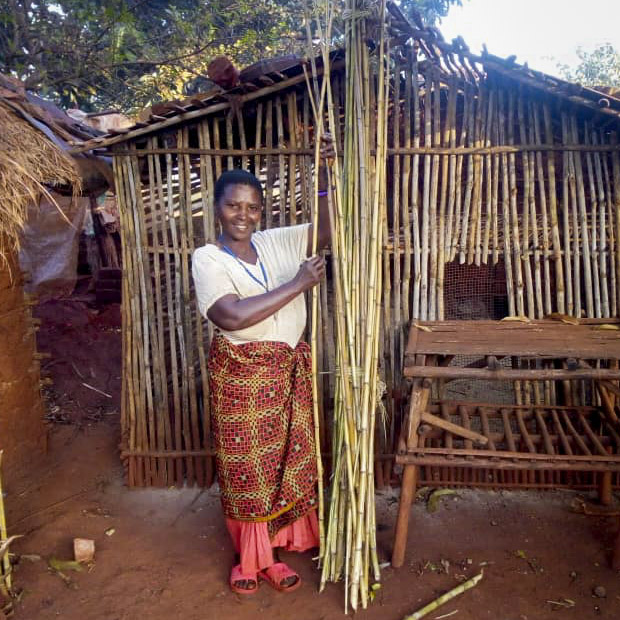
Losina stands in front of her new chicken coop, which will soon be home to her new chicken-raising business.
Replacing Losina’s discouragement with hope
At the beginning of this year, Losina Evarist Elias was discouraged. Her family was struggling to afford three meals a day. They didn’t have enough money to meet their basic needs, and didn’t even have enough clothing for all nine people in her household.
Their plot of land wasn’t yielding enough, and the wages that they earned from seasonal labor couldn’t cover all of their needs. Losina had tried to raise chickens before as a way to earn an income for her family, but her flocks kept dying in large numbers. She had a feeling that raising chickens just wasn’t a way that anyone could make enough money to care for a family.
We’re thrilled to say that Losina has changed her mind. In March, she joined a CWS program that is helping more than 1,000 farmers in Kasulu district, Tanzania, raise either chickens or pigs. She went to classes and attended workshops on a range of topics relating to raising chickens. Little by little, her discouragement was replaced with hope.
“I always believed that building a chicken shelter was expensive and would consume a lot of my money,” Losina says. During the program, though, she learned how to construct a chicken coop using locally-available resources. Then she put what she learned into action. “I collected bamboo not far from here to build the shelter, and used old, rusty metal sheets for the roof,” she explains. Now she has a chicken coop to protect her flock.
The larger issue, of course, was the diseases that had wiped out her flocks before. Newcastle, fowl pox, botulism and others kill chickens quickly and in large numbers. Losina and her husband had felt helpless to stop outbreaks before when they started. “Chickens were dying in large numbers because of diseases, and I didn’t know what to do,” she explains. “Now I learned how to vaccinate chickens and prevent chicken diseases.”
Armed with this new information, and about to receive three chickens to get her started, Losina is willing to try again. And this time she expects a much different result. “I am grateful to CWS for bringing this project to us as we had the opportunity to learn. Through the training, I will be able to produce in surplus and that will help us to solve several challenges facing my family,” she says.
Women’s Right to Water: a “Learning Route” in Argentina
Agustina Ramos Mejia | March 3, 2020
It was the end of October, and spring had just started in Argentina. In the Gran Chaco region, though, it felt like the middle of summer as the temperature easily reached 110° F. We were in Orán, a town in the province of Salta in the Gran Chaco. Thirty women got together to exchange experiences and learn new technologies for …
- Page 1 of 2
- 1
- 2