Stories of Change


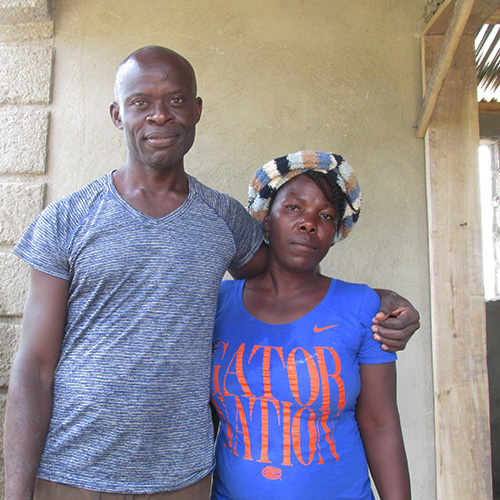
Simeus (left) at his new home.


CWS has repaired or rebuilt hundreds of houses in Haiti for survivors of the 2010 earthquake, Hurricane Matthew in 2016, Hurricane Irma in 2017 and now the earthquake that struck in October 2018.

A new house means confidence for a teacher in Haiti

“In Hurricane Matthew, my house was completely destroyed. I couldn’t even live there. We couldn’t live like that.”

Simeus Elpeuve is a teacher at the public school of Diondion in Haiti. When Hurricane Matthew hit in 2016, his family was living in a house made of rocks, with a partly concrete floor and a tin roof. Its fragile structure was no match for the storm.

Because of his limited teacher salary, Simeus says that it would take years to be able to rebuild. His family was prioritized to receive a new house as part of a CWS program supported by the ELCA.

“When I look at what we had before, compared to this, it is completely different,” Simeus says. “When we look at the construction materials that are in this one, it makes us feel satisfied. At the same time, hats off to this institution that helps people through construction. For example, as teachers, even if we were to work for two, three or even five years, we wouldn’t be able to realize such construction. We could build a house this size, but something like this would be very difficult for us on our salary.”

Simeus says that there’s no way he could afford the house on teacher’s salary. Now, though, he has a house that he can be proud of and one that can inspire his students to value education. His students know him as their teacher, but when they saw his old living situation he says they didn’t have much respect for him. Today they see a nice, sturdy home, and children for years to come will have more respect for him because of it. “I know that what I’m looking at here is not just for five or six years, or 10-15 years. I think it has a durability – a very long lifespan. That means that for children who are still to come – who haven’t even been born yet – they will always understand that this is the house of Teacher Elpreuve.”

For Simeus and his family, this house means more than just a home. It means peace of mind for years to come and safe haven to weather whatever storms will rage in the years to come. It means that students in the community can find a role model in their teacher. And it means that he can continue to work as a teacher to provide for his family.
Stories of Change


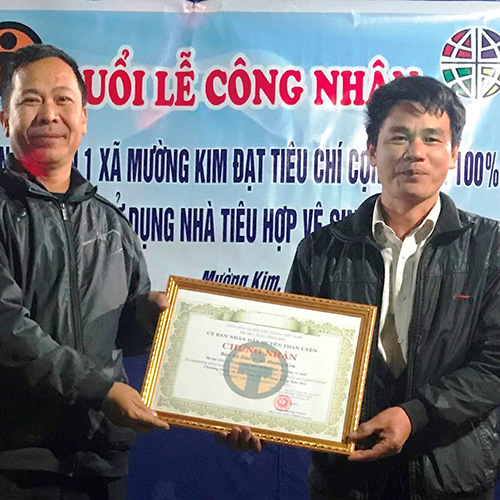
Lo Van Nhoi, right, receives the village Open Defecation Free certificate for display in the village.


CWS efforts in Vietnam positively impacted 40,036 people in 69 communities last year.

A village achieves Open Defecation Free status in Vietnam

“Just last year, there were only about 20 families using sanitary latrines. As the head of the village, I wanted to encourage other families to do so as well, but it was hard, and I did not know how to do it efficiently. When I heard that CWS would work with villages in the commune, I was glad to be chosen to join the four-day training course about Community-Led Total Sanitation, which I came to see was a very efficient method for mobilizing people to improve their knowledge and change their attitudes and thinking for safer behavior.”

Lo Van Nhoi is the young leader of Na Dan #1 village in Vietnam. After he attended that CLTS training course, he immediately registered with his commune’s People’s Committee to have a community sanitation start-up event in Na Dan #1. The event was a big success. These events are designed to shock people about the dangers of open defecation, and that certainly happened here. Nhoi’s friends and neighbors were surprised to learn that open defecation is responsible for transmitting diseases into the environment and then to them and, especially, to their children. They knew that they had to do something.

The start-up event was followed by a sanitary latrine-building session in the village. That way people had hands-on experience as well as the confidence and motivation – including accountability from their neighbors – to build family latrines.

Fast forward to August 2018, when Tran Van Thang, a CWS field-based project officer, joined the celebration at Na Dan #1 as they received their certification as an Open Defecation Free village. Thang could see the happiness and excitement on the face of each person present, including Nhoi.

With the ODF certification comes a small cash award, which the people of Na Dan #1 decided to use to purchase new tables and chairs for their community meeting space. “It is great that we could decide together what we needed the most, and we all wanted tables and chairs so we can use our Culture House more often for meetings and gatherings, instead of having to impose on one family to use their house, which we used to have to do,” Nhoi explained.

Reflecting on the success of Na Dan #1, Nhoi says, “I see once again that donor support for sanitary latrine promotion is not only for healthier living environments and good basic hygiene, but is also a catalyst for us to return to help facilitate more community development in the future.”


Stories of Change


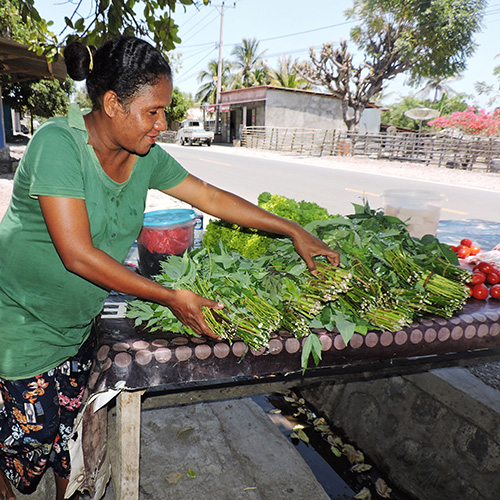
Zelia sells her vegetables.


CWS expanded the Timor Zero Hunger program from West Timor, Indonesia, to neighboring Timor-Leste in 2018.

A mom with a dream, and a plan, in Timor-Leste

“To be honest, I’m not happy with our life and the very small income my husband earns from driving a motorcycle taxi.”

That’s what Zelia Pintu da Cruz told our team during a recent information session on improving home gardening. Zelia’s husband earns about $10 each month driving a motorcycle taxi. Zelia herself is a subsistence farmer who can earn a few extra dollars during the rainy season by selling surplus mustard greens, spinach and cassava. She is also a mother of three children between 4 and 11 with a fourth one on the way. “I want to increase my income and support the education of my children. My dream is that they attend university,” she tells us.

Unfortunately, Zelia’s family’s financial situation is common in the part of Timor-Leste where she lives. Families across Timor-Leste are facing hunger and extreme poverty. While most families grow some vegetables for their own meals, especially corn, many struggle to have food year-round. Increasing droughts as a result of climate change are making the problem worse, too. That’s why our team in Dili, the nation’s capital, are so excited that we’re expanding our Timor Zero Hunger program, which was started in the island’s other half – West Timor, Indonesia.

In August, Zelia joined 28 of her neighbors for a four-day education and training program focusing on improving home gardening. The class was taught by government agricultural extension workers, with support from CWS staff. Zelia loved it, saying, “Although I already grow vegetables, I now have new information, more knowledge, ideas for better planting techniques and better skills to improve my gardening. And I know that my husband will support me to increase productivity.”

She is already putting into practice what she learned about making and using organic fertilizer and organic pest control. Since Zelia is a member of a CWS-supported farmers group, she and her family will also have access to additional seeds and tools for a new communal garden that will supplement her home garden – which she also plans to expand with new and different vegetable seeds from CWS.

Here’s just one of the things that makes Zelia so amazing. Remember that her dream is for her children to attend university? Well, she told us during the class, “You know, this is the first formal training of any kind that I have ever attended in my life. It was so good that the facilitator translated all the information from Tetum to Tokodede, our local language, so we could follow more easily – so, thank you.” Moms like Zelia, who eagerly work every day so that their children have opportunities that they themselves never did, are a source of inspiration to us every day. And we’re privileged to be part of helping them – and their children – achieve those dreams.


Stories of Change


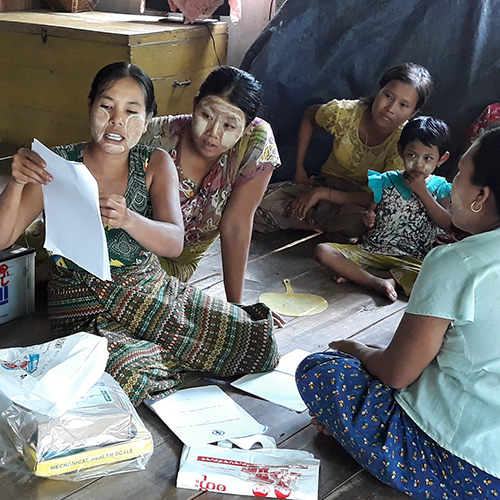
Khin Myo Thant facilitates a session with moms in her village.


CWS programs in Myanmar reached 18,876 people in Myanmar last year.

Moms in Myanmar Helping their Children Grow up Healthy

Khin Myo Thant, 33, spends most of her time caring for her young son, Hein Aung Soe. She also helps her husband, U Aung Ko, grow okra on an acre of land owned by family members. Their yearly income from selling okra – which can only happen during the November-April dry season – is about $492. It’s not enough to cover their family expenses, so U Aung Ko also fishes in the rainy season for food and a little extra money.

Sadly, but not surprisingly, little Hein Aung Soe was found to be underweight during a recent CWS-led nutrition assessment in the village. Because his parents were facing deep poverty, they weren’t able to provide the nutritious, plentiful diet he needed to grow to a healthy weight.

Hein Aung Soe and his mom were invited to join a CWS program focusing on nutrition education and awareness. Although she was sad to find out that her son was underweight, Khin Myo Thant was grateful for the opportunity to join these sessions. She wanted to learn more about child health and wellbeing, especially through better nutrition. She never missed a class, and she was actively engaged with the other mothers in the sessions.

After eight months of learning and sharing, Khin Myo Thant was nominated and chosen to be a Mother-Leader for our village. She says, “I am proud of what I have learned, especially about different types of foods’ nutritional value, new recipes for cooking healthy meals for young children, the importance of exclusive breastfeeding and growth monitoring. I have also learned some facilitation skills that I use when leading monthly Self-Help Group meetings, organizing monthly growth monitoring and facilitating exclusive breastfeeding sessions for other mothers – all with coaching from CWS staff. Now I can help my son – and other children – grow up to be healthy. I really appreciate the support from CWS and their donors for our children.”


Stories of Change


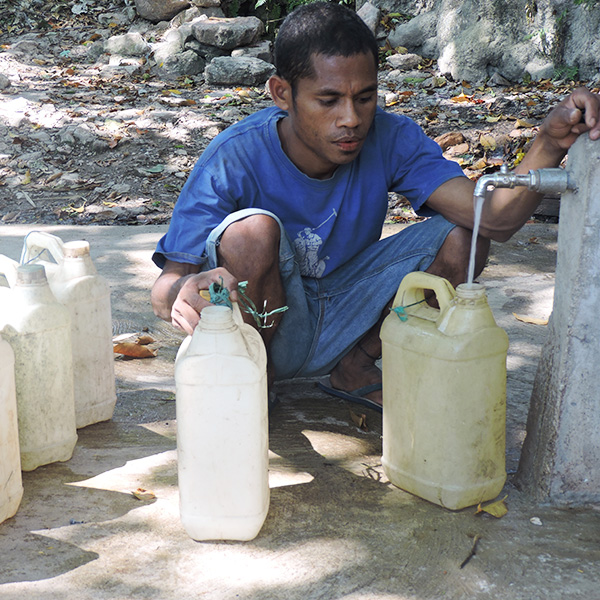
Mateos fills up water containers at the new tank.


CWS efforts in Indonesia positively impacted more than 17,000 people in 16 communities this year.

From 20-hour lines to Enough for All

There are 83 families – about 400 people – in Mateos Missa’s village of Saenam in West Timor, Indonesia. Mateos, 33, lives with his wife, Yufita Sio, and their two daughters. Mercy is a toddler, and little Misa is still a newborn. Mateos chairs the Oe Sustana Water Use Committee, which means that he is responsible for making sure that water is used fairly.

This has been a challenging job for years, because families in the village faced a desperate water situation, especially in the dry season. There is a spring nearby, but it wasn’t protected. That meant that families were using water that was filled with dirt, leaves and animal waste. To make things worse in an area where water was scarce, there wasn’t a way to store the spring’s water. When someone wasn’t filling a container, the precious water would just run off and be wasted.

Before, “we only showered once a week,” Mateos recalls, “We mostly only washed our faces; or, when we went fishing, we would bathe in the ocean. That’s salt water, though, so we didn’t really feel clean. Families with newborns would bathe their babies every day with clean water, like we did with Misa. But, every family had to send someone to walk for an hour to collect water from the spring, where it took up to 10 minutes to fill just one five-liter container.”

By the end of the nine-month dry season, only one spring was still running and it could  take up to an hour to fill that same five-liter container (that’s about 1.3 gallons). Families would get in line at 3 a.m. to wait for their turn, and some would still be there late into the night. The last families would fill their buckets or jerry cans and head home at 11 p.m.

To help the community change this awful situation, our team helped protect the spring and construct a concrete water tank in May of 2018. Community members contributed labor, tools, wood, transportation and meals during construction. Mateos led the Water Use Committee through an important discussion about how to control water use so that everyone would have a chance to meet their family’s needs, even with water being a scarce resource.

Now, water can be collected for a couple of hours in the morning and then again in the evening. Outside of these times, the spring is filling the tank. When families arrive to fill their buckets, jerry cans and other containers, enough water is stored in the tank for all 83 households to have their right to water met without waiting in long lines.

In Mateos’ words, “We are very happy and thankful to CWS for the support because now the quantity and quality of water at the spring have improved; it is much cleaner now that it is protected. And no water is wasted as it is being saved in the tank. Filling our containers is much faster now and we don’t have to queue from early morning to late night. Finally, we can use the water not only for cooking and drinking; now we can also shower more than once a week if we need to, which is great.”


Stories of Change


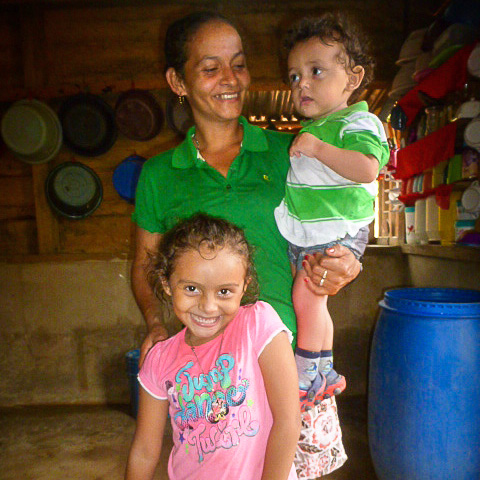
Gloria, Tatiela and Josmel. Photo: Denise van Wissen


CWS and partners are helping more than 1,300 people in 17 communities in the North Caribbean Coast Autonomous Region of Nicaragua.

Moms are teaming up for child nutrition in Nicaragua

Yeltsin Pérez got to know our partner in Nicaragua’s Caribbean region, AMC, when she participated in a class for young farmers in her community of Nazareth a few years ago.

Now 22 and married to the young pastor of the Siksikwas village church, Augusto Tenorio, Yeltsin was pregnant with the couple’s first child when she came in contact with AMC again last year. With support from CWS, AMC was leading classes for moms in the area about how to keep their babies healthy.

Yeltsin was eager to learn all she could about raising her baby, and she never missed a session. She learned about breastfeeding, how and when to transition babies to solid food, what that solid food should be and how to make sure babies have safe water.

When her baby was born, Yeltsin put into practice everything she had learned. She said it wasn’t easy to breastfeed exclusively, since mothers in the area traditionally give their babies herbal tea and other drinks as early as two or three months of age. She stuck to what she learned, though, and her baby is now seven months old, in good health and is starting to eat solid food.

In the spirit of teamwork, Yeltsin volunteered to visit pregnant women and mothers in her neighborhood to share what she had learned and to help them as they faced some of the challenges that she had also faced. She has five moms in her group, and she checks in with them at least twice each month.

Gloria Marenco is one of the moms in Yeltsin’s group. Her first child, Tatiela, is a 6-year-old first grader at the Nazareth primary school. When Tatiela was a baby, Gloria did what most moms here do. She gave her herbal tea at just a few months of age and stopped nursing after about a year.

Things have been different for Gloria’s son, Josmel. He’s only a year old, and Gloria was already part of a mothers group that AMC organized when she was pregnant. Like Yeltsin, Gloria learned about how to have a healthy diet while pregnant, the importance of exclusive breastfeeding, how to best start feeding her baby solid food and about the importance of clean water.  She also put into practice what she learned, and she can tell that it’s helpful. Josmel likes to drink water from a cup. Since their family only has water for a few hours each day, Gloria connects a clean hose to her tap and fills up freshly-washed barrels, then she boils the water before the family drinks it. She has noticed that Josmel doesn’t get diarrhea as much as Tatiela did as a baby.

Yeltsin visits Gloria every week to share what she has learned at the meetings for community health volunteers. They talk and support each other through their struggles.

Woman to woman, mother to mother, the babies of Nazareth are becoming healthier.

AMC stands for Accion Medica Cristiana. CWS, Growing Hope Globally and World Renew support the AMC team in Nicaragua’s Caribbean region as they partner with communities to improve agriculture, clean water and nutrition for young children and their families.


Stories of Change


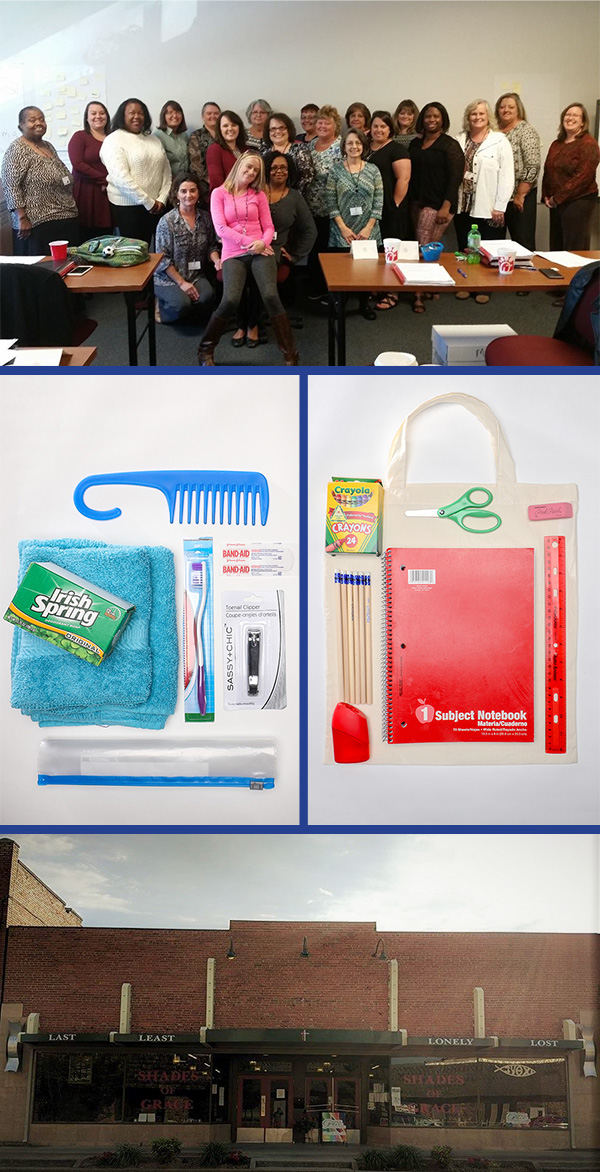
Top: UETHDA Neighborhood Service Center staff. Middle left: a CWS Hygiene Kit. Middle right: a CWS School Kit. Bottom: Shades of Grace United Methodist Church


CWS distributed more than 75,000 CWS Kits and CWS Blankets in the first half of 2018.

Source: CWS Kits and Blankets shipping report January - June 2018

CWS School Kits, Hygiene Kits and Blankets bring comfort to Northeast Tennessee

Nestled along the Appalachian Mountains, the Upper East Tennessee Human Development Agency is in the heart of poverty-ridden America. UETHDA serves Carter, Greene, Hancock, Hawkins, Johnson, Sullivan, Unicoi and Washington counties.

Teams in each of the agency’s nine Neighborhood Service Centers work daily to help clients overcome the daily hardships that they face. Specifically, they offer assistance that helps people get on a path to long-term self-sufficiency.

One thing that families visiting the centers often need are school supplies. We provided 120 CWS School Kits to UETHDA for distribution to school-age children because, as Community Services Director Norma Tremblay notes, “families who are struggling to pay their bills and put food on the table should not have to worry about purchasing paper and pencils.”

In that same spirit of long-term progress, UETHDA works in partnership with other local organizations serving vulnerable populations in the area. In particular, they focus on reaching people facing homelessness. “A warm blanket or a hygiene kit can mean the world to these individuals who have lost so much and have so little,” says Norma.

At least half of the people at any given worship service at Shades of Grace United Methodist Church are experiencing homelessness. But in Shades of Grace they have found a haven. The church provides meals, showers, addiction help, GED education, job assistance, prayers and fellowship. And CWS Kits and Blankets. Through their partnership with Shades of Grace, UETHDA has distributed 120 lightweight blankets, 125 heavy blankets and 240 hygiene kits. Norma says that people who received the supplies said things like, “I’m going to smell good today!” and “I have been praying for a blanket.”

“The blankets and personal hygiene kits that were provided by Church World Services have made such a difference and meant so much to the homeless population in Northeast Tennessee,” Norma says. “UETHDA is forever grateful to Church World Service for your generosity and support.”


Stories of Change


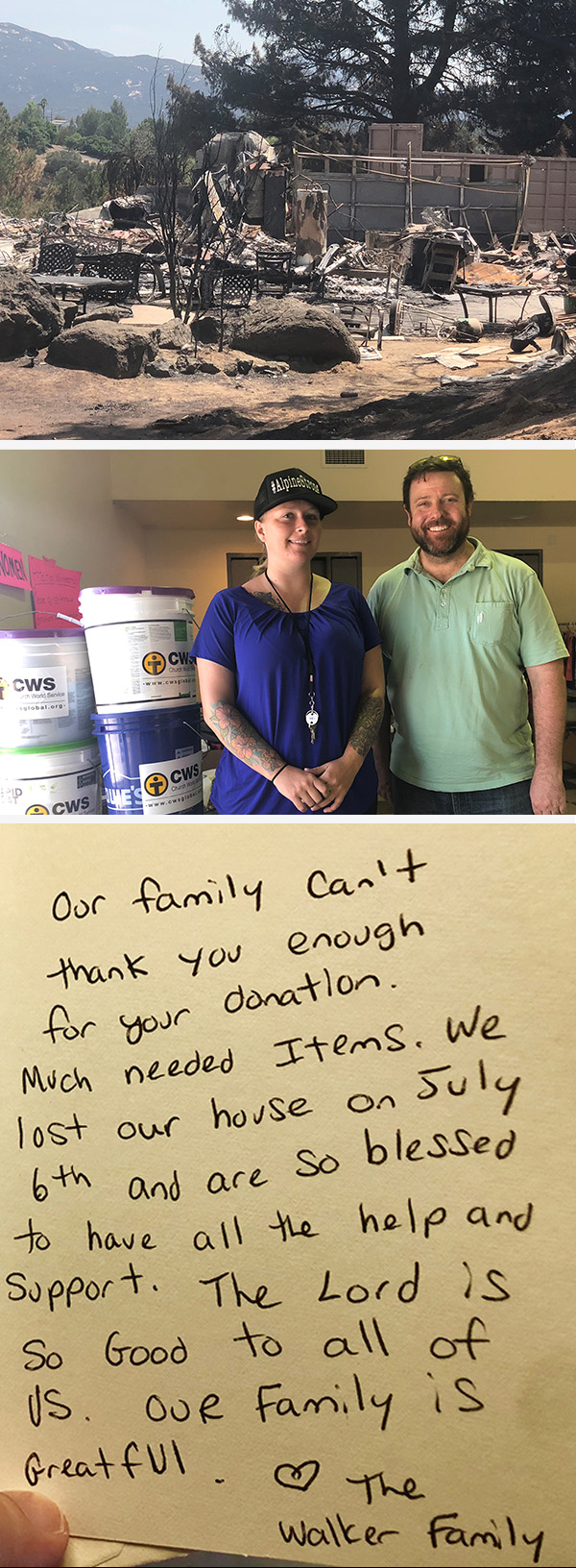
Top: fire damage in Alpine, California. Middle: Stephanie Sorrels and CWS Congregational and Community Event Specialist Jason Welle. Bottom: a thank you note from a family in California


CWS distributed more than 75,000 CWS Kits and CWS Blankets in the first half of 2018.

Source: CWS Kits and Blankets shipping report January - June 2018

CWS Kits and Blankets help wildfire victims recover in California

The residents of southern California are accustomed to wildfires during the summer.  But this summer was different. The fires were more intense.

A record-setting heat wave, coupled with moderate winds, sparked brush fires across southern California that destroyed homes and forced thousands to evacuate.

Not knowing whether their homes would still be standing, hundreds of residents fled the West Willows community near Alpine in late July hoping they would be able to once again return home.

“My husband is in a wheelchair, so I had to move quickly to get us out of the house.  I just grabbed a few things I couldn’t replace, like a couple of photograph and our cats, and we quickly left the house,” said a long-time resident of Alpine who asked to remain anonymous.

“It was just devastating.  I saw the embers flying through the air and landing on the rooftops of the homes and I knew there wasn’t much the firefighters would be able to do,” said Stephanie Sorrels.  “But I knew there was something that I could do to help people following the fires.”

Stephanie gathered several friends and other volunteers in her community to open the West Fire Victim Supply Post at the Boulder Oaks Elementary School.  After a few announcements on the radio, donations came pouring in from around the area.

Church World Service provided CWS Emergency Cleanup Buckets, CWS Hygiene Kits and CWS Blankets to the Supply Post to help provide a little comfort to people in a time of need.

“Some people didn’t lose their homes, but they knew they were going have to do a lot of clean up from either smoke or water damage. Knowing they had this cleanup bucket was a huge relief. It was one less thing they had to worry about when they returned to clean up their house,” said Jason Welle, CWS Community and Congregational Engagement Specialist in Los Angeles.

“When they look inside the bucket they are just excited, they are like ‘oh my gosh this is really awesome.’  They were just so thankful.  Every person who took a bucket, wanted me to tell you ‘thank you,’” said Stephanie.   She continued by saying, “And I would want to give them [the donors] a hug.”

These relief efforts are only possible because of our dedicated congregations and donors who assemble CWS Kits and provide CWS Blankets.  Each year Church World Service provides thousands of CWS Kits and Blankets to organizations here in the US and around the world.  These kits and blankets are a tangible reminder that no matter what challenges people may be facing, they aren’t facing them alone.

“One of the community members here told us that those of you willing to put these kits together are our heroes,” said Jason.

Thank you for being a hero and providing these CWS Kits and Blankets.


Stories of Change


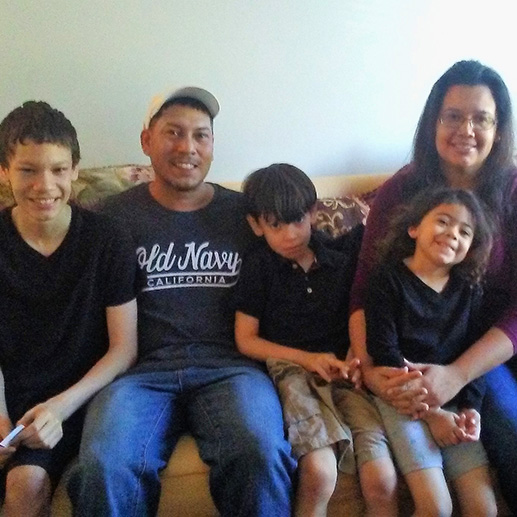
Roxana, Bryan and their children.


The CWS Lancaster team has helped 17 Puerto Rican evacuees find employment in recent months.

Supporting Puerto Rican evacuees as they start over in Lancaster

Our team in Lancaster, Pennsylvania has been supporting newly-arrived refugee families in the area for decades. As Puerto Rican evacuees began to arrive in the area following Hurricane Maria in late 2017, we realized that we could use that experience welcoming families to support these families, too.

Bryan, Roxana and their three children arrived in Lancaster in December. Roxana had 10 years of experience working with customers in Bayamon, Puerto Rico. She had a gift-wrapping business and worked in a local gift-wrapping and sweets shop. When she enrolled in the employment program with CWS Lancaster, she was interested in finding a job with a schedule that would allow her to take her children to school each morning and pick them up after. The Employment Specialist helped Roxana get a job as a Room Attendant at a local hotel that was within walking distance of their home. Not only is she able to still care for her children, but she can use her customer service skills and practice English with the hotel guests.

Bryan was already employed when the family connected with CWS Lancaster, but the Employment Specialist encouraged him to find a job with higher pay and that could better use his skills. He had worked for two years paving roads in Bayamon. The Employment Specialist talked to him about transferring those skills to the construction industry in Lancaster, specifically for a precast cement company. Bryan eventually passed the entry test for the position, and was hired in a permanent, full-time position earning $14.50/hour with comprehensive benefits.

Roxana and Bryan are content with their jobs, and they are doing well. And our team is proud to be able to continue to help our new neighbors settle into Lancaster.

The CWS Lancaster Puerto Rican Evacuee Program supports newly-arrived families with housing and employment support. So far, 17 evacuees have enrolled in the employment program; 12 of them have been placed in full-time jobs. We’ve helped 14 families pay their rent and/or security deposits as they settle into new housing, and we’ve helped 11 families find housing and negotiate a lease. 


Stories of Change


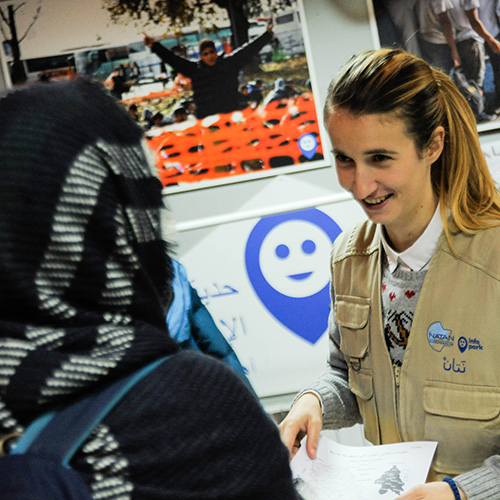
A female staff member and client at Info Park. Photo: courtesy Info Park


104 women and girls have participated in Girls Day activities at Info Park in the last five months.

A ray of sunshine for refugee women in Serbia

Imagine an ordinary day in the life of a bright and determined 17-year-old girl. What do you think of? Is she doing her homework and working on college applications? Playing sports on her high school team? Spending time with her friends, or looking for internships?

You probably didn’t think of a refugee camp, miles from home and everything familiar to her. Sadly, that’s Fatima’s* reality. She is a bright and determined 17-year-old, but she lives with just one of her elderly parents in a refugee camp in Belgrade, Serbia. She felt like her life was frozen, in limbo at the moment that a future filled with possibilities should be unfolding in front of her.

Fatima’s story, unfortunately, is also the story of many other girls and women who have arrived in Serbia as migrants and refugees since the so-called Balkan route to Europe was activated in the summer of 2015. The number of migrants and refugees in Serbia is no longer at the peak levels it was after the route began, but their needs continue to be complex and the risks they face continue to be high. This is especially true for women and girls.

Everyone in this vulnerable population struggles to meet basic needs. The support system of family and neighbors that they once had at home is gone. They have often been preyed on by smugglers who take their life savings and don’t follow through on promises. As men feel helpless and frustrated, rates of intimate partner violence against women rise.

With all of this in mind, CWS partner Info Park began hosting Girls Days to help women and girls gain the information, skills and confidence they need to make their own decisions, advocate for themselves and build a social network of trust and support within the refugee community. On Girls Day, women and girls attend workshops on various topics like gender, human rights, health, assertive communication, gender-based violence and intimate partner violence; participate in creative workshops like jewelry making or henna; take German or English classes; and do yoga together.

Girls Day programs are offered in three locations in Serbia. In the first five months of the program, more than 100 women and girls from Afghanistan, Iraq, Iran and Somalia participated. Child care is also provided during the activities; more than 30 children accompanied their moms or sisters to Girls Day activities. Info Park has also arranged for Dignity Kits and supermarket vouchers for these women to ensure that they can control resources to meet their basic needs, which they often have to depend on male community members for. Counseling, action plans and referrals to other services are provided for survivors of gender-based violence, whether ongoing or in the past. The team has assisted survivors of early forced marriage, intimate partner violence and physical, sexual or emotional abuse.

Back to Fatima on this summer day in July. She has been attending German classes at InfoPark for a while, and she is now confidently fluent in the language. She is one of the most regular participants of Girls Day each week and is currently leading the group that helps other women organize and speak up about their current needs. She has made a plan for her future – she wants to work as a physician one day. Until that day comes, she is putting all her efforts and time in building her assets step by step to this goal.

When it comes to this not-so-ordinary 17-year-old, we’re there to give her the space and access she needs to accomplish all that she has set her mind to. As she puts it, “It feels cloudy almost every day. But when I join my friends at the workshop, it feels like here, in our small circle, sun is shining again.“

*Name changed to protect her identity.