Stories of Change


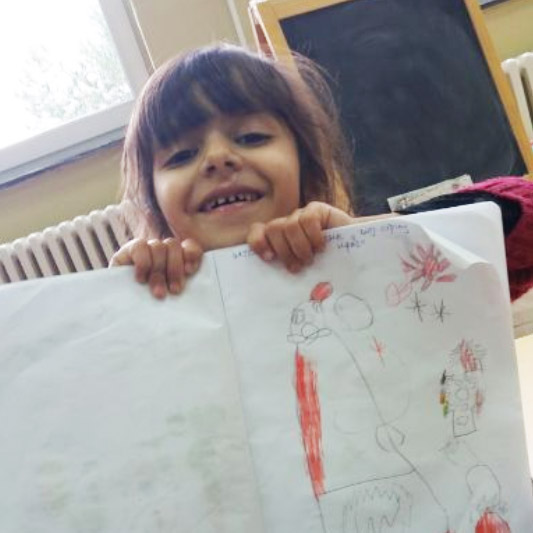
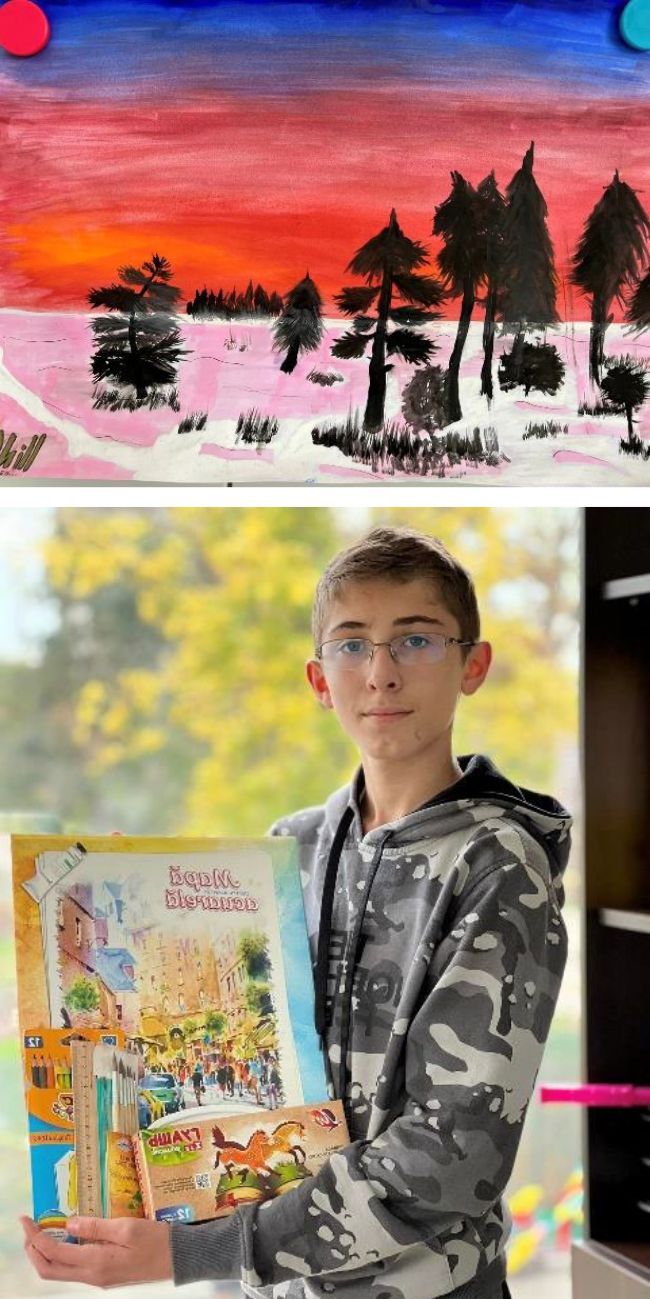
Top: Mark's painting, Bottom: Mark and the art supplies he received

A Young Man with A Plan

While war may seem to stop or slow down ordinary life, for children affected by it, it may do the opposite. Children affected by war are often forced to speed up their lives and become little adults. Young boys and girls may feel like they have to step up when a parent is deployed or their families experience a loss. When we met 13-year-old Mark, we recognized that he was one of these young adults.

When Russia invaded Ukraine last year, Mark, his mother and his his little brother were all forced to flee to neighboring Moldova. Like many other Ukrainian fathers, Mark’s dad had to stay behind in Odessa to join the military effort in defending Ukraine. Quickly, Mark stepped up to the plate and began to engage in new responsibilities. He learned how to use public transport, went grocery shopping, helped with housework and he took care of his little brother.

During his school classes at Anastasis, the CWS-supported educational center in Balti, Mark started thinking about how to take care of his mom and brother. He decided he would become an artist and sell his paintings. His first goal was to use the money from his paintings to buy his mom a birthday present.

Mark got to work and took both his school commitments and art lessons at Anastasis very seriously. He was a young man with a plan! To support Mark in his artistic endeavors, we gifted him a brand-new art kit. As soon as he completed his painting, our partners at the center surprised him by buying it from him to showcase in the center. Mark is saving the money to buy a gift for his mom and brighten up her birthday.

Today, Mark is still on his journey to become a successful artist. Through our program, we are making sure Mark can pursue his dreams while also feeling the freedom to have fun and just be a kid. Mark’s beautiful painting is a bright and colorful reminder of what our youngest program participants can do when they are determined, encouraged and full of hope.

As the war continues, you can support other children like Mark by donating here


Stories of Change


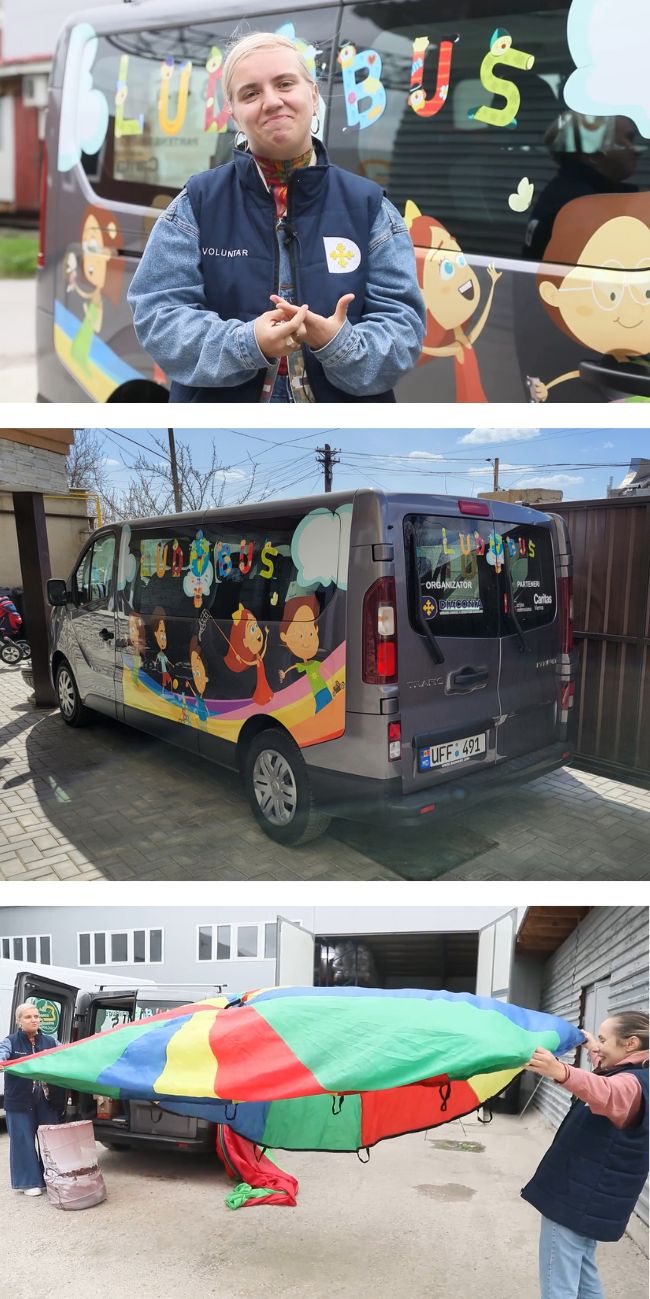
Top: Daniela in front of the LudoBus, Middle: the Ludobus, Bottom: Daniela and her colleague show us the activities inside of the bus

Bringing Fun and Big Hugs

Just like many kids around the world anticipate the arrival of an ice cream truck, in Moldova, many children look forward to the arrival of the LudoBus! The LudoBus, which means “fun bus” or “play bus” in English, was created by our partner Diaconia to bring education and fun to Moldovan children in rural areas. When thousands of Ukrainians fled to neighboring Moldova at the start of the war, the program shifted to include refugee children living in local refugee accommodation centers.

We recently met Daniela, who is the LudoBus program coordinator. Like the bus, Daniela embodies a friendly, joyful and bright spirit and a sunshine personality. She told us that when the refugee crisis began, they were committed to serving the new families. She said, “Our main goal was to reach as many refugee centers as possible and in the first two months we managed to reach about 15-17 refugee centers.”

The first few months were difficult for the LudoBus team. Many of the volunteers did not speak Ukrainian or Russian, so language barriers created new challenges when trying to connect with children. Regardless, the team used their creativity and, “communicated through facial expressions or with their hands,” Daniela explained. Soon the kids became comfortable and were able to open up to the volunteers and open up about what they were feeling. “They felt free,” said Daniela.

The LudoBus was making dozens of children feel happy again, but its magic didn’t end there. The children’s parents and grandparents also felt the happiness of the program as they saw their children smile and have fun. Daniela shared, “I remember all the hugs we received from their grannies. That was the most amazing ‘pay’ we could receive.” Daniela gleefully recounted an instance in which they were playing with the kids and one of the children’s grandmothers took over the activity because she was so excited to see her grandchildren be happy and have fun. Daniela joked that the grandmother was doing such a good job that she asked herself, “wait, what am I doing here?”

Daniela recalled that CWS supported the program through school supplies. She shared, “at the beginning, we saw that there was a need for school supplies for the older kids that were doing online lessons but we didn’t have the ability to obtain the school supplies.” Through the support of CWS, the program received a major donation of supplies that were distributed to about 500 children. “It was a very big help from Church World Service,” said Daniela.

Daniela exudes gratitude for the support the program received and said she’d like to give our supporters and donors, “a big, big hug and a big, big thank you.” She added, “I know you weren’t there with us but I hope that you can feel through the words that I’ve said that you really helped. Every little small help really counted. I know you cannot enter my mind and see all the smiles that I’ve seen and all the tears that I’ve felt, but I want to give you a great big hug and thank you.”

We are thankful for people like Daniela and our supporters who have helped spread joy and care to hundreds of Ukrainian children. Your love and support is truly like a “big, big hug.”

To join Daniela in showing compassion and continue supporting Ukrainians, click here. 


Bojana’s Powerful Love


January 24, 2023

In Belgrade, Serbia there is a community that has been forgotten and left behind by most of society: the Roma community. People living within Belgrade city limits may only know the Roma children who often spend countless hours working on the streets to support their families. Due to a history of discrimination and exclusion, Roma families have been forced to …

Stories of Change


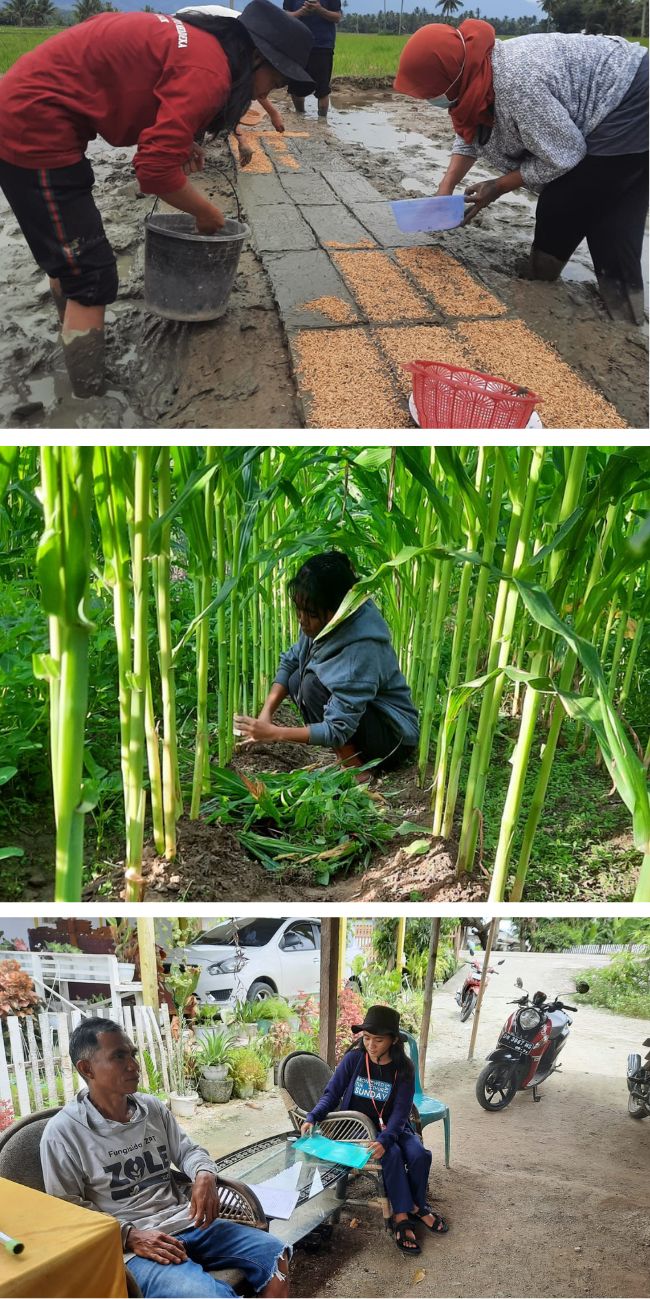
Top: Vicha and other farmers rice seeding, Middle: Vicha planting corn, Bottom: Vicha collecting data for farm groups

Vicha and the Power of Learning

On most days, you will likely find 21-year-old Vicha exploring the world from the comfort of her home in northern Indonesia through various books. Vicha is the oldest of three siblings and is passionate about learning and caring for her family. When her father passed away in 2019, Vicha decided to dedicate herself to practicing and learning about agriculture. Now, when she’s not snuggled up with a book, she’s likely with her mother at their garden, where they work together to produce a harvest they can sell or cook to feed their family.

Vicha knew that by learning more about agriculture, she could increase the quality and quantity of their harvest and share her knowledge with other farmers in her district. When she was younger, Vicha dreamed of becoming a doctor. This desire to care for others is also present in her new career path as an agriculturalist. In pursuit of this career, Vicha applied for and earned a scholarship to pursue a degree in agriculture at Tadulako University. She is now in her 8th semester and is working on her final project.

Recently, Vicha’s university partnered with CWS’ local partner, INANTA, to invite students to participate in our program, DREAM 2. By joining the program, Vicha has been gaining field experience while learning about irrigation systems, land management, organic fertilizers, organic pesticides, climate-smart agriculture and agricultural product marketing. Since Vicha had to learn through online classes during the pandemic, she is especially thankful for the hands-on experience. She also shared that the program has allowed her to collaborate with her community through farm groups that focus on rice seeding. Through these groups, she is part of a collaborative effort to care and provide for her family and neighbors.

Vicha told us that she believes education can eradicate poverty and lead her to a life full of hope. She is grateful for her family’s support and the opportunities she has received and hopes that other youth like her will have the same opportunities. Through education and compassion for her community, Vicha has become a leader and change-maker, ready to inspire others and make an impactful difference.


Stories of Change


Children at the Belgrade botanical garden.

Preschool for Jelena

Jelena* was scared to start preschool. She’s a 6-year-old who lives in Belgrade, Serbia, with her family. 

Jelena’s family are from Belgrade’s Roma community. They live in an informal settlement with other Roma families. Enrolling in school and pursuing an education aren’t givens for Roma children, since they are among the most marginalized children in the country. In order to get into elementary school, though, all children must finish preschool (which in Serbia lasts for one year and is before first grade, like kindergarten in the United States).

If Jelena is going to get an education, she had to start with preschool. She refused to go, though, saying she would rather stay home. Her mom and grandmother dropped her off, but she would run home crying. Getting increasingly desperate, Jelena’s mom reached out to CWS’s partner and our Protection through Education program. This program focuses on helping Roma children enroll in school and giving them the support they need to stay in school and not resort to living or working on the streets.  

The program team agreed to help. As a first step, we invited Jelena to join other children on a field trip to Belgrade’s botanical gardens. That way she could meet some of the children who would be her classmates outside of the classroom, in a more relaxed environment. She loved the idea, joined the trip and had a great time. 

Step by step, the program team kept working with Jelena. They visited her family and got to know her. A breakthrough moment came when Jelena told the staff that she wanted to be a hair stylist when she grew up. One team member told Jelena that she had also wanted to be a hair stylist when she was Jelena’s age. She explained that going to school is an important first step in chasing her dreams. She talked about the importance of education and all of the ways that it could help Jelena. Jelena listened closely and then agreed. She would no longer fight the idea of going to preschool.

We’re excited to say that Jelena is thriving in preschool. She started later than the other children, but she’s there every day learning. She is taking the steps she needs to towards her education–with her family and the Protection through Education team there to have her back. We’re excited to see her chase her dreams, one step at a time.

*Name changed to protect identity


Stories of Change


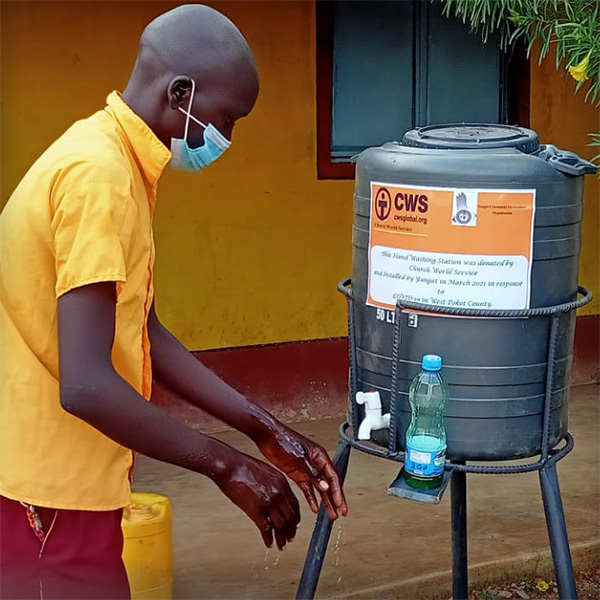
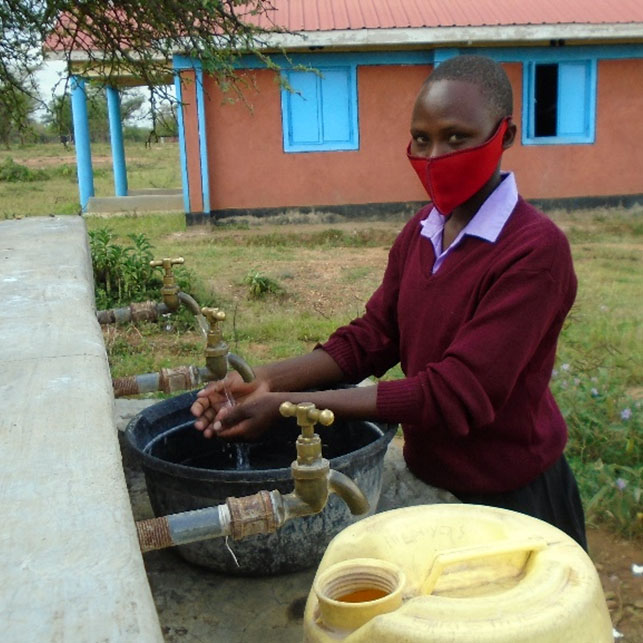
A student in West Pokot County, Kenya, uses a handwashing station funded by CWS to help communities prevent the spread of COVID-19.

Students in rural Kenya are on a path to greatness

“We are very grateful to CWS and its partners for the great transformation happening at our school,” says Francis Loseron, the chairperson of Chepakul School in rural western Kenya. “The reason I say this is because the girls’ biggest need [a dormitory] has been met; as a result, they will be happy, healthy and ready to learn. It’s a sad state that so many of our public schools are in similar high-poverty situations, but it’s also a testament to the power of our community here. We assigned ourselves different roles during the construction. Mr. Samson Kameri, the school treasurer, and I saw to it that parents came out in large numbers to support the construction projects. Also, we had a shortage of toilets at the school. With the [CWS and partner] support, we are now confident that the school’s sanitation has been improved and the school now has enough toilets.”

Every child should have the chance to go to school and get an education. What happens, though, if that school isn’t equipped to help them learn? What if it is too far away, and the long walk to and from school is dangerous for girls? What if the school doesn’t have enough bathrooms, or running water? What happens if parents don’t realize how many doors education can open for their children? And, as we’ve seen recently, what happens when a pandemic closes school doors for months?

All of these “what ifs” are real challenges facing many of our neighbors worldwide. Here at CWS, we know that we can overcome them when we work together. That’s why our team in Kenya is working with communities in West Pokot County, where Loseron lives. Hand in hand with students, parents and communities, we are knocking down these challenges. We’re constructing dormitories so that girls don’t have to face dangerous journeys every day. We’re installing water pumps, tanks and toilets to improve hygiene and sanitation. We’re talking to parents about the importance of education. Finally, as schools reopen after long pandemic-driven closures, we’re helping teachers and school leadership welcome them back.

Selina is an eighth grade student at the same school, Chepakul. “CWS not only made it possible for us to have a dormitory at our school,” she said, “but also helped improve water systems and provide life skills and mentorship programs for us.”

Selina also told us how CWS helped as the school reopened. “Early in 2021, 10 students dropped out due to problems from the coronavirus. Some of them were either preparing to get married or engaging in work like bodaboda [motorcycle taxis],” she said. In West Pokot, it is not uncommon for teenage girls to be married to older men for economic reasons. “CWS helped our teachers and parents bring them back to school,” Selina said.

She has a message for you, too: “We see ourselves being great people in the future, and we are so proud and grateful for our supporters for reaching out to us.”

Liman Agnes is the deputy head teacher at nearby Ngengechwo primary school. “The girls’ dormitory built by CWS at Ngengechwo triggered the West Pokot county government to construct a boys’ dormitory,” she said. “Because of this, boys here have no reason to miss school…student enrollment has doubled, and we attribute this to efforts by CWS in our school and community. Parents are more positive than before, and we are working with the leaders to ensure that students, particularly girls, are supported to stay in school.”

Liman told us about how the pandemic had impacted her school. “Our students were lagging behind, having lost almost a year of school during the COVID lockdown. Their counterparts in Nairobi and other big cities were still learning because they have internet connections at home and can afford computers. We are grateful to CWS for helping our teachers to facilitate catch-up learning sessions when the schools were reopened,” she said. “They trained teachers, supplied materials and shared information with our parents about COVID prevention.”

In the neighboring community of Kapsentoi, Totok Lolinganya is the father of Sikuku and Patience, who have just finished high school and eighth grade. “I am deeply humbled because I am one of the lucky parents whose children had a chance to benefit from CWS programs in Kapsentoi,” Totok said. “The most important project was providing counseling to our girls. They have also given me the resolve to take Patience to secondary school, since I now know that there is hope for our girls–as opposed to my tribe’s attitude that girls are a source of wealth in the form of dowry when they get married. My two educated daughters will be great. They will not only change the status of my family, but they are already becoming great role models to their fellow girls, including families who believe that marriage is everything.”

Girls across West Pokot County–and their families and school communities–are blazing trails right through the challenges that they used to face. We’re so proud to stand beside them as they do.

Stories of Change


Suada in the courtyard near her school.

Nothing can stop Suada

As a Roma woman in Belgrade, Suada has faced a lot of challenges in her life. She grew up in an informal settlement in the city. She had to help her mom with chores in the house and care for her siblings, so she didn’t have time to go to school.

Suada also has challenges hearing and speaking. Being a person with a disability on top of being an ethnic minority meant that she often faced double discrimination. Other members in her family had similar disabilities, so they didn’t have the resources or knowledge to help Suada get the care she needed. 

As we’ve learned, though, nothing can stop Suada.

She heard about a CWS-supported adult literacy class for women who weren’t able to finish primary school. She decided to join the classes. 

A previous student in the program was blind, but she managed to finish high school and find a job. So the program team had no second thoughts about welcoming Suada when she approached them and expressed her interest in learning. Her teacher has basic sign language skills thanks to a local center for people with hearing impairments, which made it easier to communicate with Suada. 

Suada is a regular attendee of the classes and, we’re excited to say, is making great progress. She is enthusiastic during class, and her favorite subjects are math and calculus. Everyone in the class is struck by her will and determination to finish her education. As for the future, Suada says that she will pursue training as a hairdresser once she finishes her primary education so that one day she can open her own hair salon. 


Stories of Change


Anita in her classroom.

It’s never too late to learn to read and write

Anita was born and raised in Macedonia. Two years ago, she escaped her abusive husband–who was also a drug addict–and fled to neighboring Serbia with her children.

After she arrived in Belgrade, Anita went to enroll her two daughters in school. That’s when she learned about a CWS program that helps women learn to read and finish their education. That program is operated out of the very same school where her daughters are now students. One of the teachers explained the program to Anita, who hadn’t finished school but wanted to at least learn how to read and write.

Reading and writing unlock huge amounts of freedom for women like Anita. When a woman learns to read and write, she can use smartphones and the internet. She can read street signs and maps to get around. She can understand medical forms and read prescription bottles. She can read the news and maintain correspondence. And she can help her children with their homework.

Anita enrolled in the program, and so far she has proven to be a fast learner with a sharp mind. She says that she wants to finish school so that she can find a job and pay bills, but also so that she can manage tasks like obtaining documents. “My greatest motivation to complete elementary school are my children. They are so happy because their mom will become literate,” she says. 

We are excited to help Anita finish her education and be a role model for her daughters. 


Stories of Change


Mercy washes her hands at a water point at Ngengechwo Primary School.

Water Access & Bathrooms Allow Girls in Kenya to Focus on Their Futures

Water is a top priority in arid communities around the world. And the part of western Kenya where Mercy lives is no exception. Mercy’s community is largely made up of livestock farmers.

Unfortunately, it’s also a community where girls have a huge disadvantage. The chances of a girl finishing school are slim. Girls are expected to care for their families and younger siblings. And considering that schools are usually far away from where families live, just getting to and from school every day can be dangerous and prohibitive. Girls as young as 12 are married off to older men.

Mercy is a boarding student at Ngengechwo Primary School, which is part of a CWS education program. She recalls how she and the other girls would go to a community water point after school each day to bring back water for their evening and morning. It was a long walk to the one community borehole that served both people and livestock. “It was stressful to fetch water, since herdsmen put their livestock first before women or school children,” she says. “We had to wait until all the animals were watered before we could fetch our water and go back to school.” Sometimes the men would harass the girls, and forced marriages sometimes came out of these interactions.

Back at the school, bathrooms were also a problem. There was only one latrine for boys and one for girls. When you had to go, you often had to wait in a long line. Many students used nearby lands instead, which led to high levels of diarrhea and water-related diseases. It was unsanitary, unsafe and undignified.

CWS teamed up with the school management and parents to address these challenges. Soon there were more bathrooms. The school now has huge water tanks, and the water is tapped to several water points on the school grounds. Mercy, who is now 15, says she has seen a huge change in herself and her fellow students. She says that all the students now use the bathrooms. “Proper personal hygiene has improved amongst us,” she says. “Dignity can also be observed on our faces, since we have washrooms where we can change and dispose of used sanitary pads without anyone knowing.”

“Life has changed and become much more comfortable at our school,” Mercy says. “Many thanks to CWS for these wonderful projects in our school.”

Soon, Mercy will sit for Kenya’s Certificate for Primary Education. This is a huge step for girls from a community where many of their peers are forced to drop out due to early marriage or pregnancy. We’re proud to be able to help Mercy and her peers as they focus on what’s important: reaching their potential.


Stories of Change


Delphine stands in front of the new dormitory.

A Safe Dormitory for Girls at a Kenyan School

Delphine is determined to learn. She’s a 14-year-old student at Ngengechwo Primary School in rural western Kenya.

Because the school is far away from her house, Delphine is a boarding student. It allows her to focus on her studies and means that she doesn’t have to make a long, dangerous journey to and from school each day.

Delphine has been a boarding student since she was in Grade 5. At that time, though, there wasn’t a dormitory at the school. The girls who were boarding students would sleep on their classroom floors at night. But space was limited, so it was a logistical nightmare. They had to rearrange the classroom every morning and evening. They would take their bedding outside every morning and hang it over a fence. Each girl had a metal box to keep her personal items in, which were kept at the back of the classroom. But those boxes were hard to access during the day and were noisy and disruptive to get into. “The classrooms we used to sleep in were very congested and dusty. Having our personal items destroyed by others was the order of the day,” she remembers.

The school didn’t have enough bathrooms, and the girls would go to a nearby river to bathe. The worst part of the month was when a girl would get her period. “It was very difficult for us girls to open our boxes to pick out a sanitary towel for changing because the other students, especially the boys, would laugh at us when they noticed. Others would avoid you entirely because in our culture it is believed that when a girl is on her period, she should stay far away from others and should not touch anything commonly used by others,” she explains.

Needless to say, it wasn’t a good situation. In fact, it was so hard that Delphine gave up boarding at one point, opting to live at home and make the long journey each day.

But today is a different story. Ngengechwo Primary School is now part of a CWS education program. Among other upgrades, it now has a dormitory building for girls. There is water on site as well as sanitary bathrooms that Delphine and the other students can use.

In fact, Delphine is now one of 84 girls living in the new dormitory. “I give thanks to CWS because on year [after I stopped boarding at the school] you came to the aid of the girls studying at Ngengechwo. You came to put up a big girls’ dormitory with enough space and washrooms as well as the latrines at the school boarding section,” Delphine says. “The environment changed to a very friendly one, enhancing our privacy, safety, health and performance.”

In fact, Delphine noted that a rare phenomenon is happening at Ngengechwo. “Since its construction, the girls’ population enrolled at the school for boarding has been constantly increasing and, contrary to the normal, has surpassed the boys’ population by far. Were it not for this facility, many of us girls would not be here today. Thank you very much to CWS.”