
Andrea Casamento’s journey from personal pain to collective advocacy highlights how families of incarcerated people—especially women—transform isolation into strength, leading to global recognition of their rights. Through ACiFaD’s partnership with CWS, her work has reshaped policy, elevated lived experience and inspired international action against systemic injustice. When Andrea Casamento stepped onto the TEDx Río de la Plata stage for the …
Youth Advocate for Safer Spaces: A Step Toward Dignity and Rights
October 9, 2025
On September 30, CWS Latin America and Caribbean commemorated the International Day of Children and Adolescents with Incarcerated Adult Relatives, highlighting a major milestone in the defense of their rights: the participation of youth representatives in a thematic hearing before the Inter-American Commission on Human Rights and the resulting Resolution 2/25, which recognizes the rights of children affected by incarceration. …
When Pipe Dreams Start Becoming Reality
Luciano Cadoni | May 26, 2021
“One of the aspirations of Plataforma NNAPES [and CWS]…is that children can be protagonists and speak with their own voice about their reality and can articulate their demands and their vision about this issue.” Martín Coria, CWS Regional Director for Latin America and the Caribbean, said this in a 2016 interview that went on to be part of a documentary …
A Simple Piece of Wood
Luciano Cadoni | December 10, 2020
A simple piece of wood. Objectively, that’s what you see in this photo. And for most people, it’s just that. But for our colleagues at the Civil Association of Relatives of Detainees of Argentina—known as ACIFAD for its acronym in Spanish— and for us, it’s a lot more than that. It’s the result of years of struggle, countless meetings, setbacks …
Stories of Change
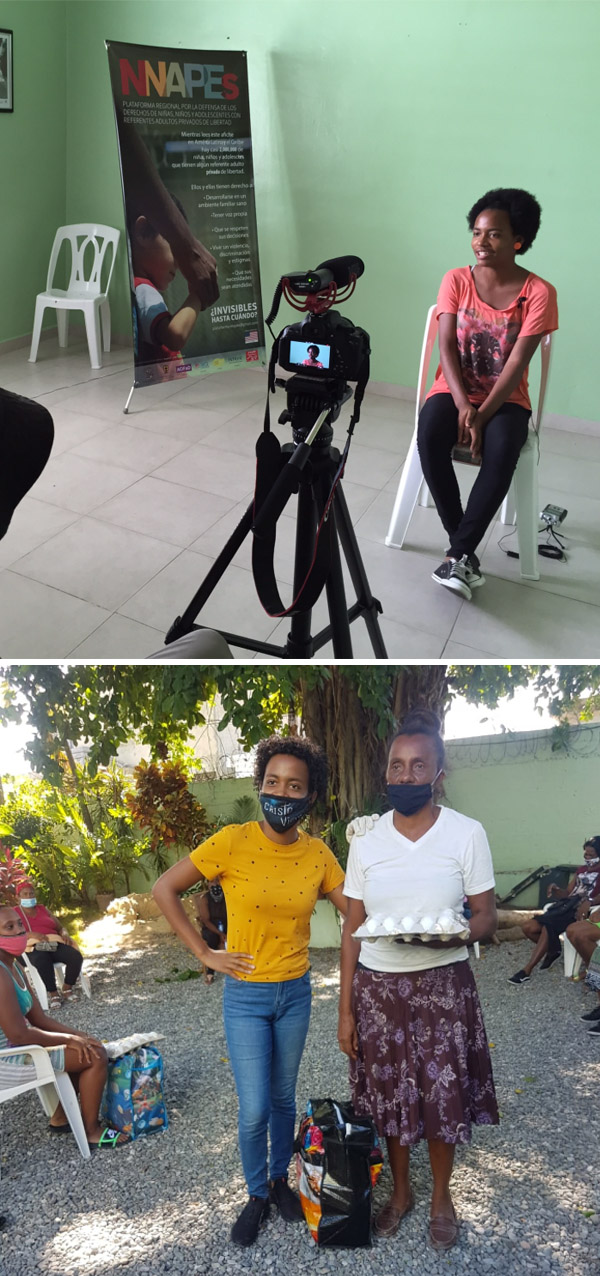
Top: Felicia in 2015, being interviewed for a documentary about children with incarcerated parents. Bottom: Felicia in 2020, responding to the coronavirus pandemic in the Dominican Republic as a staff member of Caminante. Bottom photo courtesy Caminante.
On International Day of the Girl, Wisdom from a Role Model
Felicia is a longtime friend of CWS from the Dominican Republic. CWS supports regional advocacy and support of children whose parents are incarcerated. Felicia participated in programs through our partner in the Dominican Republic, Caminante Proyecto Educativo. She has shared her own experience as the child of an incarcerated parent with international audiences and has helped bring attention to an issue that affects millions of children. Today, she is on the staff at Caminante. Our team chatted with Felicia in honor of International Day of the Girl, which is on Oct. 11. Here’s what she had to say:
1. How did you first hear about CWS and Plataforma NNAPES, the regional advocacy platform for children with incarcerated parents?
In 2015, I had the honor of getting to know the work of the NNAPES platform and CWS in the Dominican Republic. It was there that I met Luciano Cadoni, who was one of the people who invited me to the interview that changed my life. I say it changed my life because it was the first time that an adult approached me and my family to ask us how we were, how we felt and what it was like for us to have a father deprived of liberty. It was the moment I was able to breathe, express myself, know who I was and start changing my life in a wonderful way.
2. What types of activities did you participate in through Caminante?
I have participated in several activities through Caminante, many of which have been supported by CWS. I have participated in camps for children and adolescents, I have been in the young alert project, which is a project that has enriched me a lot. I have led many activities for children and youth, guiding them on what their rights are. Through these programs, they were given help and support, and I’m trying to move forward with them.
3. How has Caminante changed your life?
Caminante changed my life in a very wonderful way from the beginning, since I came in as a program participant. That’s when I learned for myself what NNAPEs is, and today I’m a cultural educator as part of the NNAPEs project here in the Dominican Republic. It fills me with pride and makes me feel good because I know children and adolescents who are going through the situation that I went through, and I can give them my support. I can give them advice, work with them and learn a little more every day. That makes me feel really good.
4. What is the most rewarding part of working for Caminante?
The most rewarding thing for me is to be able to support so many children and adolescents who, in turn, support me. I also really like to gain experience on these topics. It’s nice to go home for the day and know that I worked with 31 families with children and teenagers with parents deprived of their liberty. I was able to help them, I was able to advise them, I was able to arrange an appointment with the counselor. Being able to visit them and know that they are okay are things that make me feel good and make me grateful. And I’m grateful to God, to the NNAPEs project and to CWS because they changed my life forever.
5. What is something that you think more people should know about what it’s like to be a child whose parent is in prison?
I think that more and more people should know about children and adolescents who have adult references deprived of their liberty. Adults often judge children because their parents have made a mistake, and that doesn’t feel right. That’s why I think everyone should know how the NNAPEs project changes lives, as it helps children, children and teenagers to get ahead. CWS helps many children from different countries who are in this situation. I think the NNAPEs project changes lives.
6. October 11 is International Day of the Girl. What advice would you give to another young girl whose father is in prison in the Dominican Republic?
My advice to all children and adolescents with parents deprived of liberty is to fight for your dreams, to try to get ahead and never shut up. If you want to express what you feel, do it. Your father and your mother are always going to be there to support you and listen to you. No parent wants to do anything wrong for their children. Parents always fight so that we have the best and have a good education. I want them to try to focus on the positive and not so much on the negative and understand that our parents, wherever they are, are always accompanying us.
From the Shadows to the Negotiating Table
Luciano Cadoni | May 18, 2020
In the face of coronavirus, prisons around the world have the makings of a tinderbox for an outbreak. Inmates live in cramped spaces. Sanitation conditions are often poor. Older inmates or those with health conditions live among the general population. In some cases, worried inmates have demonstrated and demanded protection when the virus arrives at their facility. One of these …
Celebration of UN Convention on the Rights of the Child Highlights Voices of Children of Incarcerated Parents
Luciano Cadoni | November 20, 2019
Today in celebration of the 30th anniversary of the UN Convention on the Rights of the Child, the Inter-American Court of Human Rights, the highest judiciary body in Latin America and the Caribbean, hosted a special session. Judges from the court heard directly from children affected by migration, incarceration and armed conflict. Two of the presenters, Hector from Nicaragua and …
New Study Finds Children of Incarcerated Parents in Latin America and the Caribbean Face Violence, Social Isolation and Discrimination
April 29, 2019
FOR IMMEDIATE RELEASE: April 29, 2019 CONTACT: media@cwsglobal.org | 212.870.2188 Washington, D.C.— Church World Service today released a new study titled “Childhood That Matters,” which details the harmful impacts of drug policy on children of incarcerated parents in Latin America and the Caribbean. The study finds that children of incarcerated parents (COIP) are often exposed to multiple forms of violence, …