
Stories of Change
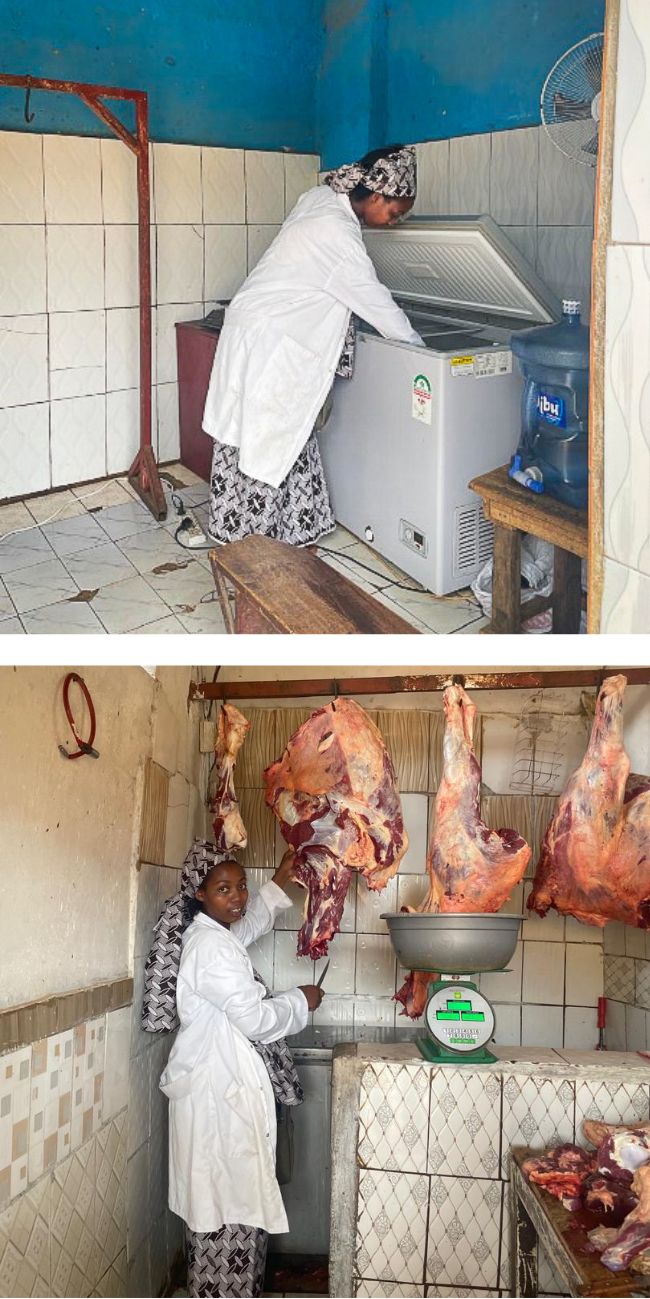
Top and Bottom: Evelyne works in her business.
From Refugee to Entrepreneur: Evelyne’s Story of Resilience and Growth
Through support from CWS’s Igniting Innovation Project, in partnership with YWCA Rwanda, Evelyne Ntakirutimana’s business grew dramatically. A refugee entrepreneur in Mahama Camp, Rwanda, Evelyne’s journey shows how targeted investment and training can spark long‑term economic transformation for refugee families and communities.
A Refugee‑Led Business Creating New Opportunity
Evelyne Ntakirutimana demonstrates the powerful impact that can emerge when refugee entrepreneurs receive dignified economic opportunities paired with practical skills support. Evelyne runs a butchery business in Mahama Camp in Rwanda. Through the CWS Igniting Innovation Project, in partnership with YWCA Rwanda, she gained access to capital, training and a formal business space that allowed her to move from day‑to‑day survival to building a thriving enterprise.
When Evelyne first began her business, she operated with only 150,000 RWF per month (104 USD). Limited capital meant she could not buy enough meat or invest in cold storage. Without refrigeration, she often relied on informal and unreliable storage arrangements, which caused losses and reduced her already thin profit margins. Like many refugee entrepreneurs, she faced the cycle of having too few assets to grow but too little revenue to save or invest.
The Igniting Innovation Project provided an initial grant of 700,000 RWF (485 USD), which Evelyne used to purchase a refrigerator and secure formal business premises. This step marked a major turning point. Cold storage allowed her to maintain larger quantities of inventory, and a formal space gave her visibility with local authorities and freed her from operating in constant insecurity. Through a second grant of 300,000 RWF (208 USD), combined with 350,000 RWF (243 USD) she saved through her community savings group, Evelyne was able to buy her first full cow and begin planning for long‑term business growth.
Building Employment and Strengthening Her Family’s Future
Formalizing her business gave Evelyne the confidence to participate more in the local economy. During a project training on financial management and marketing, she recognized that the meals being served indicated demand for meat supply. She approached the organizers and secured a contract to provide meat for future activities—recognizing opportunities for growth and building her confidence in promoting her business through the local community.
Evelyne now employs two young men from the camp who previously had no stable income but now each earn 60,000 RWF (42 USD) per month. She also withholds half of their wages as structured savings that the employees can later use to start their own businesses. Although this approach is unusual, her employees appreciate that they’re able to build capital they would otherwise struggle to save. The model has strengthened Evelyne’s business while supporting the development of future entrepreneurs, giving back to both her community and neighbors.
The success of Evelyne’s business has allowed her family to purchase land and begin planning for a future home. She has enrolled her two children in private school, prioritizing their long‑term opportunities. Evelyne describes how her understanding of money has shifted. In the past, she often felt unsure how to use even small amounts of leftover income. Today she approaches her finances with confidence and sees every investment as a step toward growth.
Looking Ahead: A Bright Future for Evelyne
In the future, Evelyne hopes to hire two additional employees, open a second business location and eventually raise livestock to supply her own butchery. In camps like Mahama, where economic opportunities are limited, each new job has meaningful impact.
As a formal business owner, she contributes tax revenue to the local municipality. Most importantly, she has gained a sense of agency. She identifies opportunities, mobilizes community savings and invests in both her business and her children’s education.
Her story shows that with the right support, refugee entrepreneurs can build strong, sustainable businesses that benefit entire communities.
To learn more about our work in Africa, click here.