
Along the Thailand–Myanmar border, democracy activists and displaced families are finding safety, mental health support and essential resources. Stories like Ei Ei Khin’s show how local partnership and access to safe shelter restores dignity, stability and hope for people facing trauma and conflict.
Finding Safety Through Shelter and Community Support
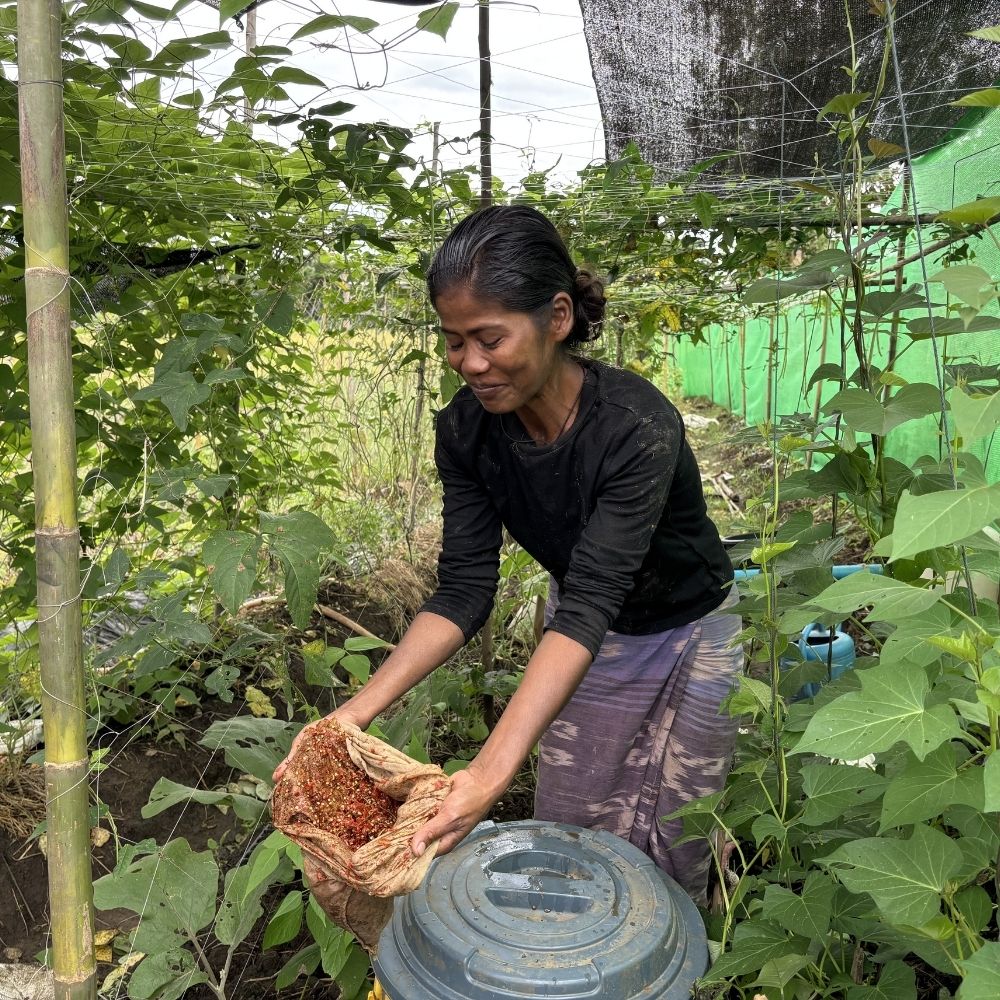
Ei Ei Khin works on her organic farm, which raises enough funds to help cover her basic living expenses.
In the shadow of conflict and forced displacement, the path forward can feel impossible. Yet along the Thailand–Myanmar border, families like Ei Ei Khin’s are finding safety, stability and the chance to rebuild their lives.
When ongoing political violence made staying in Myanmar too dangerous, Ei Ei Khin, a 43-year-old single mother and democracy activist, was forced to flee her home. With her young son, she crossed into Thailand in search of protection, carrying with her the weight of uncertainty and fear that so many displaced families face.
Ei Ei Khin found refuge through CWS’s partnership with Blossom Future, a local refugee-led organization, which provides safe shelter and essential assistance to people forced from their homes. There, she and her son received food and other essentials, and Ei Ei Khin even later received job training courses to begin planning her next steps.
For families fleeing persecution, timely generosity can be the difference between fear and stability. In this safe environment, Ei Ei Khin was finally able to recover from uncertainty and begin imagining a future beyond survival.
Building a Livelihood Through Sustainable Agriculture
As part of the program’s commitment to long-term recovery, Ei Ei Khin participated in agricultural training designed to help displaced people develop sustainable livelihoods. The training offered more than technical skills—it provided a path toward independence and renewed purpose.
Ei Ei Khin had owned some land in Myanmar and knew about farming, but through the training, she deepened her knowledge on climate-smart agriculture and water management to help her become more successful.
After completing the program, Ei Ei Khin received start-up support to establish her own organic farm on 0.5 acres of land. Today, she grows food that supports both her household and local markets, earning about 5,000 Thai baht per month (approximately USD 155) and helping cover basic living expenses for herself and her son.
She distributed surplus vegetables to other refugees in the surrounding community. What began as a way to feed herself has slowly become a source of support for others nearby who also struggle with unstable income and limited food access.
“Alone, life for women is very difficult,” Ei Ei Khin shared. “I have been able to work and to feed myself and other refugees like me. I want to be successful in farming here.”
With the right resources and support, families like Ei Ei Khin’s can begin to move from survival to self‑reliance—a journey fueled by compassion in action. Through safe shelter, skills training and livelihood opportunities, Ei Ei Khin has reclaimed a sense of control over her future and hope for what lies ahead.
Stories like Ei Ei Khin’s are made possible because supporters choose to show up, especially in moments of crisis, so families can find safety, dignity and a path forward.
This work is made possible due to the generous support of the Church of Jesus Christ of Latter-day Saints. You can provide critical support for people like Ei Ei Khin by participating in a local CROP Hunger Walk near you.