Stories of Change
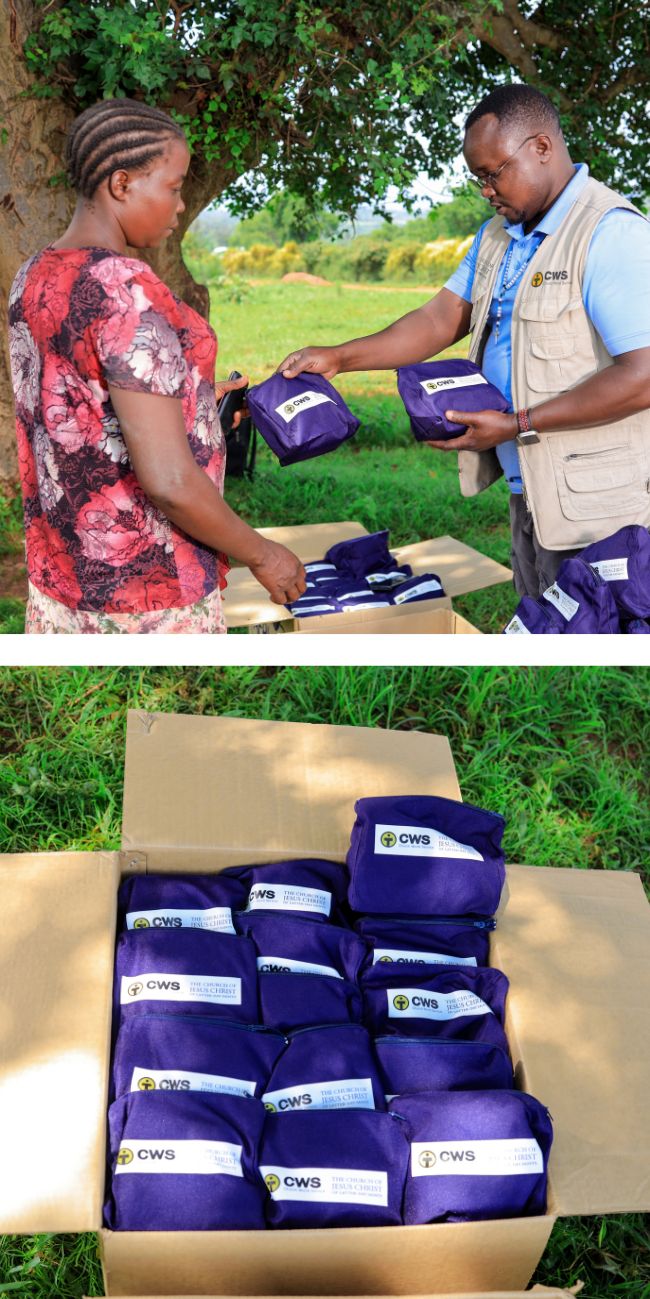
CWS staff distribute menstrual hygiene products to individuals in Nakivale refugee settlement in Uganda
Dignity Restored: How Menstrual Health Is Transforming Girls’ Lives in Nakivale
CWS’s WASH Emergency Response Project in Nakivale Refugee Settlement is restoring dignity and opportunity for women and girls by providing reusable menstrual hygiene kits, training and improved sanitation facilities. For girls like Amina, this support means renewed confidence, uninterrupted education and a powerful reclaiming of agency in displacement.
Building Dignity and Strengthening Girls’ Education
When Amina first arrived at the Nakivale Refugee Settlement in Uganda, her greatest concern wasn’t shelter or food—it was survival. Like thousands of young women and girls fleeing the Democratic Republic of Congo, she faced an unspoken but urgent challenge: managing her menstruation with almost no resources, privacy or support.
Before the CWS Water, Sanitation and Hygiene (WASH) project began, girls like Amina routinely missed up to five days of school every month. With no access to proper menstrual hygiene supplies, many relied on torn cloth, leaves or nothing at all. The shame and fear of embarrassment kept them from school, community gatherings and even the camp’s water points. Untreated infections were common, and the emotional toll was heavy.
Teachers noticed that even when girls did attend school during their periods, they struggled to focus, often distracted by discomfort and worry. What remained largely unspoken was the deeper impact the belief that their bodies were burdens, that their education mattered less and that their dignity was negotiable.
Launching a Holistic Response
In July 2025, CWS launched the WASH Emergency Response Project, recognizing that true dignity requires more than clean water and latrines. The project committed to providing 2,500 upgraded reusable menstrual hygiene kits to women and girls in Nakivale. But distribution was only one part of the solution. Each kit came with training on hygiene practices, proper usage and, most importantly, open conversation about menstruation as a natural, manageable part of life.
Amina remembers receiving her kit vividly. A community facilitator explained each component clearly and confidently—without euphemisms, embarrassment or shame. For Amina, it was the first time menstruation had been discussed with dignity.
A Transformative Impact
After receiving her reusable kit, Amina’s school attendance jumped from 60% to 100%. She no longer lost five days of learning every month. Her confidence returned, her grades improved and she rejoined group discussions, raising her hand without hesitation. She felt visible again—not as a problem to be managed, but as a student with potential.
Across the settlement, something shifted. Girls began talking about menstruation openly. Mothers and daughters shared knowledge without shame. Community health workers incorporated menstrual management into regular health sessions. Menstruation, once a source of silence, became a topic grounded in wellness and empowerment.
Amina’s experience was echoed throughout the community. Fatuma, age 16, once considered leaving school. After receiving her kit, she stayed and now trains other girls, becoming a peer educator respected in her community. Helen, a mother of three, said the kit made her feel seen again. “In the camp, we forget ourselves,” she shared. “We survive. But this project said to me: your body matters. Your comfort matters. Your dignity matters.”
Teachers also noticed dramatic improvements. “Girls are present now—and they’re present fully,” one teacher explained. “They’re not managing pain and worry and shame at the same time. They can just be students.”
Building an Integrated Approach to Sanitation
The menstrual kit distribution was paired with broader WASH improvements, including upgrades to 1,360 latrines with safe sanitation, new handwashing systems and water storage tanks and hygiene education that reached 80% of newly settled refugees. This integrated approach meant girls now had clean, private facilities to change their kits and practice safe hygiene. Menstrual management became part of a larger ecosystem that supported health, dignity and self-reliance.
The most meaningful outcome wasn’t only improved attendance or cleaner facilities—it was the normalization of menstruation. Amina has since become a mentor for younger girls in her neighborhood, discussing their bodies with confidence rather than fear. Moments once driven by shame turned into opportunities for connection and empowerment.
In a refugee context where people have lost everything—their homes, their countries, their security—the ability to manage menstruation with dignity represented something deeper: a small but unmistakable reclamation of agency, identity and humanity.
The menstrual kits were never just products. They represented a commitment to honoring women’s full humanity, protecting their futures and ensuring their education and dignity remain non-negotiable.
To learn more about our work in Uganda, click here.