
After fleeing the Democratic Republic of Congo and arriving at Tanzania’s Nyarugusu Refugee Camp, Sabina faced hunger, financial instability and depression while raising six children. Through a CWS-supported sustainable farming project, she gained agricultural skills, became a community leader and built a more stable future for her family.
Facing Hunger and Uncertainty in Nyarugusu Refugee Camp
When Sabina turned 30, she expected to find herself in the same life stage as many of her peers: building a career and looking ahead to the future. Instead, she was forced to flee her home in the Democratic Republic of Congo, arriving at Tanzania’s Nyarugusu Refugee Camp with five children and a sixth on the way.
Everything became uncertain. Sabina struggled to access enough food for herself and her family, and while she was still pregnant, her long-term partner left. Food rations were inconsistent, and the stress of financial instability, social pressure and emotional turmoil took a heavy toll.
“I was beyond depressed,” Sabina said. “I remember being taken to the hospital more than twice, but no disease was found. Still, I felt sick.”
Building Confidence Through Sustainable Agriculture Training
These challenges only grew, affecting her mental well-being, her ability to care for her children and her confidence to participate in community activities. Then, Sabina joined a CWS-implemented sustainable vegetable farming project, and things began to change.
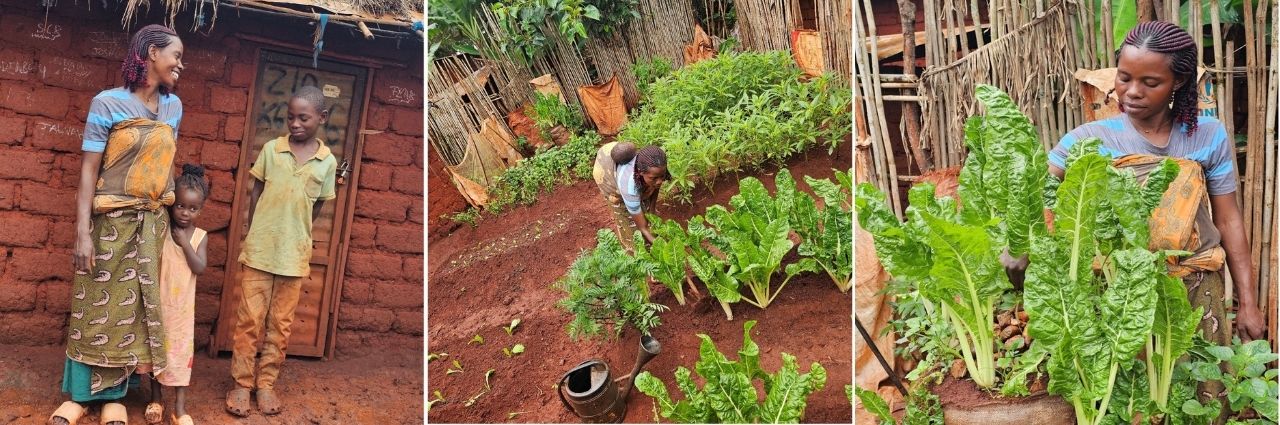
Through the project, she received training in agriculture and nutrition, gender equity, environmental conservation and natural resource management. In addition to learning farming techniques, she developed leadership and group facilitation skills and was eventually selected as a Lead Farmer for her group.
At first, Sabina had doubts about taking on a leadership role. Through additional mentorship and training from CWS, along with encouragement from her peers, she gained the confidence to lead.
From Participant to Community Leader
Today, Sabina co-leads a team of 36 members, conducting household visits, monitoring progress and helping train others in the same skills she once learned herself.
Vegetable farming has helped restore Sabina’s financial stability. Recently, she earned 97,000 KES (approximately $747 USD) from the sale of crops including amaranth and African nightshade, enabling her to better support her children’s needs. She expects an even larger harvest in the coming season.
Sabina’s children have witnessed their mother’s transformation from a period of uncertainty and hardship to a future shaped by confidence, purpose and opportunity. Alongside supporting others in her community, Sabina continues to dream of a brighter future for her children.
Her journey reflects the transformative impact that investments in food security, nutrition and gender equity can have on one person and how that impact can extend outward to strengthen entire communities.
This month marks both World Food Day and the International Day for the Eradication of Poverty. For 80 years, CWS has remained committed to helping people facing displacement, disaster, hunger and poverty access safety, opportunity and practical support. Through programs like these, women like Sabina are building healthier futures, strengthening their communities and creating pathways out of poverty.
Learn more about our work in Tanzania.