
Every year, tens of thousands of unaccompanied children seek safety in the United States, often after enduring dangerous journeys. They hope for healing and a safe childhood here, but there are many challenges that stand in the way. During National Child Abuse Prevention Month and beyond, CWS is committed to ensuring these children have the care, protection and advocacy they …
Stories of Change
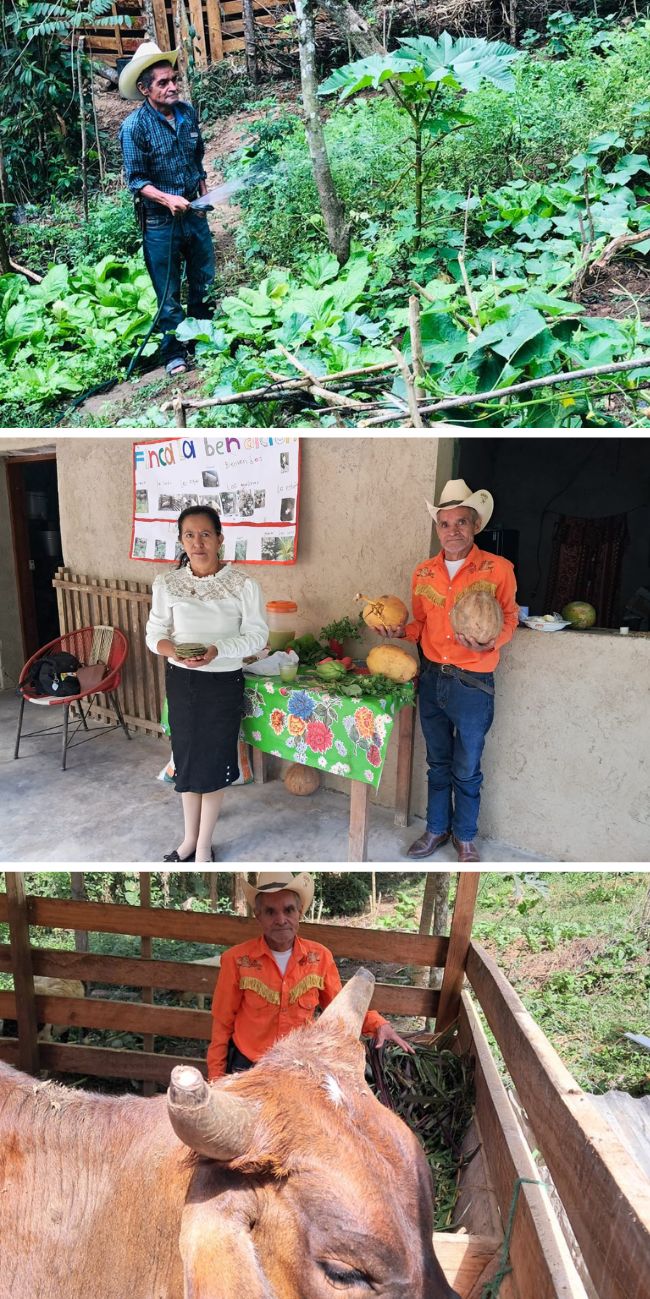
Top and Bottom: Rogelio Rivera on his farm Middle: Rogelio and his wife Suyapa
La Bendición: A Farm that Feeds the Rivera Family
Rogelio Rivera, his wife Suyapa Villeda and their family have transformed their small farm, La Bendición, into a thriving, sustainable homestead in La Sierra, Honduras. Through the Produce Verde project, they’ve embraced new farming techniques, diversified their crops and shared resources to strengthen both their livelihood and their community.
Cultivating a Life Rooted in Gratitude and Hard Work
“Thank God for a new day,” says Rogelio each morning before starting his work: he feeds his cow, waters the crops, cares for the chickens and oversees the grazing of the sheep. His wife Suyapa prepares fortified tortillas that she learned to make, along with green smoothies, before starting her own work with the vegetable garden and animals.
Rogelio Rivera and Suyapa Villeda live with their three children in the community of La Sierra, Macuelizo, Santa Bárbara. This cool-climate area, surrounded by pine trees and made up of about 30 families, welcomed them more than four decades ago.
Since joining the Produce Verde project, implemented by the Mennonite Social Action Commission (CASM), they have learned new farming techniques and built the chicken coop they needed. They also diversified their crops with plantains, cassava, beans, vegetables like radishes and mustard greens and fruit trees such as apple, papaya, pineapple and lemon. The family raises livestock, including pigs, chickens and sheep and have even started keeping native stingless bees, whose honey they use for medicinal purposes and to sell.
Their farm, La Bendición (The Blessing), is now a source of pride. “We didn’t know how to make this compost,” says Rogelio, showing worms wriggling in the soil he holds in his hand. “We’re very grateful to God,” he adds, enthusiastically pointing to the sacks of compost that now represent self-sufficiency and healthy soil from which they harvest food for their family.
Growing More Than Food: Skills, Knowledge and Community
Suyapa proudly shares that she now knows how to better care for her garden. “I’ve learned how to care for my animals and so many other things about farming. I love my little hens,” she says. They are also part of a group that promotes sustainable practices, such as avoiding burning waste and using compost in terraced fields.
As a sign of their commitment to the community—and as part of the project—they take part in the “pass-it-on” practice: a piglet is given to another family in a neighboring community so they can raise it, breed more and eventually sell them for an additional income.
As César Soriano from CASM notes: “This project and the dedication of the participants reflect a natural commitment to the land and a willingness to try new practices.”
The ‘Produce Verde’ project is implemented by our local partner, Comisión de Acción Social Menonita (CASM), with the support of Growing Hope Globally. Click here to learn more about our work in Central America.
Stories of Change
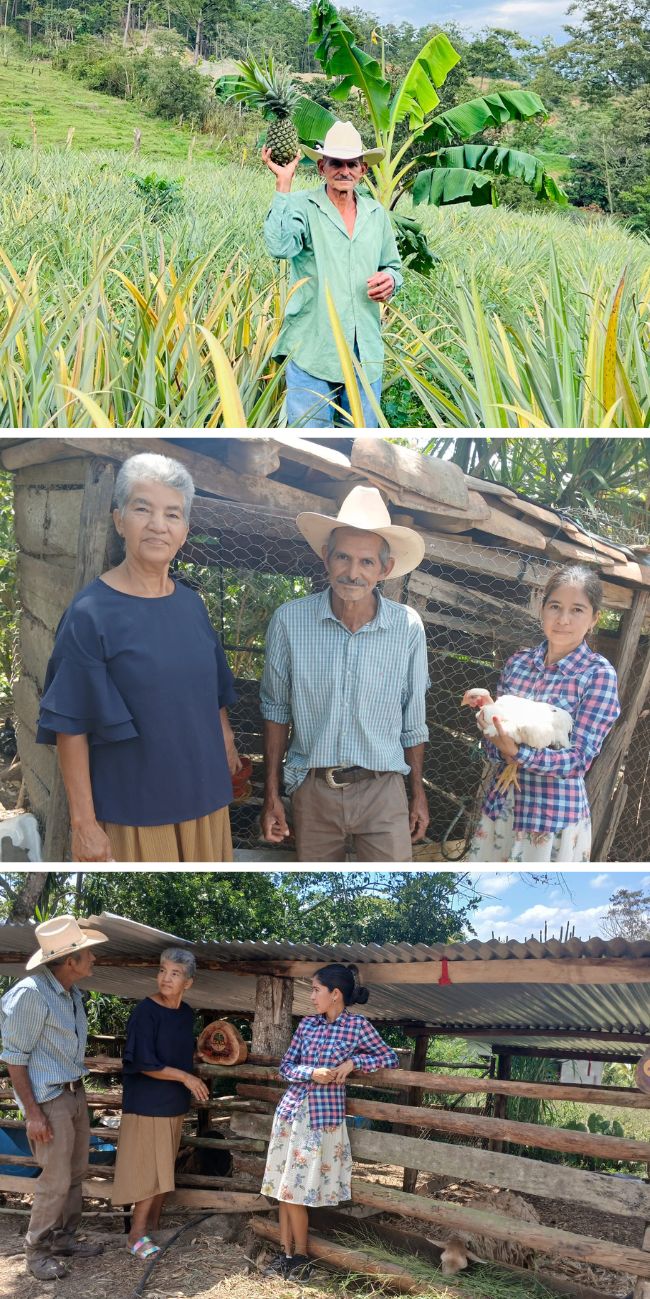
Top: Pedro Pablo Gutiérrez on his farm Middle and Bottom: Pedro Pablo with his wife Rosa and their daughter Glenda
From Pineapples to Piglets: How the Gutiérrez Family Is Cultivating Life and Hope in Honduras
Pedro Pablo Gutiérrez and his family have transformed their small farm in Las Varas, Honduras, into a thriving, self-sufficient homestead with the support of the Produce Verde project. Through teamwork, sustainable farming practices and community sharing, they’ve created a life rooted in resilience, health and generosity.
A Day in the Life on the Farm
Every morning, Pedro Pablo Gutiérrez begins his day with a prayer and a hot cup of coffee. He lives with his wife Rosa and their daughter Glenda in the community of Las Varas, Macuelizo, in the department of Santa Bárbara, Honduras.
The family takes great care of their farm. Their day begins early: feeding the pigs, checking the fish tank, tending to the animals and managing the crops. “Here, we do a bit of everything,” shared Pedro Pablo.
Pineapple cultivation is his favorite task. “We love its taste, that’s why we enjoy it so much,” he says, pointing to the staggered rows they’ve planted. Some pineapples are already ready for harvest, while others are just beginning to grow. The fruit also provides an income, as he sells them in neighboring towns. “Pineapples sell well; there’s a strong market for them.”
In addition to pineapples, the family grows corn, beans and maintains a variety of plants. They also have pigs, chickens, ducks and sheep, as well as a small fish tank. “The fish can’t be seen, but they’re there. Every morning, we turn on the water system and feed them,” explains Pedro Pablo, proud of the family’s efforts.
One of their proudest achievements is being able to share one of their piglets with another family as part of the project. “We call her ‘the boss,’” he says, pointing to the pregnant mother. “It [gifting the piglet] makes us feel useful,” says Pedro Pablo.
Building a Self-Sufficient, Healthier Home
Since joining the Produce Verde project, implemented by the Mennonite Social Action Commission (CASM), they have learned to make organic fertilizer, adopt new planting techniques and prepare meals with what they grow.
They also have an eco-stove, latrine and a grain storage system. “The stove is smokeless; the smoke goes out from the top and this way we protect our lungs,” explains Rosa. “We no longer buy eggs or chicken. Now we have everything here for home consumption,” adds Pedro Pablo.
Their farm is a model of self-sufficiency and teamwork: while one person tends the garden, another looks after the animals. For the family, the support they’ve received has been transformative. “This is the first time an institution has helped us. Thank God and thank you.”
The ‘Produce Verde’ project is implemented by our local partner, Comisión de Acción Social Menonita (CASM), with the support of Growing Hope Globally. Click here to learn more about our work in Central America or donate to support other families like the Gutierrez Family.
Revoking Temporary Protected Status for our Neighbors from Afghanistan and Cameroon Betrays Our Values
April 11, 2025
Washington, D.C.—Church World Service today expressed its deep concern over a report that the Trump administration intends to end Temporary Protected Status (TPS) for more than 9,000 Afghans and 3,000 Cameroonians living in the United States. The decision will have dire consequences for Afghans and Cameroonians who have built lives, filled essential jobs, started businesses, and contributed to our communities. …
New Report Highlights How Executive Orders are Worsening Crisis in Haiti
April 4, 2025
Port-Au-Prince, Haiti—Today, Church World Service released a new report, “The Dismantling of the Inter-American Foundation: Haiti Rapid Assessment – March 2025.” The groundbreaking report shines a light on the impacts of Trump Administration policies on Haitian farmers, families, and internally displaced people. In addition to the closure of USAID and reduced funding to UN humanitarian operations, the executive order “Commencing the …
Breaking the Cycle: Supporting Ukrainian Roma Communities
CWS is committed to breaking the cycle of discrimination and exclusion faced by Roma communities, particularly in the wake of Russia’s invasion of Ukraine, which displaced nearly 100,000 Roma Ukrainians. Through partnerships with organizations like the Roma National Center in Moldova, CWS provides essential aid to help Roma refugees and host communities achieve stability and inclusion. For centuries, the Roma …
TAKE ACTION TODAY: Urge Your Member of Congress to Defend Refugee Resettlement
April 3, 2025
UPDATE: This letter has been sent to Secretary Rubio with 40+ Members of Congress urging the restart of the refugee resettlement program. Thank you for your advocacy! Check out more CWS Action Alerts here. Despite multiple court orders, the Trump administration’s refugee ban and funding freeze remain largely in place. Thousands of refugees have been left stranded abroad, often in …
TAKE ACTION TODAY: Urge the North Carolina General Assembly to Reject Anti-Immigrant Legislation and Instead Support Welcoming Policies
April 2, 2025
This week, advocates will travel from across North Carolina to the State Capitol in Raleigh to call on the North Carolina General Assembly to protect and strengthen immigrants, refugees, and the communities that welcome them. On April 3, community members will urge their elected officials to reject legislation that would target newcomers for detention and deportation and instead advance policies …
Myanmar Earthquake: The Urgent Need for Aid and the Role of CWS
Following the devastating earthquakes in Myanmar and Thailand, which have left thousands dead and displaced millions, international aid has fallen short—especially as U.S. funding cuts hinder relief efforts. In response, CWS is working with local partners to provide emergency assistance, ensuring that affected communities receive critical aid despite global funding shortfalls. The Urgent Need for Humanitarian Aid in Myanmar On …
Faith in Action: How Religious Communities Have Historically United to Welcome Refugees
April 1, 2025
Throughout U.S. history, faith communities have been at the forefront of welcoming refugees. Across religious traditions, people of faith have worked together to respond to humanitarian crises, guided by shared values of compassion, justice and hospitality. Here are seven powerful examples of interfaith collaboration in welcoming refugees to the United States. Welcoming Refugees After World War II (1940s-1950s) In the …