
The U.S. Refugee Admissions Program (USRAP) is under unprecedented threat, as is the humanitarian infrastructure serving forcibly displaced people worldwide and here in the U.S. The indefinite refugee ban remains in place, blocking funding for resettlement agencies and stranding thousands of refugees without basic support. Resettlement offices around the country are struggling to stay open and serve vulnerable individuals who …
Stories of Change
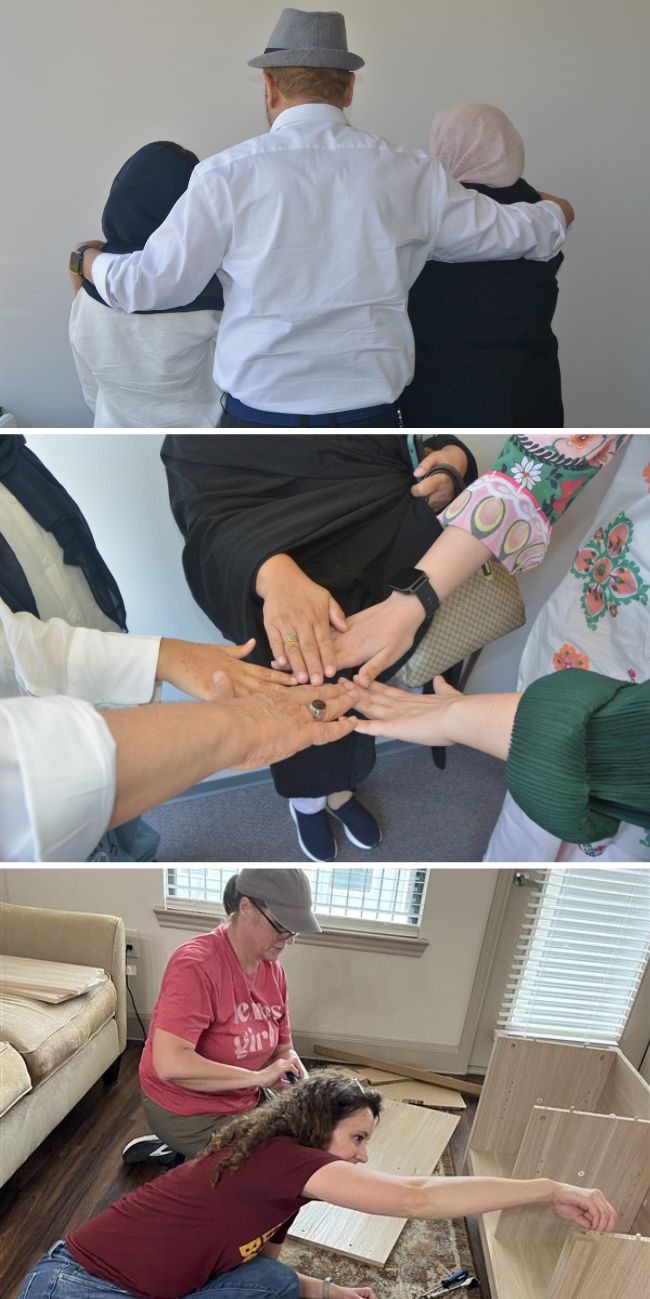
Top and Middle: The Khan Family Bottom: Volunteers set up furniture in the Khan family's home
Reunited After a Decade: The Khan Family’s Journey to Hope and Home
After more than ten years of separation, Mr. Khan finally reunited with his wife and daughters in Texas—thanks to his unshakable determination, the support of Church World Service and a community ready to welcome. Their story is a powerful reminder of the resilience of refugee families and the transformative impact of welcome.
A Journey Marked by Separation and Strength
Imagine being forced to flee your home, leaving behind your career, your belongings and, most of all, your loved ones. That was the heartbreaking reality for Mr. Khan*, who was separated from his wife and daughters, holding onto nothing but the hope that they would one day be reunited.
After fleeing Pakistan in 2014, Mr. Khan traveled to several other countries before finally being approved for travel to the United States, where he was welcomed with support from Church World Service. Though he had reached a place of safety, his heart remained with his family and, with the help of the CWS team, he worked tirelessly to find them a pathway towards safety and reunification.
At long last, on April 2, 2025—more than a decade after they were first separated—Mr. Khan welcomed his wife and children to his new community in Texas.
The journey was filled with uncertainty along the way, not the least of which included the Trump administration’s January 20th Executive Order suspending the U.S. Refugee Admissions Program indefinitely, shattering the hope of families like the Khans who dreamed of reaching safety in countries like the United States.
A Community Comes Together
When the long-awaited day finally came, the Khans were not alone. Their new community was there to welcome them home, setting up their apartment, assembling furniture and raising funds to cover the cost of their flights to the United States. Local volunteers rallied around them, providing the warm welcome that every family deserves.
“Immediately after getting the news that the family had been issued Visas, we reached out to our support community of volunteers, donors and partner organizations, and everyone said ‘Yes!’,” shared Rebecca Harrison, Resettlement Director of CWS Houston. “Within just a few days we had an apartment, furniture, home supplies and airfare lined up. I think the news of all the flights and visas that had been canceled after January 20 had been so devastating for everyone in our welcoming network, being able to do something to help bring this family to safety brought them a glimmer of hope.”
“We are grateful for all that you have done for us,” Mr. Khan shared. Even just days after finally reuniting his family, he feels a sense of responsibility in building welcoming communities for other newcomers. “We must help others who are facing problems. The United States is a country of immigrants. The entire potential of the world is here.”
Now, with their future ahead of them, the Khan family already have big plans. The daughters are already eager to attend university—an opportunity they were unable to access in Pakistan, hoping to build flourishing careers in pharmacy, IT and cybersecurity.
“We are hopeful that they will be able to go to school soon because in our country they were living in hiding. They wanted to attend university, but there were restrictions,” Mr. Khan shared. “We are happy because we can make their dreams come true here.”
Despite the new opportunities before them, the weight of their journey still lingers. The path the Khans took to reach safety—sadly, only available to less than one percent of those in need—was long and filled with hardship. “It is a really big trauma for children to have to leave their home country,” shared Azra, the family’s oldest daughter. “I had to endure things. I still need time to heal, and we will, but I am really grateful to CWS, and I hope we can be a help to other people.”
The Khan family’s journey is a testament to hope, resilience and the promise of a brighter future—not only for themselves, but for the community they now call home. Their story, rooted in courage and strengthened by the compassion of their neighbors, is a powerful reminder of the enduring strength and impact of the United States’ legacy of welcome.
*Pseudonyms have been used to protect the identity of the family.
To learn more about the work of CWS Houston, click here.
Seeking Respect and Dignity: A Sudanese Family Finds Refuge from Ethnic Cleansing Through CWS Harrisburg
Sherri Kimmel | April 24, 2025
Trigger Warning: This story contains descriptions of war, loss, trauma and death that may be distressing for some readers. Brothers Faheem, Samir and Mohamed* were children when in 2004 they fled genocide in Darfur, Sudan, making the arduous trek across the Kaja Valley border to Chad on foot and by donkey. Their pursuers, the Janjaweed (which means “devils on horseback” …
Factsheet: Violence In Gaza and The West Bank as Humanitarian Aid Remains Blocked
April 21, 2025
For decades, Palestinians have lived under occupation, facing violence, human rights abuses, systematic violations of international humanitarian law, and denial of their right to self-determination. After over a year of Israeli attacks on Palestinian civilians in the aftermath of the October 7th, 2023 Hamas attack against Israelis, Palestinians living in the Gaza Strip have been subjected to one of the …
CWS Celebrates Easter, Reflects on the Hope of the Resurrection
April 18, 2025
Washington, D.C.—Ahead of Easter Sunday in celebration of the spirit of Easter, Rick Santos, President and CEO of Church World Service issued the following statement: This Easter we celebrate and remember the life of Jesus Christ and the hope of his resurrection. We are inspired to live in the promise of a renewed world and to join together with other …
Stories of Change
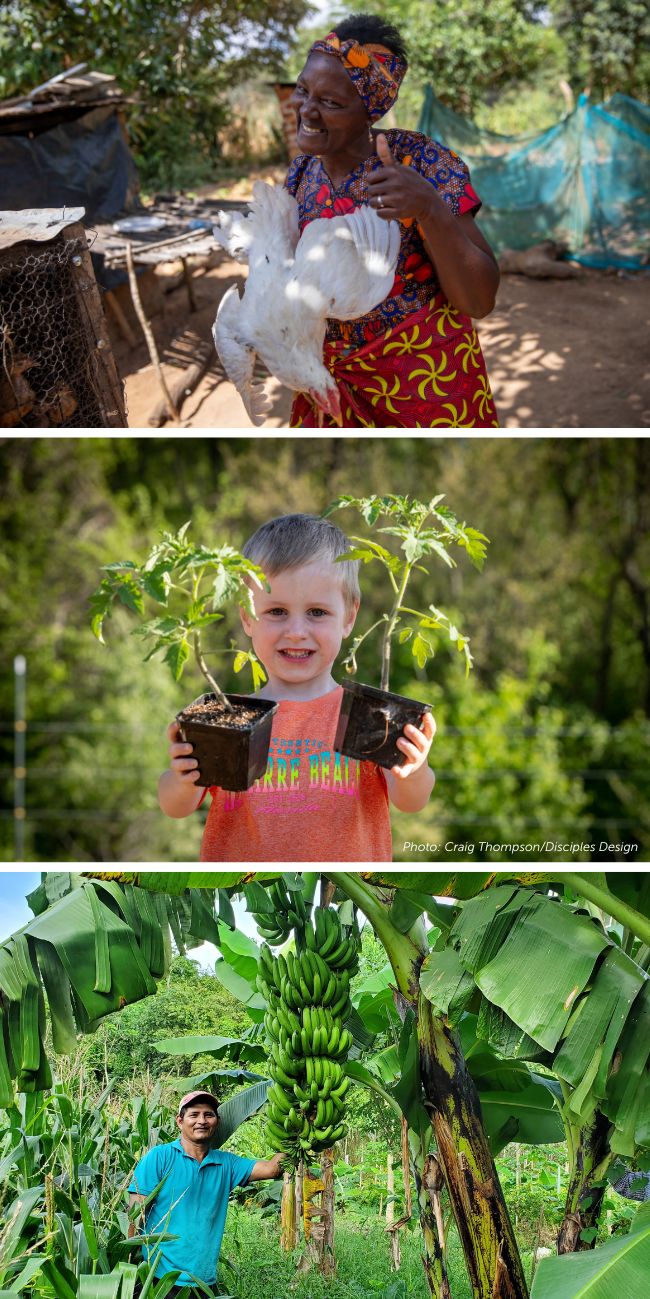
Top: Felistus Nguyo and her chickens Middle: Participant in a CROP Hunger Walk-supported community gardening program in Indiana Bottom: Oscar stands near his crops
Harvest of Hope: Growing a Better World Together
“For God satisfies the thirsty and fills the hungry with good things.” – Psalm 107:9
Across the United States and around the world, seeds are being planted—seeds of nourishment, resilience and dignity. And at the heart of this harvest are the generous donors who support CWS Tools. Because of you, families have access to more than seeds and shovels—they have opportunities to grow lasting hope.
Thanks to your support, Oscar, a farmer in Honduras, received the tools he needed to diversify his crops. He now grows not only corn, but bananas, chili peppers, cassava, papaya and pineapple—feeding his family and selling his surplus at the market. That’s the power of a simple tool in the hands of someone ready to thrive.
And then there’s Mama Nguyo’s Harvest of Hope. Thanks to the generosity of supporters like you, Mama Nguyo received something simple, but powerful: three chickens. That may not sound like much, but for Mama Nguyo, it was the start of something big.
She cared for those chickens and gathered their eggs. Before long, she had 20 chickens and was able to buy a rooster. With more eggs than her family could eat, she began selling them at the local market. Soon, she earned enough money to buy new chairs for her home and support her family’s daily needs.
This is what hope looks like.
Because of faithful donors and congregations supporting CWS Tools, families like Mama Nguyo’s are planting seeds of change—growing their own food, starting small businesses and building more secure lives. Your impact goes beyond the garden.
Empowering Farmers: Through CWS agricultural programs, 13,181 individuals received training, seeds, livestock, and tools—helping them grow more food and secure stable incomes.
Improving Nutrition: Through CWS nutrition programs, 18,652 individuals participated in training, feeding demonstrations, and mother-to-mother support groups—ensuring healthier futures for families.
Equipping Communities: Across CWS programs, 89,475 people now have the tools they need to grow food, provide for their families, and build sustainable futures.
These numbers represent real people, real hope and real transformation—made possible by you. Every shovel, every chicken, every tool becomes part of a Harvest of Hope.
You are part of the story.
Because of your compassion, families are growing food, earning income, improving health and building new futures rooted in dignity and strength. Your generosity isn’t just changing lives—it’s helping create a better world.
Thank you for planting seeds of compassion. Thank you for helping hope take root.
Learn how you can get involved with CWS Tools and donate now to help cultivate a Harvest of Hope.
Life After Arrival: Why Unaccompanied Children Still Need Protection
April 17, 2025
Every year, tens of thousands of unaccompanied children seek safety in the United States, often after enduring dangerous journeys. They hope for healing and a safe childhood here, but there are many challenges that stand in the way. During National Child Abuse Prevention Month and beyond, CWS is committed to ensuring these children have the care, protection and advocacy they …
Stories of Change
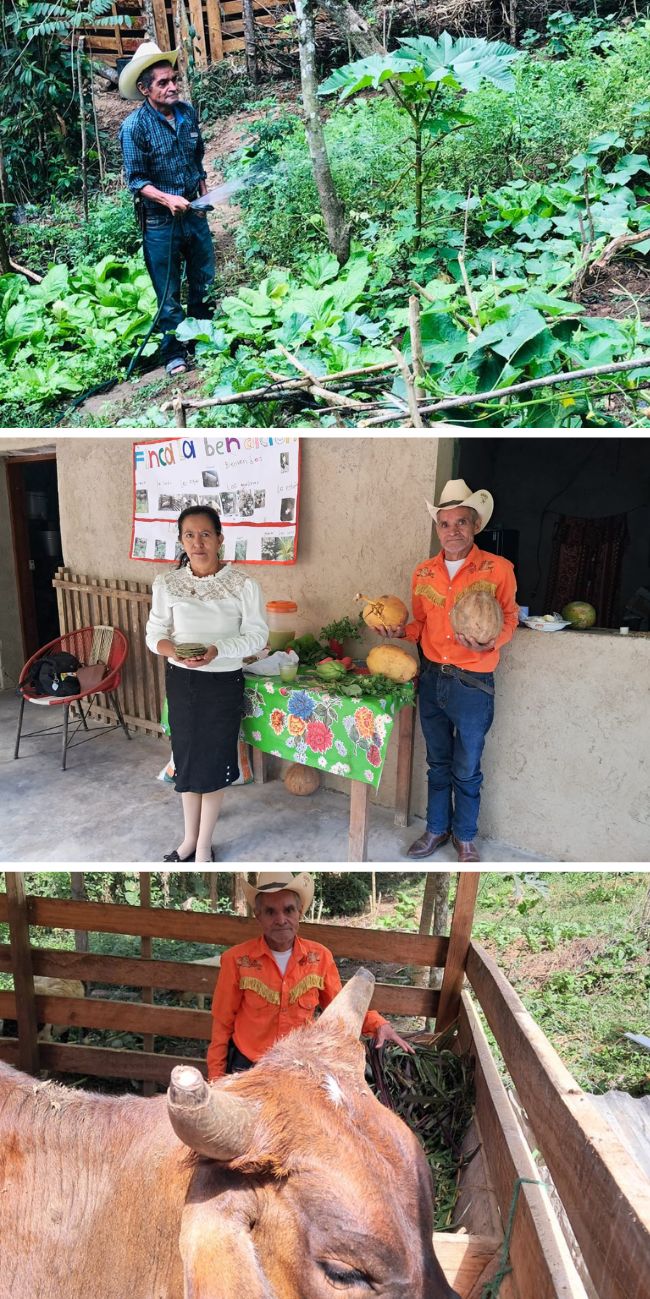
Top and Bottom: Rogelio Rivera on his farm Middle: Rogelio and his wife Suyapa
La Bendición: A Farm that Feeds the Rivera Family
Rogelio Rivera, his wife Suyapa Villeda and their family have transformed their small farm, La Bendición, into a thriving, sustainable homestead in La Sierra, Honduras. Through the Produce Verde project, they’ve embraced new farming techniques, diversified their crops and shared resources to strengthen both their livelihood and their community.
Cultivating a Life Rooted in Gratitude and Hard Work
“Thank God for a new day,” says Rogelio each morning before starting his work: he feeds his cow, waters the crops, cares for the chickens and oversees the grazing of the sheep. His wife Suyapa prepares fortified tortillas that she learned to make, along with green smoothies, before starting her own work with the vegetable garden and animals.
Rogelio Rivera and Suyapa Villeda live with their three children in the community of La Sierra, Macuelizo, Santa Bárbara. This cool-climate area, surrounded by pine trees and made up of about 30 families, welcomed them more than four decades ago.
Since joining the Produce Verde project, implemented by the Mennonite Social Action Commission (CASM), they have learned new farming techniques and built the chicken coop they needed. They also diversified their crops with plantains, cassava, beans, vegetables like radishes and mustard greens and fruit trees such as apple, papaya, pineapple and lemon. The family raises livestock, including pigs, chickens and sheep and have even started keeping native stingless bees, whose honey they use for medicinal purposes and to sell.
Their farm, La Bendición (The Blessing), is now a source of pride. “We didn’t know how to make this compost,” says Rogelio, showing worms wriggling in the soil he holds in his hand. “We’re very grateful to God,” he adds, enthusiastically pointing to the sacks of compost that now represent self-sufficiency and healthy soil from which they harvest food for their family.
Growing More Than Food: Skills, Knowledge and Community
Suyapa proudly shares that she now knows how to better care for her garden. “I’ve learned how to care for my animals and so many other things about farming. I love my little hens,” she says. They are also part of a group that promotes sustainable practices, such as avoiding burning waste and using compost in terraced fields.
As a sign of their commitment to the community—and as part of the project—they take part in the “pass-it-on” practice: a piglet is given to another family in a neighboring community so they can raise it, breed more and eventually sell them for an additional income.
As César Soriano from CASM notes: “This project and the dedication of the participants reflect a natural commitment to the land and a willingness to try new practices.”
The ‘Produce Verde’ project is implemented by our local partner, Comisión de Acción Social Menonita (CASM), with the support of Growing Hope Globally. Click here to learn more about our work in Central America.
Stories of Change
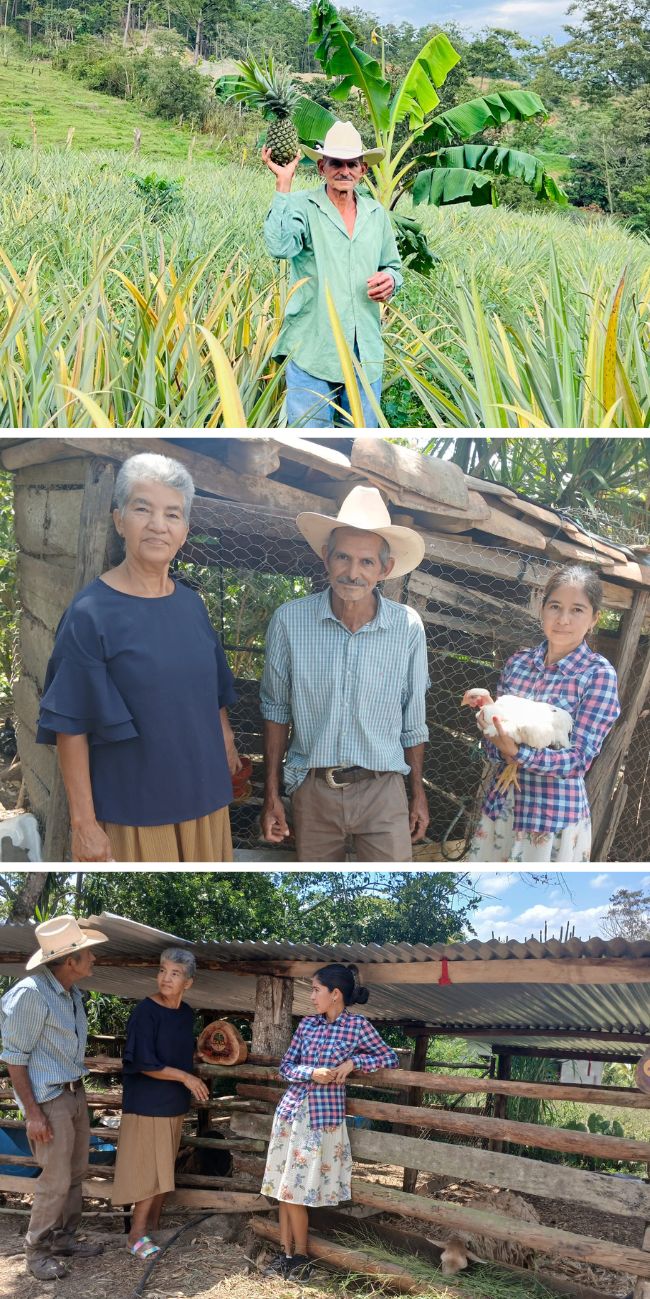
Top: Pedro Pablo Gutiérrez on his farm Middle and Bottom: Pedro Pablo with his wife Rosa and their daughter Glenda
From Pineapples to Piglets: How the Gutiérrez Family Is Cultivating Life and Hope in Honduras
Pedro Pablo Gutiérrez and his family have transformed their small farm in Las Varas, Honduras, into a thriving, self-sufficient homestead with the support of the Produce Verde project. Through teamwork, sustainable farming practices and community sharing, they’ve created a life rooted in resilience, health and generosity.
A Day in the Life on the Farm
Every morning, Pedro Pablo Gutiérrez begins his day with a prayer and a hot cup of coffee. He lives with his wife Rosa and their daughter Glenda in the community of Las Varas, Macuelizo, in the department of Santa Bárbara, Honduras.
The family takes great care of their farm. Their day begins early: feeding the pigs, checking the fish tank, tending to the animals and managing the crops. “Here, we do a bit of everything,” shared Pedro Pablo.
Pineapple cultivation is his favorite task. “We love its taste, that’s why we enjoy it so much,” he says, pointing to the staggered rows they’ve planted. Some pineapples are already ready for harvest, while others are just beginning to grow. The fruit also provides an income, as he sells them in neighboring towns. “Pineapples sell well; there’s a strong market for them.”
In addition to pineapples, the family grows corn, beans and maintains a variety of plants. They also have pigs, chickens, ducks and sheep, as well as a small fish tank. “The fish can’t be seen, but they’re there. Every morning, we turn on the water system and feed them,” explains Pedro Pablo, proud of the family’s efforts.
One of their proudest achievements is being able to share one of their piglets with another family as part of the project. “We call her ‘the boss,’” he says, pointing to the pregnant mother. “It [gifting the piglet] makes us feel useful,” says Pedro Pablo.
Building a Self-Sufficient, Healthier Home
Since joining the Produce Verde project, implemented by the Mennonite Social Action Commission (CASM), they have learned to make organic fertilizer, adopt new planting techniques and prepare meals with what they grow.
They also have an eco-stove, latrine and a grain storage system. “The stove is smokeless; the smoke goes out from the top and this way we protect our lungs,” explains Rosa. “We no longer buy eggs or chicken. Now we have everything here for home consumption,” adds Pedro Pablo.
Their farm is a model of self-sufficiency and teamwork: while one person tends the garden, another looks after the animals. For the family, the support they’ve received has been transformative. “This is the first time an institution has helped us. Thank God and thank you.”
The ‘Produce Verde’ project is implemented by our local partner, Comisión de Acción Social Menonita (CASM), with the support of Growing Hope Globally. Click here to learn more about our work in Central America or donate to support other families like the Gutierrez Family.
Revoking Temporary Protected Status for our Neighbors from Afghanistan and Cameroon Betrays Our Values
April 11, 2025
Washington, D.C.—Church World Service today expressed its deep concern over a report that the Trump administration intends to end Temporary Protected Status (TPS) for more than 9,000 Afghans and 3,000 Cameroonians living in the United States. The decision will have dire consequences for Afghans and Cameroonians who have built lives, filled essential jobs, started businesses, and contributed to our communities. …