
It’s a fact: Refugees around the world have made innumerable contributions to the communities that welcome them. When individuals seeking safety arrive in their new homes, they bring their skills, experience and knowledge with them. Across decades and borders, these contributions have led to many of the daily But what if history had played out differently? What if, instead of …
Sewn With Hope: Elvira’s Path from Ukraine to Serbia
Forced to flee Ukraine in 2022, Elvira rebuilt her life in Serbia through creativity, community and determination—turning her sewing skills into a source of purpose, income and empowerment for herself and other refugee women. With support from CWS and partners, her family is now charting a path toward independence and stability. Stitch by Stitch: Reclaiming Purpose Through Creativity Before the …
Stories of Change
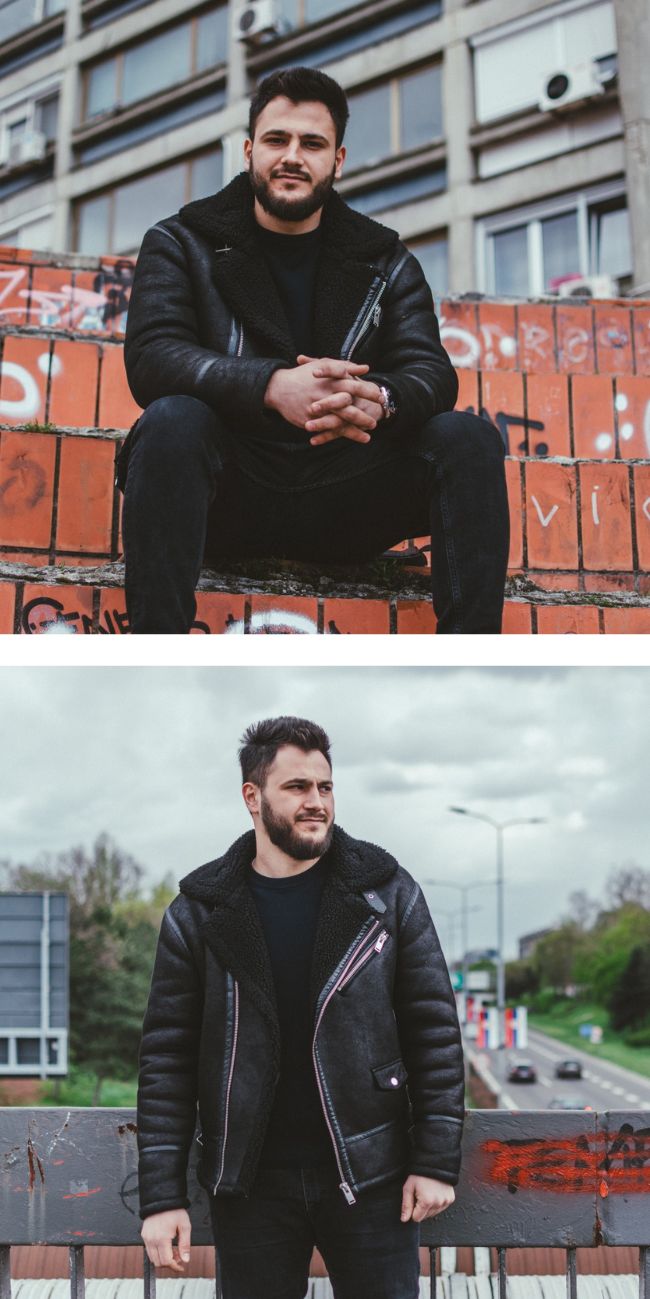
Top and Bottom: Ahmed in Belgrade, Serbia
Beyond All Limits: Ahmed’s Journey from Baghdad to Belgrade
After arriving in Serbia as a teenager from Iraq, Ahmed has spent over a decade building a life in Belgrade—overcoming language barriers, legal hurdles and housing challenges with determination and grace. Now on the path to Serbian citizenship and pursuing his dream of becoming a pilot, Ahmed’s story reflects resilience, belonging and the quiet hope of starting anew.
From Baghdad to Belgrade: Finding Home and Identity
Ahmed’s journey in Serbia began in 2014, when he arrived in the southern city of Nis with his father, who had come to pursue postgraduate studies, and his two brothers and two sisters. Just sixteen at the time, Ahmed left behind the streets of Baghdad for a life in the Balkans, stepping into an unfamiliar world.
When asked whether he’s faced particularly hard moments since arriving, he quietly points to the early language barrier as the biggest hurdle. Over time, he overcame it thanks to his father, who supported him through long evenings of learning, and to his first girlfriend in Serbia. When they met, she didn’t speak English, and he didn’t speak Serbian, so they taught each other. Today, most people wouldn’t guess he wasn’t born here. “You know that feeling when you live abroad, and you just can’t fully get the jokes or slang and something’s always missing?” he says. “Well, I get the jokes. I grew up here. Belgrade is my city.”
As things changed back home in Iraq, so did their lives in Serbia. By 2017, the worsening security situation forced Ahmed’s father to seek international protection for the entire family. In early 2018, they were granted subsidiary protection, a status that had to be renewed every year. It offered safety, but limited their freedom of movement. Eventually, his family moved to Türkiye. Ahmed stayed behind, navigating adulthood alone in a new country, eventually making his way to Belgrade.
One of the harshest restrictions he’s faced was not being able to travel. Subsidiary protection doesn’t come with a passport and Ahmed has carried the quiet weight of that limitation for years. “A colleague said to me, ‘Let’s go to the seaside, it would be so great!’ And I told her, ‘I’ve never seen the sea. I’ve never been to a beach. I’d love to go, but I can’t.’” Only in late 2024 did things begin to shift. When the law changed, Ahmed finally received permanent residency, and with it, the chance to apply for Serbian citizenship.
Despite years of uncertainty, Ahmed has never let restrictions dim his spirit. He speaks of Belgrade with the warmth of someone who’s truly grown roots. “Belgrade is Belgrade, there’s no city like it. Every day something’s happening. People are out in the streets, partying, living. Even if you don’t have money, you can feel the energy. This city is alive. It has a soul.” Ask him where he’d take friends visiting from Iraq and he has a list ready: Kalemegdan at sunset, the riverfront at Dorcol, quiet walks through Zvezdara forest, the charm of Zemun. His favorite café. A park bench in Dedinje. Places where the city speaks softly.
New Wings: A Dream to Fly and a Life Rebuilt with Support
Today, Ahmed works at the local airport, preparing meals for Arabic-speaking travelers. He sees comfort in the familiar spices and sees kinship between Serbian and Arabic cuisine. He swears by sarma, proja and cevapi (kebabs). But the airport isn’t his final destination. Ahmed is studying to become a pilot. His dream is to soar above the places he has called home—Baghdad, Belgrade and beyond and see the world from a bird’s perspective.
Recently, Ahmed found himself facing another challenge. He had to leave the apartment he had lived in for years with very little notice and nowhere to go. Thanks to CWS and our partners at the Belgrade Centre for Human Rights, he received a temporary housing accommodation for a month—just enough time to catch his breath and figure out his next steps. This short-term housing solution, part of a broader effort to support refugees and asylum seekers at critical moments of transition, has helped many like Ahmed avoid slipping into homelessness while they work toward more stable, long-term solutions.
Nowadays, he continues forward with quiet determination and open-hearted hope. He’s not sure where life will take him and he’s okay with that. “I’m not afraid,” he says. “I’ll try whatever comes. Anything’s possible.”
CWS is thankful for the generosity of Airbnb.org, whose support has allowed individuals like Ahmed to receive temporary housing as they establish their new and permanent homes. Learn more about our ongoing work in Eastern Europe and how CWS provides temporary housing support by visiting our website.
Stories of Change
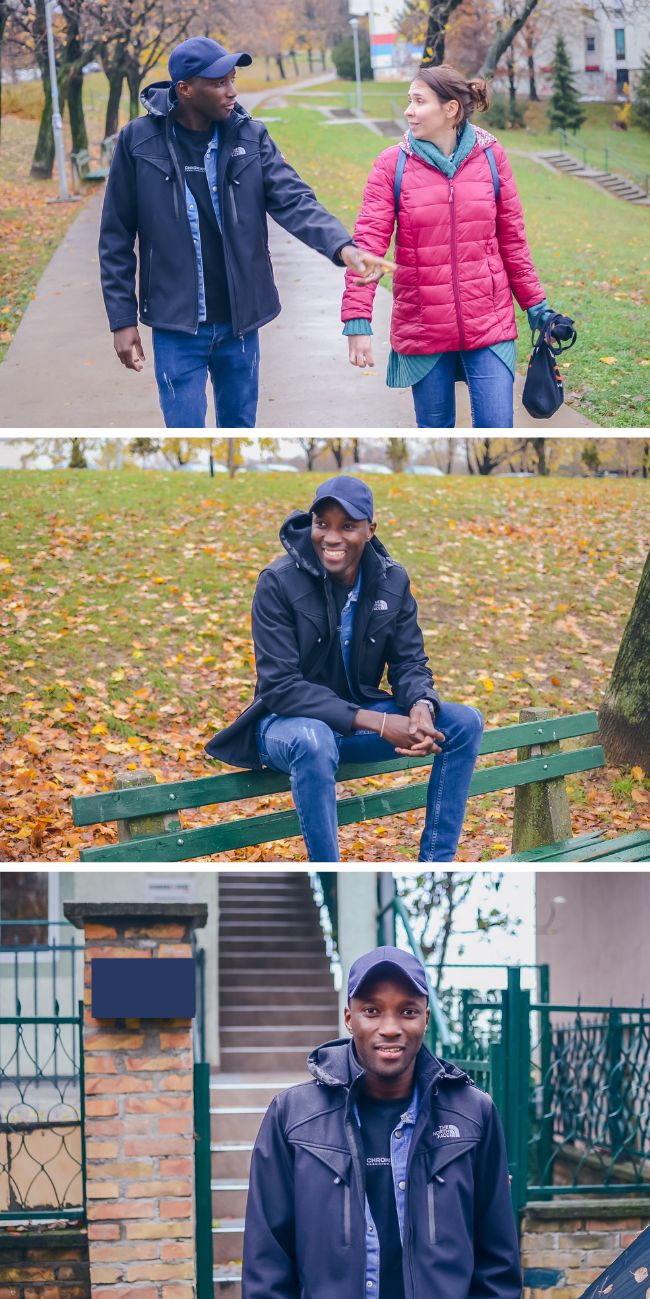
Top: Adamou being accompanied to his apartment Bottom: Adamou in front of his na
Adamou’s Journey: From the Borderlands of Niger to New Beginnings in Serbia
After fleeing violence in Niger, Adamou found safety and hope in Serbia with support from CWS and the Belgrade Centre for Human Rights. Now rebuilding his life with resilience and optimism, he continues to pursue his dreams while inspiring others with his kindness.
From Tragedy to Triumph: Adamou’s Journey to Safety
Adamou once led a carefree life in a small town near the borders of Mali and Burkina Faso. A spirited young boy from Niger, he always preferred chasing footballs to flipping through textbooks and could almost always be found on the field. But in 2018, the calm began to fray. The rising tide of violence in the region crept steadily toward his community, until in May 2020, it struck with full force.
While Adamou was away at a football tournament, an armed group attacked his hometown. Over 50 civilians were killed in the onslaught, including members of his own family. He was still just a boy when his mother urged him to flee, to survive, to start again.
That journey led him to Serbia.
A New Chapter in Serbia: Support and Shelter
Here, Adamou found safety at the House of Rescue, a shelter for unaccompanied and separated refugee and migrant children. With CWS partner, the Belgrade Centre for Human Rights, by his side as his legal representative, he gained asylum in the spring of 2022. It marked more than just legal status; it marked the beginning of healing, hope and possibility.
Football remained his anchor. He played with local clubs and never missed a match by his beloved Real Madrid or Chelsea. But off the field, Adamou was quietly building a new life, one step at a time. Today, he works as a Data Entry Clerk at an IT company. With his tall frame and striking presence, friends often tease him about a future in modeling. He laughs it off but doesn’t entirely rule it out.
Life threw Adamou another curveball in the fall of 2024, when he had to leave his apartment on short notice. With time running out and nowhere to go, the Belgrade Centre for Human Rights and CWS quickly stepped in to offer temporary shelter—a swift support that makes a world of difference when someone is suddenly left without a roof over their head or needs emergency accommodation.
Since launching this support in September 2024, CWS has provided temporary housing to 14 individuals, all foreign nationals living in Serbia. Some were refugees from Ukraine, and others had survived dangerous migration journeys or faced labor exploitation. For Adamou, the housing support was more than just a bed; it offered a safe pause, a chance to breathe and the space to gather strength for whatever came next.
Despite all he’s faced—the loss, the upheaval and the uncertainty—Adamou remains resilient, openhearted and quietly determined. He has a way of forming connections wherever he goes, and people are drawn to his kindness and optimism. When asked about the future, he simply smiles and says, “I’m patient. I know what I want, and I’ll get there.”
CWS is thankful for the generosity of Airbnb.org, whose support has allowed individuals like Adamou to receive temporary housing as they establish their new and permanent homes. Learn more about our ongoing work in Eastern Europe and how CWS provides temporary housing support by visiting our website. Donate here to continue to help refugees like Adamou.
House Proposal of levying of fees on Immigrants would Harm the Vulnerable, Especially Children
May 2, 2025
Washington, D.C.—In response to a recent heinous proposal in the House of Representatives by Republican lawmakers, Christine Lemonda, Senior Director Children’s Services, issued the following statement “The proposal to levy massive fees on potential sponsors of unaccompanied children is nothing less than a policy of family separation. These kids are fleeing violence, persecution, and desperation and should be swiftly released …
Stories of Change
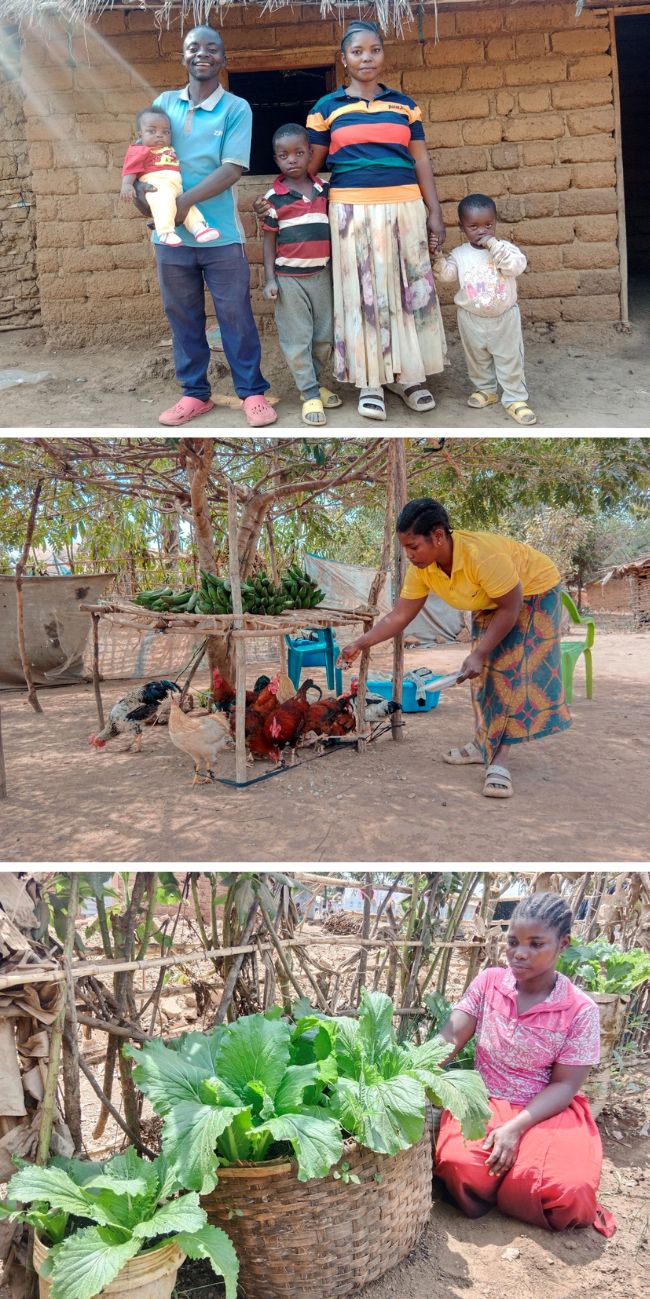
Top: Seluwa with her family Middle and Bottom: Seluwa with her chickens and crops
From Gardener to Entrepreneur: Seluwa Said’s Journey to Success
After fleeing conflict in the Democratic Republic of Congo, Seluwa Said and her family faced extreme hardship in Tanzania’s Nyarugusu Refugee Camp—until joining the CWS Sustainable Vegetable Farming Project, which empowered her to grow nutritious food, start a business and build a more secure future.
From Struggle to Survival in Nyarugusu Refugee Camp
Originally from the Democratic Republic of Congo, Seluwa Said was forced to flee her home due to ongoing conflict. In 2018, Seluwa arrived at the Nyarugusu Refugee Camp in Tanzania, in search for a safer future for herself and her family.
Along with her husband and three children, Seluwa faced significant hardships, including severe food shortages that forced them to survive on just one meal a day. She told us, “When we arrived at Nyarugusu Refugee Camp, we faced many challenges. First, we only had one meal a day, and even that was often delayed. We didn’t have any money to buy soap, clothes or school supplies for our children. Despite receiving support from various organizations, the situation remained difficult due to insufficient food and the lack of income-generating activities.”
In 2022, a transformative opportunity emerged when Seluwa joined the Sustainable Vegetable Farming (SVF) Project, implemented by Church World Service and funded by the Canadian Food Grain Bank and the Anglican Church of Canada’s PWRDF. This project has supported a total of 810 households in Nyarugusu Refugee Camp, significantly improving food security, nutrition and income for many families.
Empowered Through Sustainable Farming
Seluwa received comprehensive training in organic vegetable farming and was provided with essential agricultural inputs, including vegetable seeds, a hand hoe, a watering can, a rake, a hand sprayer pump, seven buckets of cattle manure and other necessary materials for establishing a kitchen garden.
With newfound knowledge and resources, Seluwa devoted herself to her kitchen garden, planting a variety of vegetables such as kale, amaranthus, Chinese cabbage, African nightshade and spinach. Her hard work paid off with a bountiful harvest, providing her family and neighbors with nutritious food and opening up opportunities for income generation.
From Kitchen Garden to Thriving Entrepreneur
Seeing the success of her vegetable garden, Seluwa decided to expand her venture by selling surplus vegetables within the camp. Her high-quality produce quickly earned her a reputation, and the income from these sales allowed her to start a small business selling essential household items. As her entrepreneurial spirit grew, her business began to thrive.
With the profits from her vegetable sales and small business, Seluwa made an investment in her family’s future by purchasing two chickens. This modest investment soon expanded to seven chickens, providing a steady supply of eggs and an additional source of income.
Throughout her journey, Seluwa received unwavering support from her husband, who has been a pillar of strength and encouragement. Together, they have worked tirelessly to secure a better future for their children.
Seluwa expressed her gratitude, saying, “My heartfelt gratitude to CWS for their incredible support through the Sustainable Vegetable Farming project. Your generous assistance has transformed my life and my family’s in ways I could never have imagined. Today, I am proud to call myself an entrepreneur. I have even expanded my efforts by raising chickens, which has further improved our financial stability. Thank you for believing in me; your work has made a profound impact on our lives, and we are deeply grateful for your kindness and dedication.”
We would like to thank our partners, the Canadian Foodgrains Bank and the Primate’s World Relief and Development Fund for allowing this assistance to be possible. You can learn about our programs in Tanzania here.
Fighting for Family: How One Attorney in Colorado is Reuniting Afghan Allies with Their Loved Ones
May 1, 2025
After fleeing Afghanistan, Afghan allies Abed and Hafez found hope with the support of CWS Fort Collins and Immigration Staff Attorney Rona Schank, whose own immigrant journey fuels her fight for justice and welcome. Their stories highlight the power of persistence, community and the transformative impact of compassionate legal advocacy. In the wake of Kabul’s fall, Colorado became a new …
CWS to Close 11 Local Program Offices Serving Refugees and Immigrants
New York City– CWS today announced that the organization will be closing 11 program offices across the United States following sweeping actions taken by the Trump Administration terminating or suspending federally funded programs supporting refugees and immigrants. The office locations in the process of closing include: Georgetown, DE; Jacksonville, FL; Orlando, FL; Grand Rapids, MI; Kalamazoo, MI; Burlington, NC; Charlotte, …
Take Action: Urge Your Members of Congress to Defend Refugee Resettlement and Protect Federal Funding for Refugee Programs
April 30, 2025
The U.S. Refugee Admissions Program (USRAP) is under unprecedented threat, as is the humanitarian infrastructure serving forcibly displaced people worldwide and here in the U.S. The indefinite refugee ban remains in place, blocking funding for resettlement agencies and stranding thousands of refugees without basic support. Resettlement offices around the country are struggling to stay open and serve vulnerable individuals who …
Stories of Change
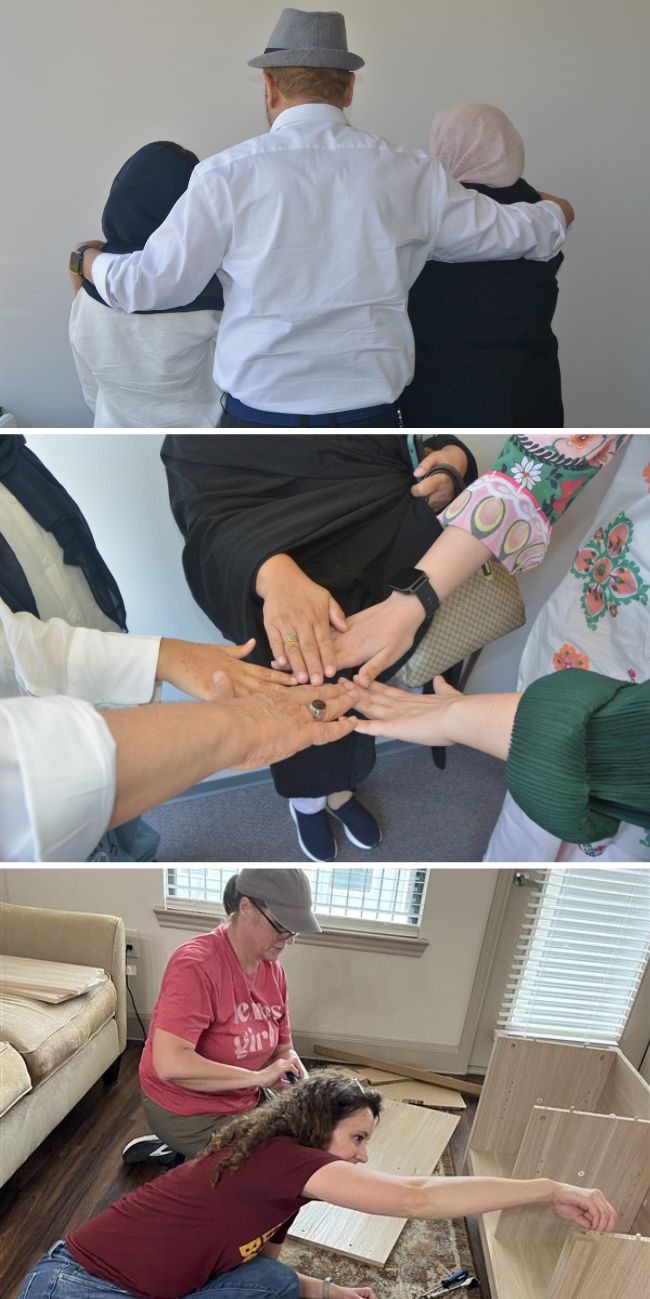
Top and Middle: The Khan Family Bottom: Volunteers set up furniture in the Khan family's home
Reunited After a Decade: The Khan Family’s Journey to Hope and Home
After more than ten years of separation, Mr. Khan finally reunited with his wife and daughters in Texas—thanks to his unshakable determination, the support of Church World Service and a community ready to welcome. Their story is a powerful reminder of the resilience of refugee families and the transformative impact of welcome.
A Journey Marked by Separation and Strength
Imagine being forced to flee your home, leaving behind your career, your belongings and, most of all, your loved ones. That was the heartbreaking reality for Mr. Khan*, who was separated from his wife and daughters, holding onto nothing but the hope that they would one day be reunited.
After fleeing Pakistan in 2014, Mr. Khan traveled to several other countries before finally being approved for travel to the United States, where he was welcomed with support from Church World Service. Though he had reached a place of safety, his heart remained with his family and, with the help of the CWS team, he worked tirelessly to find them a pathway towards safety and reunification.
At long last, on April 2, 2025—more than a decade after they were first separated—Mr. Khan welcomed his wife and children to his new community in Texas.
The journey was filled with uncertainty along the way, not the least of which included the Trump administration’s January 20th Executive Order suspending the U.S. Refugee Admissions Program indefinitely, shattering the hope of families like the Khans who dreamed of reaching safety in countries like the United States.
A Community Comes Together
When the long-awaited day finally came, the Khans were not alone. Their new community was there to welcome them home, setting up their apartment, assembling furniture and raising funds to cover the cost of their flights to the United States. Local volunteers rallied around them, providing the warm welcome that every family deserves.
“Immediately after getting the news that the family had been issued Visas, we reached out to our support community of volunteers, donors and partner organizations, and everyone said ‘Yes!’,” shared Rebecca Harrison, Resettlement Director of CWS Houston. “Within just a few days we had an apartment, furniture, home supplies and airfare lined up. I think the news of all the flights and visas that had been canceled after January 20 had been so devastating for everyone in our welcoming network, being able to do something to help bring this family to safety brought them a glimmer of hope.”
“We are grateful for all that you have done for us,” Mr. Khan shared. Even just days after finally reuniting his family, he feels a sense of responsibility in building welcoming communities for other newcomers. “We must help others who are facing problems. The United States is a country of immigrants. The entire potential of the world is here.”
Now, with their future ahead of them, the Khan family already have big plans. The daughters are already eager to attend university—an opportunity they were unable to access in Pakistan, hoping to build flourishing careers in pharmacy, IT and cybersecurity.
“We are hopeful that they will be able to go to school soon because in our country they were living in hiding. They wanted to attend university, but there were restrictions,” Mr. Khan shared. “We are happy because we can make their dreams come true here.”
Despite the new opportunities before them, the weight of their journey still lingers. The path the Khans took to reach safety—sadly, only available to less than one percent of those in need—was long and filled with hardship. “It is a really big trauma for children to have to leave their home country,” shared Azra, the family’s oldest daughter. “I had to endure things. I still need time to heal, and we will, but I am really grateful to CWS, and I hope we can be a help to other people.”
The Khan family’s journey is a testament to hope, resilience and the promise of a brighter future—not only for themselves, but for the community they now call home. Their story, rooted in courage and strengthened by the compassion of their neighbors, is a powerful reminder of the enduring strength and impact of the United States’ legacy of welcome.
*Pseudonyms have been used to protect the identity of the family.
To learn more about the work of CWS Houston, click here.