
In the communities of West Pokot, Kenya, lasting transformation starts with one essential resource: water. Through long-term partnership and community-led development, CWS supports families as they move from water access to sanitation to thriving livelihoods.
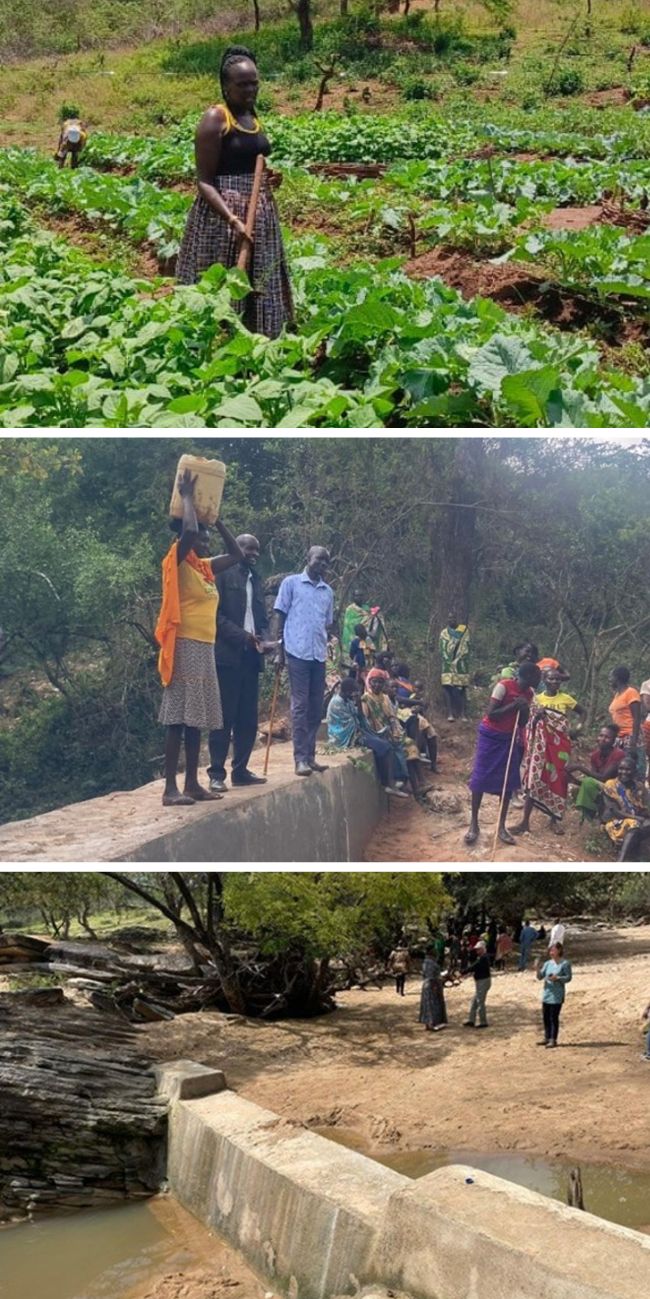
Top: Vivian in the vegetable garden Middle: Susan on new sand dam with jerrican Bottom: Established sand dam from behind
From Water Access to Community Health
When we think about transformation in a community, it’s easy to notice the visible things first—gardens full of greens, chickens clucking in the yard, women running savings groups and building new livelihoods. But in West Pokot, Kenya, I was reminded that none of these successes happen on their own. They all begin with one essential gift, water: reliable, accessible, sustainable water.
In the village of Kachereta, we met Susan and witnessed the very beginning of this journey—a sand dam newly built with guidance from CWS and our partner Yang’at. At first glance, it looks simple: a concrete wall across a seasonal riverbed. But in reality, a sand dam is a lifeline. When the rains come, it will capture layers of water-rich sand behind it, creating a year-round reservoir filtered naturally through the sand itself.
Today, women and girls in this community still walk three hours each way to collect water. But soon, they’ll only walk 200 yards—a change that means girls can attend school, women can work in their gardens and families can live with dignity rather than exhaustion.
This is where the CWS workflow begins, and it’s not a passive process. CWS provides the technical expertise, concrete and rebar—but the community builds the dam with their own hands. They gather stones, haul sand and organize themselves into a working group that will steward not just the dam, but every future development step. In building a dam, they also build unity, leadership and confidence. They build the capacity to take the next step.
For the village, the next step after securing a sustainable water source is sanitation. CWS works with communities to teach the importance of latrines, safe water handling and handwashing—crucial steps in reducing diarrheal disease, which remains one of the top killers of children under five globally. When clean water is paired with safe sanitation, the health of an entire village shifts.
Women Leading the Way in Psirwo
Once water and sanitation are secure, communities can begin the work of livelihoods—and that took us to the village of Psirwo, where we met Vivian. CWS has been working in Psirwo for over fourteen years, so their water and hygiene systems are in place. Once their days were no longer consumed by walking miles for water, the women were free to focus on building income and opportunity.
With support from CWS and Yang’at, each woman received four chickens as well as seeds and training to start vegetable gardens. This provided eggs and vegetables for their families and extra to sell. With time reclaimed and a new source of income, the women organized a village savings and loan association where every woman contributes, and every woman can borrow at a low interest rate. They call it “table banking”, and this gives every woman a stake in her community’s progress.
With their savings, these 28 women joined together and bought two acres of their own land and more chickens. Their flock of three hundred is now a business, selling eggs at local markets and chickens to the local school where their children attend.
The women of Psirwo recently planted a demonstration garden where they teach other women from surrounding villages how to grow kale, spinach and tomatoes—foods that nourish families and strengthen livelihoods. Their success is spread outward, setting off a chain reaction of empowerment—built slowly, intentionally and sustainably.
For 25 years, CWS has walked alongside communities in this region, not offering quick fixes but long-term partnership. We stay long after the sand dam is built, long after the garden grows, ensuring families have the tools and support they need to lead their own transformation.
It all begins with water and leads to chickens, beans and big dreams.
Lenny Blue participated in a recent CWS delegation that traveled to visit programs in Kenya during Fall 2025. To learn more about our work in Kenya, click here.