Stories of Change
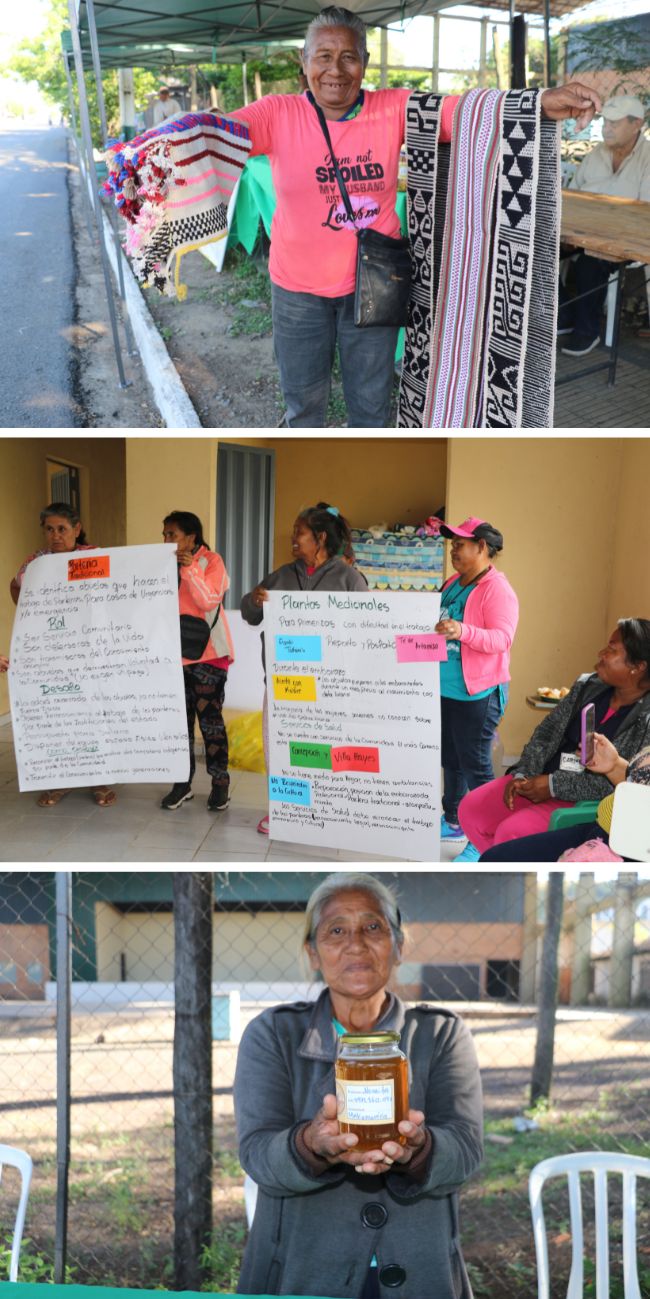
Top and Bottom: Program participants pose at a local honey fair Middle: Midwives present at an educational training
Indigenous Women Driving Change in the Paraguayan Bajo Chaco
In Paraguay’s Bajo Chaco region, nine Enxet Sur Indigenous communities are strengthening leadership, securing access to safe water and building sustainable livelihoods. Through training, advocacy and productive activities like beekeeping and home gardens, families are gaining greater autonomy, economic stability and the tools to defend their rights.
Over the past three years, nine Indigenous communities of the Enxet Sur people in the Paraguayan Bajo Chaco have worked to strengthen community leadership, defend their rights and build sustainable livelihoods. The Pastoral Social Diocesana de Benjamín Aceval (PSDBA), with support from Church World Service (CWS) and Growing Hope Globally, has led the Integral Rural Development in Nine Indigenous Communities of the Paraguayan Bajo Chaco project, now in its final year.
Communities face persistent challenges including limited access to safe water, weak health and education services and vulnerabilities related to climate change. The project has focused on building local capacity, strengthening community leadership and supporting their advocacy for basic rights.
Water and Honey: Engines of Well‑Being
In the last year, more than 300 people—mostly women—participated in 70 workshops on water purification, leadership, human rights, Indigenous education and climate change adaptation. Productive initiatives such as beekeeping, home gardens and small livestock rearing are now strengthening food security and family income.
In addition, more than 50 families are producing honey, and 10 villages sell up to 70% of their harvest in fair markets. “Thanks to them [the bees], I already bought my refrigerator, bed and freezer,” shared Genara Martínez, from the Espinillo community.
Access to clean water remains critical. Since water comes from shared tajamares (small community rainwater ponds), simple purification practices are vital. At least 150 households now boil or treat their water, and 16 community water structures have been built or improved. As Elsy Ramos of Yakye Axa explained, “We learned that by purifying the water, we prevent diseases like diarrhea.”
Defending Their Rights
For many participants, this is the first time they have received training on their rights as Indigenous peoples. In 2025, more than 230 women were trained in human rights and community leadership. “It is the first time we are being trained in our rights. We are very happy with you; you open our eyes and help us learn more about our Indigenous law,” said Julia, one of the participants.
The demand for water remains urgent. “If we do not have water, we cannot do anything—we cannot cook or bathe, and the children cannot bathe,” said Aparicia González from Sawhoyamaxa.
Where abandonment once prevailed, hope is taking root. As the project nears completion, communities are more organized, women are more empowered and families have stronger tools to claim and defend their rights.
This program is implemented by our local partner, Pastoral Social Diocesana Benjamin Aceval, with financial support from Growing Hope Globally. To learn more about our work in Latin America, click here.