
Stories of Change
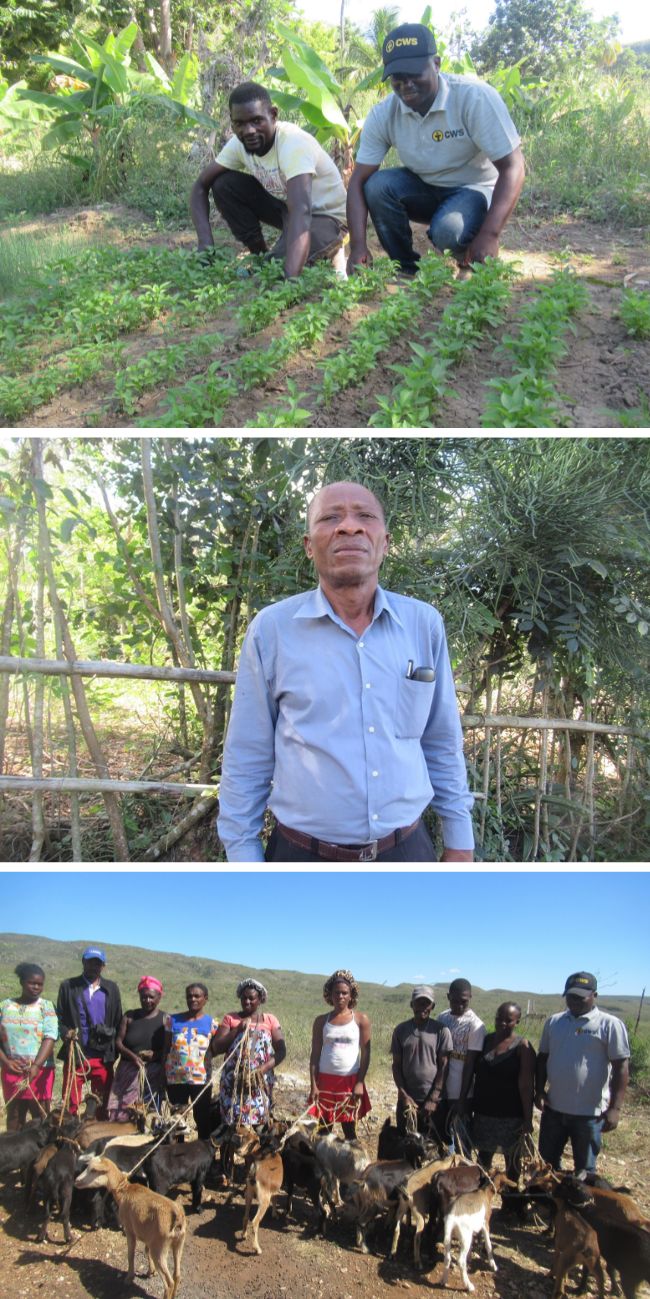
Top: CWS staff member kneels alongside a farmer in his garden Middle: Bruly Cornet Bottom: Distribution of goats to program participants
Building Resilience in Haiti: Voices of Hope Amid Crisis
When disasters, drought and violence collide, resilience becomes a lifeline. In Northwest Haiti, families in Baie‑de‑Henne are enduring one of the harshest years in recent memory. From climate shocks to economic isolation, the challenges are immense, but the stories emerging from this region also reveal strength, ingenuity and hope.
Families in the Lower Northwest Department of Haiti have been hard hit over the past year. Major cuts to international assistance have left more than 10,000 farming families without seeds at the beginning of the planting season. The few crops they managed to sow failed to germinate as delayed rains stalled the start of the season. Families who still had access to water carried it by hand to their garden plots, only to watch insects devour their seedlings because drought had eliminated other food sources.
The second planting season in August offered brief hope, but that disappeared quickly. Flooding in September and Hurricane Melissa in October destroyed most plantain and cassava crops just as they were ready to harvest. At the same time, gang‑related roadblocks and violence further isolated the region, cutting families off from national markets and causing food prices to skyrocket.
In the face of these overlapping crises, two projects supported by Growing Hope Globally, implemented locally by OPFSLDIBH with the accompaniment of Church World Service (CWS), have become a crucial support system. These initiatives offer families the tools, training and confidence they need to adapt. As Isaiah 41:18 promises: “I will make rivers flow on barren heights… I will turn the desert into pools of water.”
A Spring Restored, a Community Renewed
One of the greatest accomplishments of the past two years reflects that promise: the rehabilitation of the Dumercy natural spring, which had been dry in earlier years but has now flowed continuously for two years, even surviving the severe floods and hurricane.
The spring now provides essential water for laundry, animals and cooking. Around it, previously infertile land has been transformed. Families have planted plantains, taro, corn and pumpkins, feeding their households and selling surplus at the Mare Rouge market.
This transformation was possible thanks to extensive soil‑conservation efforts. Forty‑one people received specialized training in soil‑conservation techniques, and together with trained supervisors, 195 manual laborers applied those methods across eight hectares surrounding the Dumercy source. Their work included the installation of rock walls, wattle fences, soil‑fixation barriers and vetiver hedgerows—structures that held firm during both the September floods and Hurricane Melissa.
Natural Solutions for Hard Times
Among the dozens of farmers who strengthened their skills is Michelet Nacius, a 51-year-old resident of Bombel and father of seven. “For a long time, I have had insects ravaging my crops, with a negative impact on yield. However, based on this training, insects will no longer devastate my crops. I already started producing and using natural pesticide, with good results. Before, I had no means to combat pests. Thank you, OPFSLDIBH and CWS, for this initiative that helps me combat damage caused by insects.”
His experience is shared by many in the agroecological groups. Natural pesticide has become a vital tool during a year when drought forced insects to aggressively seek green crops. These trainings have allowed farmers to protect their fields without relying on expensive or unavailable chemical products.
67-year-old farmer Bruly Cornet also saw life-changing results after spending years battling erosion. “When it rained, erosion caused me a lot of problems because it left holes and took away the top soil.” After soil‑conservation structures were built on his land, everything changed. “I already harvested beans and corn… The structures played a big role in the increase of my yield.” He now protects the conservation work and encourages his neighbors. “They are very useful for the land… I will continue to protect my other plots.”
Despite losing 96% of their harvests, living under gang‑induced isolation, and facing rising food costs, families in Baie‑de‑Henne are not giving up. They are rebuilding soil, restoring springs, adopting climate‑resilient farming techniques and strengthening their small businesses.
This is what resilience looks like in Northwest Haiti: farmers harvesting again, women expanding businesses, elders protecting their land and families standing together, even in the storms.
We are grateful to Growing Hope Globally for their support of this work.
Learn more about CWS’s work in Haiti here. Visit the CWS Latin America and Caribbean website here.