
Farmers in Cambodia’s Stung Prey Pros Watershed are improving vegetable production, strengthening livelihoods and adapting to changing climate conditions through climate-smart agriculture and Farmer Field Schools.
Across Cambodia’s Kampong Thom Province, smallholder farmers face a combination of challenges, including shifting weather patterns, limited water access, declining soil health and market constraints. Together, these factors affect their ability to sustain their livelihoods.
Through the CWS-led Building Climate Resilient Communities in the Stung Prey Pros Watershed project, farmers are participating in Farmer Field Schools and receiving training in climate-smart agricultural production. Beyond agricultural training, these schools have become a platform for broader Ecosystem-based Adaptation (EbA) planning, helping communities connect farm-level challenges with wider issues, like water management, ecosystem restoration and future local investment priorities.
Learning Climate-Smart Vegetable Production
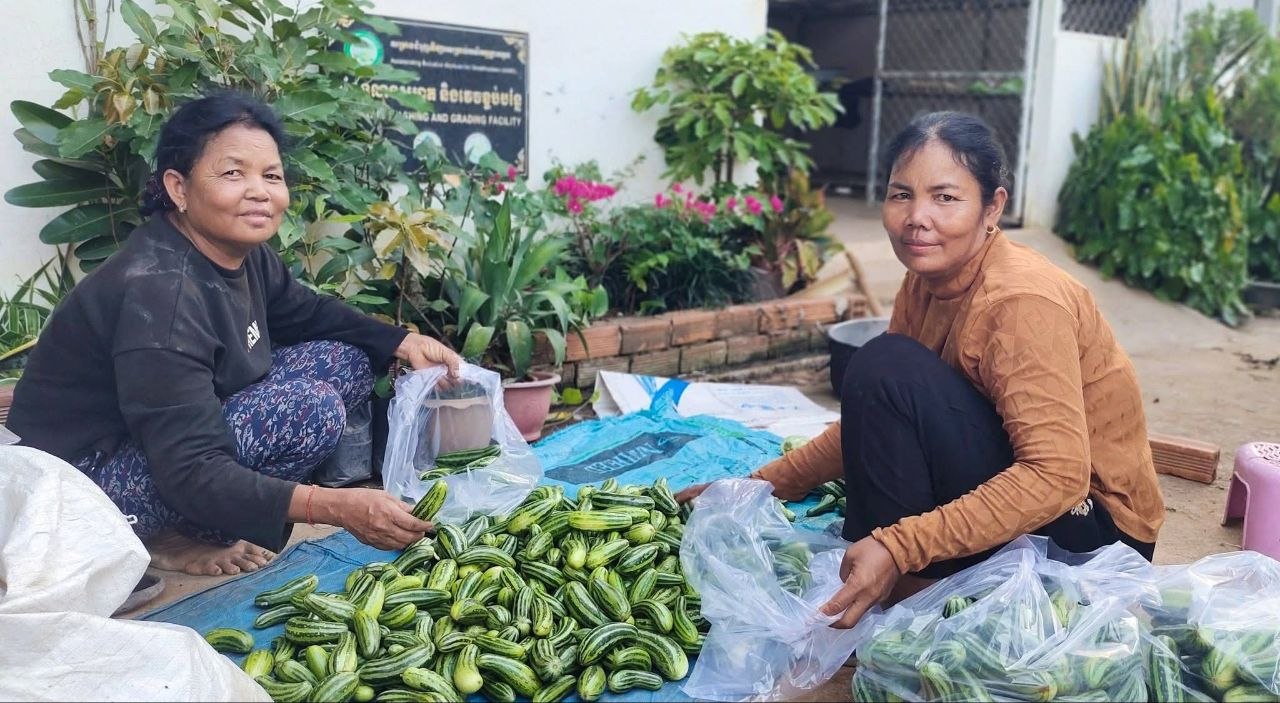
In Lvea Chum village, vegetable farmer Ms. Seang Khai participates in a local farmer group to better manage her 86,111 square feet of land.
“Through the Farmer Field School, I went to eight learning sessions, including topics like crop protection and selecting crop varieties, and have used the skills I learned in my farming all year long. I also serve as a local vegetable collector, gathering vegetables grown by our group members and bringing them to market.”
Every day, Ms. Seang Khai collects more than 2,200 pounds of vegetables from ten different farmers, eight of whom are women. This model helps group members combine their harvests and access markets more effectively instead of relying on individual buyers.
“The Farmer Field School helped me improve how I grow and handle vegetables, but the benefits extend beyond my own farm,” said Ms. Seang Khai. “When farmers can produce high-quality vegetables, work together and have a market for what they grow, we have more confidence to continue these practices and improve our livelihoods.”
Ms. Seang Khai’s experience reflects a broader trend among vegetable producers in the project area. Across Snov, Lvea Chum, Sirey Vong and Trapeang Russey villages, four vegetable production groups bring together 44 farmers, including 25 women, who collectively cultivate approximately 2.26 million square feet (21 hectares) of land to grow diverse vegetables.
Sustaining Local Ownership and Climate Resilience
Farmer resilience depends not only on agricultural practices but also on water, healthy soil, streams, vegetation and forests.
As part of this project, the Watershed Technical Working Group engaged approximately 460 farmers in climate-smart agriculture, ecosystem restoration and community-led adaptation planning. Farmer Field Schools evolved into platforms for community-led EbA planning, resulting in 19 investment plans that lay the groundwork for future climate finance.
Following the successful completion of the project, CWS Cambodia continued to invest its own resources to sustain these results and strengthen local ownership.
Ms. Seang Khai’s experience demonstrates what sustainability can look like at the community level: knowledge gained through a Farmer Field School is being applied on farms, farmers are organizing their production and local producers are helping fellow farmers access reliable markets.
For communities in the Stung Prey Pros Watershed, climate resilience goes beyond adopting new farming techniques. It means working together to strengthen climate-smart production, build viable livelihoods and foster community ownership of the natural resources on which those livelihoods depend.
Learn more about CWS’s work in Cambodia here.