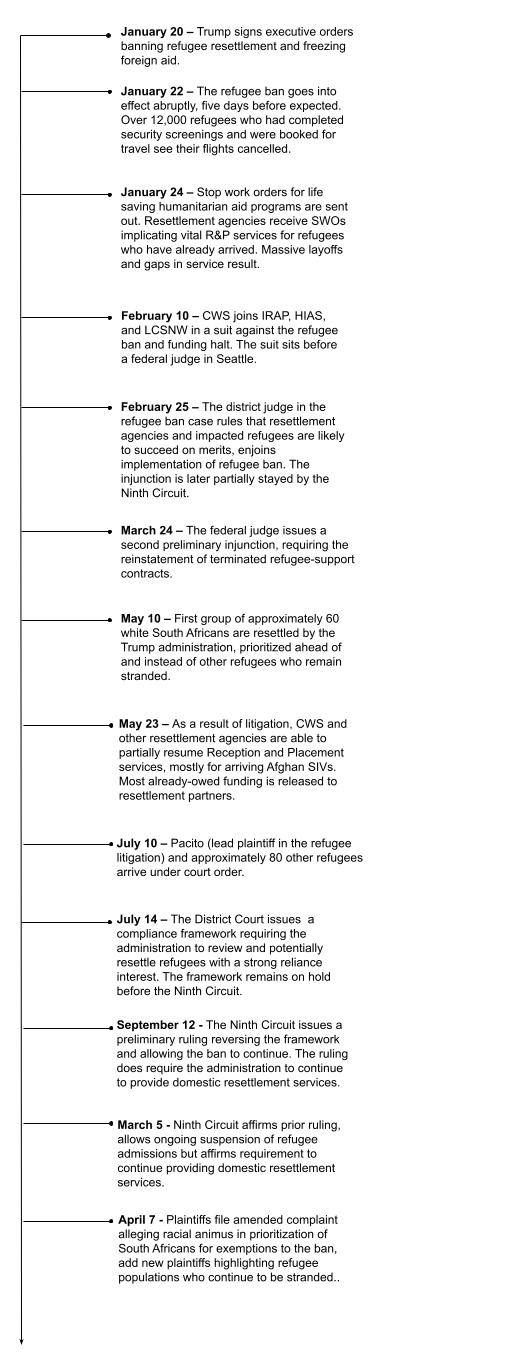
The Trump administration’s indefinite refugee ban, stop work orders and prolonged delays in reimbursement for resettlement agencies have had a devastating impact on tens of thousands of refugee families and communities across the country and around the world. Welcome to the latest edition of State of Play from Church World Service. This resource will provide regular updates from the CWS Policy Team on the current state of play; updated asks for national, state and local leaders; and the latest headlines and community resources.
Latest Headlines:
- NBC News: Texas DA says ICE intentionally hit immigrant with a car and may have withheld evidence
- The Guardian: How immigration is molding the US midterms: ‘Trump has gone too far’
- ProPublica: These Women Were Trying to Escape Domestic Abuse. ICE Detained Them Instead.
- Bloomberg Law News: DHS Rule Nixes Automatic Extension of Immigrant Work Permits
Opportunities to Take Action:
- CWS Action Alert: Demand Justice and Accountability After ICE Shootings
- CWS Action Alert: Urge Your Elected Leaders to Fight for Refugees Ahead of Upcoming Presidential Determination on Refugee Admissions
- CWS Action Alert: Protect Immigrant Children: Urge Congress to Demand Safety and Due Process
- CWS Action Alert: Urge Your Members of Congress to Pass the Protecting Sensitive Locations Act
- CWS Action Alert: Urge Your Senators to Pass Legislation to Protect Haitian TPS Holders
- CWS Action Alert: With All Eyes on Iran, Palestinians Continue to Suffer Daily Attacks and Constant Hunger
- Sign Petition to the White House: Keep Our Promise to Refugees
- CWS Action Alert: Tell Your State Lawmakers – Do Not Let Refugees & Other Newcomers Go Hungry as Federal SNAP Cuts Take Effect
Community Resources:
- Welcome.US Free Citizenship Tutoring: A trained volunteer will meet with you one-on-one to practice civics questions, English conversation, and the citizenship interview. Citizen Guide can be used on its own or as extra practice alongside a citizenship or English class. Sign up for Citizen Guide or email learner@welcome.us with questions.
- CWS: Lakou Tanama Virtual Haitian Healing Spaces
- Georgetown Collaborative on Global Children’s Issues: Explainer for Parents and Their Helpers Seeking Family Reunification
- NILC: Public Charge: Frequently Asked Questions for Immigration Advocates
- Restoring Dignity: Pathways to Financial Stability resources
- CLINIC: Parish Toolkit: Supporting Immigrants in a Time of Need
- CWS: Ten Major Immigration and Refugee Policy Changes Since January 2025
- CWS: Bill Summary of the Protecting Sensitive Locations Act
- Refugee Storytellers Collective: Making Informed Decisions: A Risk Assessment Worksheet for Public Engagement
- ACLU: Enforcement at the Airport
- United Church of Christ: Love Knows No Borders Resources
- IRAP: Refugee Re-vetting and Detention
- USAHello: Multilingual Immigration Guide with clear, direct-to-community information
- IRAP: What do the recent U.S. immigration changes mean for Afghans?
- NILC: How to Find a Loved One After a U.S. Immigration Arrest and What to Do if Arrested or Detained by Immigration
- CWS: How the One Big Beautiful Bill Will Impact You
- Just Security: Litigation Tracker: Legal Challenges to Trump Administration Actions
Stories of Impact:
Fran: “The wait has become endless. A year of processes, of dreams of a better life, of yearning for security and stability for my family. Venezuela, a country that once was home, became a place where workplace persecution forced me to seek refuge elsewhere. One of my sons was also enrolled in the program and he went ahead, and we had hope of reuniting, and when they had already requested our travel documents and we were in the process of buying plane tickets the USRAP prohibition came into effect, freezing our plans. Months of anxiety, of uncertainty, of unanswered questions: When will we be able to be together again? The distance is a weight we carry, a constant reminder of what we have yet to achieve. Uncertainty is a lonely path, but the hope of reuniting with my son is what drives me to move forward, not to lose faith in a future where we can be together and safe.”
Samuel: “My name is Samuel. I was approved by USCIS as a refugee in March 2024, and since September of that year I had a U.S. resettlement agency assigned to my case. I currently live in a third country with my partner, with whom I have shared a stable relationship for more than eleven years. In January 2025, I was called to repeat my medical exams, but only a few days later everything was suspended after the change of government in the United States. Since then, our process has been frozen, and we remain stranded without clear answers — with our suitcases full of hope, waiting for the moment to finally travel. These months have been emotionally very hard. Living for so long in uncertainty, unable to move forward or plan for the future, has deeply affected our mental and emotional well-being. As an LGBT refugee couple — and in my case, living with HIV — every day here brings constant challenges to our health, safety, and hope. Despite the pain and frustration, we continue to believe in the possibility of a better life. We share our story because we know we are not alone, and because behind every paused case there are human beings simply seeking safety, acceptance, and the chance to rebuild their lives with dignity.”
Find more stories of impact here, and watch this space for new stories as they arise. Have a story to share? You can share it with us via this form for refugees overseas or this form for refugees, immigrants and service providers in the U.S.